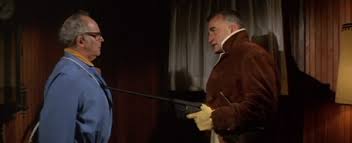
The one man against Authority movies of yesteryear used to be a sexy vehicle narrative for Western cinema. Whether it was Roy Scheider in “Blue Thunder” or Clint Eastwood in “The Gauntlet” exposing crooked cops, or Rowdy Roddy Piper provoking the Aliens who have corrupted the world’s Media in John Carpenter’s “They Live”, the one Man performing outrageous acts of maniacal violence dynamic against the Establishment’s Shrines, Buildings and Institutions routine has been written out of films probably due in part to the real life lunatics who have acted out in similar fashion but at the high cost of Human lives and in the name usually of matters related to mental illness. One such film from 1972 was directed and starred in by George C. Scott, fresh off his triumphant acting performance in “Patton”. Titled “Rage”, it showcases the righteous lone Wolf narrative and transforms the backdrop to rural Wyoming in the early 1970’s.
Shot in Panavision and Cinemascope by Fred J. Koenekamp, “Rage”, despite it’s A-list movie look, has a TV-movie feel to it at first, the telegraphed music and rather two-dimensional opening puts the viewer in a artificial place of tranquility. We are introduced to Scott as a rural Wyoming ranch owner named Dan Logan, who along with his son Chris has decided to spend the night under the stars on their land (Chris is played by young actor Nicholas Beauvy). Logan has livestock on his land, mainly sheep, who seem to be all over the place, grazing indiscriminately. Dan and his son are spending some quality time together, learning to drive a car, building campfires, tending to the Sheep, etc. The Saccharine sounding soundtrack gives the impression that we are being set up by the visage of all this feel-good postcard Americana, and we are.
After a seemingly tranquil night sleeping out on the land under the stars, Logan wakes up the next morning, his Dog is whining and wants him to get up. Logan discovers his son covered in Blood and having trouble breathing. Logan gathers his son’s body and carries him to his truck, and then rushes the Boy to the Hospital, the first of the Institutions that will deceive him. In the film, Logan is announced as being a 42-year old widower, his son Chris looks like he is Fourteen. The score by 1970’s Music score empresario Lalo Schifrin becomes tension filled and dire, as the credits roll to open the film, we see dead sheep everywhere laying on the ground…..what is going on here?
We discover that Logan will soon be being duped by a consortium of Doctors, Bureaucrats and Military Personnel. Any Institutions or Pillars of Society in this film cannot be trusted. In addition, we discover that the United States Military has a nearby Fort to Logan’s land and they may have been experimenting with dangerous nerve agents, the nerve gas being meant to be doused on fictitious hostile forces, not sheep and people out for a stroll. The Military Plane exuding the nerve gas has a mistake or glitch occur during it’s flight over it’s intended isolated target, the nerve gas gets accidentally dispersed over civilian land, including Logan’s. While Logan’s son’s health deteriorates while they are in the Hospital, we learn that Logan is dying as well, Logan begins to piece together what has happened. Since the film is titled “Rage”, the second half of the film involves Logan seeking retribution against the Industries and Institutions that he feels have transgressed and failed against him and his son.
Despite the film’s sappy and disingenuous beginning, once the action starts, the movie becomes a taut and white-knuckle exercise, the conflict being between the Rural civilian who wants to believe in the Institutions and Halls of American Industry (including the US Military) and the haughty and deceptive stance that those same Institutions take towards the civilian populace. Once the Military has a top secret meeting and it is divulged that their personnel had fucked up, the Military has no intentions of making things right or coming clean. Their position is just to placate Logan while waiting for him and his son to inevitably die due to health complications from their exposure to the nerve agent in this film, known as MX-3.
Once the duplicity of the authorities kicks in, “Rage’ becomes a quietly seething, paranoid film. The authorities, led by a mysterious Doctor (played by a young Martin Sheen) attempt to keep Logan in his Hospital room for as long as possible, continuing to tell him that his son will be fine. Meanwhile, we know the kid is dying, his exposure to the nerve gas was extensively more acute than Logan’s was. In addition, the Hospital attempts to keep Logan doped up and sedated, they are hoping to run out the clock on any chance of Logan becoming alert and aware to what is going on before his exposure to the nerve gas makes him too incapacitated to do anything about it. The top secret Military meetings that the film displays, shows the audience a Military that believes itself to exist on a plane above the common folk, that the Military’s shadow existence supersedes all other societal concerns, and that any apparatus of the inner workings of the Civilian world will capitulate to the Military’s needs as is so desired. The Hospital, the Police, the City Council, all of these Institutions of Civilian empowerment are at the mercy of the Military and will do it’s bidding when called upon.
With similarities to Alan Rudolph’s under appreciated Sci-Fi Military Thriller “Endangered Species” (From 1982, another forgotten film that I will review in the future), “Rage” is actually a less optimistic movie than Rudolph’s. Logan’s violent outburst is partly attributed to the effects of the nerve gas, that akin to the exposed masses in George Romero’s 1973 film of identical nature, “The Crazies”, the nerve agent can also cause deranged violent sociopathy. When Logan goes to visit a sneaky local Doctor played by Bernard Hughes with the intention of threatening him at gunpoint, the Doctor at first placates him with lies and half-truths. When Logan opens fire with a modified rifle on the Doctor’s pet cat, however, the Doctor is suddenly more forthcoming with accurate information.

During a Military meeting, while all involved are smoking cigars and wringing their hands, one expert from the Tech Lab that created the nerve agent, Dr. Janeway (played by Robert Walden, you might remember Walden from “All the President’s Men” as a dirty tricks expert)informs the group that even slight exposure to the chemical could potentially kill 50% of the civilian population, the scenes of the powerful consorting with itself on what to do show conflict within the ranks on what to do next; while the more intelligent seem to suffer through moments of conscience, the less intellectual seem more intent on following orders and covering up what they can. The film puts forth the notion that in order for the US Military to succeed to its optimum capabilities, the public must be willing to bend to the needs of the Military, that the Military is to be deemed unaccountable, if necessary.
When one of the local health inspectors (played by Lou Frizell), attempts to observe the damage done to Logan’s livestock, he is turned away by the Military as they have essentially seized Logan’s land while Logan is in the Hospital on the grounds that his property is needed to be quarantined. Due to the progressive nature of the nerve agent, when one General asks a nerve agent expert what the chances of Logan and his son surviving are, the expert replies none, there is no chance they will survive. The Military wants to monitor Logan and his son’s condition, in part because they have only exposed animals to this agent intentionally to this point, they want to document the health erosion of both Logan and his son.
As the film turns in part to the realm of Science Fiction, we see Government troops in Hazmat suits covering Logan’s land, searching for carcasses of dead animals, of which there are many. As I viewed this particular scene, I wondered what the genesis of these fictionalized events was? Where did the idea for this film originate? After some mild digging, I discovered there was an event that is chronicled by several sources, of a real-life screw-up by the United States Military in 1968 involving unintended deadly released Pathogens and nerve agents into the air of an area in Western Utah near a Military installation known as Dugway Proving Ground. The Industrial mistake led to the deaths of an estimated 5600-6000 sheep in the area surrounding the Military Base. These events were most likely the inspiration for both this film as well as Alan Rudolph’s previously mentioned Sci-Fi action thriller from 1982. The Dugway Proving Ground Incident is mentioned in “Rage” during a news broadcast.
The look of the Wyoming landscape in this movie is sweeping and inspiring, the tight visage of the Interior and Hospital scenes are attractive as well. Although the movie was scripted by Phillip Friedman and Dan Kleinman, one gets a sense that this was George C. Scott’s baby, the passion that exudes from his portrayal of Dan Logan and the climactic outburst of the film signify that Scott’s soul was bared in making this. Certainly, Scott was granted more autonomy by Hollywood Studios after his iconic performance in “Patton”(1970), and his work in the couple of years following would denote this. When you take into account the socially convention upheavals of such films as “The Hospital”(1971), “They Might Be Giants”(1971), “The New Centurions” (1972) and this film. Scott, with all his acting range, creates another unique portrayal. He has the look, demeanor and style of a typical American rural everyman. He’s not brilliant, just a land-owning consumer, steeped in traditional American Anglo stoicism.
With a tight, short haircut, a Denim Jean wardrobe, a rusty Pick-Up Truck and an aw shucks personality, Scott as Logan is to represent the character as unassuming, humble and beholden in his belief in America and it’s systems. His film puts forth the idea that America is more tethered to the sanctity and impenetrability of it’s Military than it is for the safety and well-being of it’s tax paying citizens. While the Military gets the brunt of the criticism in the film, the rest of the American Industrial and Civic power structure is called out by this film as well; the film puts forth the idea that rather then cop to any fallibility, the people in charge will lie to us to cover their asses without fail.
The problem with this particular movies’ longevity in the public eye in my opinion is the manifestation in modern times of violent cinematic images being brought to life by troubled citizens who were influenced to some degree by the violent cinematic images that they witnessed. When Logan snaps, he goes after Police, Doctors, Buildings owned by Tech Companies who do work for the Military, and Military bases themselves. In 1972, when this film was released, I would contend that filmmakers foresaw an older and more genteel audience of intellect-minded patrons seeing this movie. There was less thought of hysteria-driven customers going out and attempting such visceral demonstrations of destruction. The film’s climax was most likely intended to be metaphorical.
Yet in today’s internet-fueled cyber theater, a culmination of less cerebrally developed individuals (along with certain types of mentally ill persons) acting out misguided fantasies of self-righteous violence has led to most certainly a monitoring of what imagery the public should have access to. A movie about a man being driven to homicidal rage with good cause against pretty much all of the Institutions of Authority is potentially a vibe that the powers that be don’t want citizens hopped up on internet conspiracies tapping into at the moment.

I recall as a child scouring the TV Guide section of the Washington Post, whenever my parents would get the Post’s Sunday edition in the 1970’s. The Post had a TV Guide section that was like a separate paper magazine that came inside the Sunday Newspaper bundle. It would list all the local and Network programming for the week from stations in Washington, D.C and Richmond, Va. It’s review of “Rage” placed the film in exalted territory, if I recall correctly, grading the movie four stars out of four. There was a time I believe that this film was held in somewhat high regard. None other than Quentin Tarrantino is supposedly a big fan of this film. The film’s awkward telegraphed beginning, as well as some of Scott’s inexperience as a Director in regards to pacing hamper the movie, but the second half of the film is sturdy, eloquent and strong.
Scott stages most of the second half with intense music from Schifrin, who seems much more comfortable delivering probing, questioning sounds than fluff. There are a considerable amount of close-ups and moments of reflection in the second half of the film. Scott the Director seems to have saved his most mature and reflective pay-offs for the stretch run. Logan’s actions are not celebrated as heroic, we’re uncomfortable watching them, that in a way we are watching a tale of collateral damage. Of poisoned metaphorical chicks coming home to roost in the form of once-loyal citizens turning their guns on the authorities when the authorities have shown they will deceive and exploit when it suits their needs and expect the public to process this in a manner that they believe will be for their own good. I believe for these reasons mentioned, that as time goes on, “Rage” will be a more difficult film to find on streaming platforms, see it before it vanishes from our cultural mind’s eye for good.
Leave a Reply