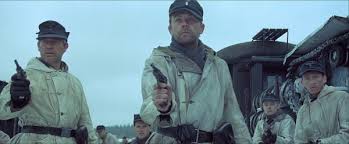
From the 1950’s on, it appears when one became an established Hollywood actor/brand, you were eventually destined to don the Nazi uniform, the Dallas Cowboys’ home jersey of Military Uniforms for White Folks. Especially if you were English. James Mason was Edwin Rommel in 1952’s “The Desert Fox”. Richard Burton was a Nazi in “Massacre in Rome”. Marlon Brando played a Nazi in “The Young Lions”. Harrison Ford, Clint Eastwood and Frank Sinatra all wore Nazi uniforms as disguises in 60’s and 70’s action pics. Olivier was nominated for an Oscar for playing a Nazi dentist. Gregory Peck was nominated for a Golden Globe for playing a Nazi Doctor. Peter O’Toole was a Nazi General in 1966’s “Night of the Generals”. Also in that one was Omar Shariff as you guessed it, a Nazi. Not sure how that worked, but hey, it was the 60’s. It seems like everyone played a Nazi at some point except Sidney Poitier and Bert Convy. James Coburn played a sympathetic Nazi War hero of the Eastern Front in Sam Peckinpah’s “Cross of Iron”, Robert Shaw was a cynical Bleach Bond German Tank Commander in “Battle of the Bulge”. Even Robert Vaughan, Anthony Hopkins and Roger Moore played Nazis.
With all these big names playing History’s Number One ranked bad guys, what about the idea of say, Michael Caine as a Nazi? Robert Duvall? Donald Sutherland? Anthony frickin Quayle? The ultimate taboo White Supremacy role, besides playing sympathetic Southern confederates, the heroic clean-cut Nazi look was a study in perversion. Akin to making gangsters or pirates appear admirable, the Hollywood construct for Nazis in movies in the early days typically involved the Nazis getting their ass kicked. Tarzan movies with Nazis being swallowed by quicksand or a cavalcade of Hollywood stars gunning down Germans as if they were mannequins holding sub machine guns. Over the years, however, this evolved, however, into films where the English-speaking film goer found themselves uncomfortably at times rooting for anti-hero Nazi characters to survive on screen. The aforementioned Caine, Sutherland, Quayle and Duvall were in what I would dub a perverse Hollywood World War II film, based on a popular novel from the mid-1970’s by author Jack Higgins. Titled “The Eagle Has Landed”, I first viewed this cinematic mega-opus when I was Nine years old and the film made perfect sense to me, even though the protagonists were Nazis. Watching this film recently, I thought plot-wise it had all the nuances of being written by someone more mature then a Nine-year old for certain, like maybe Eleven or Twelve years old. The plot unfolds like it was written for a Middle School Creative Writing Assignment.
Directed by old-time Movie Vet John Sturges (“The Great Escape”, “Never So Few”), “The Eagle Has Landed” has a slick look, opening with helicopter shots of German mountain ranges covered in snow, we are led to believe that it is late 1943 as the film opens, an announcer informing us that German paratroopers had successfully rescued deposed Italian dictator Benito Mussolini in a daring mountaintop rescue from an Italian prison in September of 1943. That event actually occurred. The film puts forth the theory that bolstered by the success of this daring pinpoint strike mission, the Nazis would next attempt to kidnap Winston Churchill in a similar fashion, to potentially use Churchill as a piece in a negotiated peace deal that would keep the Allies from overrunning everything that the Nazis had conquered to this point. As ridiculous as this plot sounds, the details and minutiae of the plot are by modern standards laugh-out loud unintentionally hilarious.
Robert Duvall plays a Nazi higher-up, complete with eyepatch and cool-looking super tight leather coat. He could be a Nazi, he could be a promoter for a Metal band, he could be a singing extra from “Rocky Horror Picture Show”, he could be the prototype for the M Bison character from the Street Fighter Video game. At least Duvall attempts a foreign accent, which is more than I can say for Anthony Quayle. Quayle plays Duvall’s superior officer and he looks and sounds (except for the fetching German Navy uniform he is wearing) just like he did in “Lawrence of Arabia”; I kept waiting for him to ask Duvall when they plan to attack the Turks at Acaba. For this suicidal Churchill kidnapping mission, Quayle and Duvall need a kick-ass Hero to lead the mission, a Mother fucking Nazi Sergeant York. While rummaging through piles of dossiers, they come across the omnipotent file of a commanding officer who has overseen a lot of killing of the enemy, saved a number of his Teutonic comrades, and he’s handsome as Alfie with his fab hair and great-fitting uniform. At the same time that Duvall learns of his potential uber-soldier, he discovers from his crack staff of Nazi code breakers that none other than Winston Churchill will be taking a vacation at a remote oceanside location very soon.
Seeing the intel as a sign of divine providence, Duvall begins quoting Jung, telling his underling that Jung believed in the significance of simultaneous relative events and that the convergence of Duvall’s discovering of the existence of the Michael Caine character (Officer Steiner, the same name as Coburn’s character in “Cross of Iron”) and the news of Churchill’s vacation at the same time means to Duvall that his character must spring into action immediately. Screen writer Tom Mankiewicz I believed tried to do something with this material, but the plot on it’s own is some seriously stupid shit.
Beginning with our introduction to Caine and his mates, a gritty scene at a remote train depot somewhere in Europe. As Jewish prisoners and others are being loaded onto cattle cars by stormtroopers, Steiner and his merry band of Paratroopers just happen to be hanging around the train yard in their dandy White Paratrooper attire. Suddenly, a young Jewish Girl attempts to escape the cattle car. She evades the Guards, and makes her way over to Steiner and his Men, who in turn take pity on her and help her attempt an escape. They even pull their guns on an officer of higher rank. You see, these are cool Nazis, you dig? Not the kind that got beat up by Art students at the “Unite The Right” rally in Charlottesville, Va a few years ago, I mean these are woke Nazis. Steiner and his men are like a band of benevolent Pirates or a less religious and more pleasant version of Caine’s 17th-century gang of Thirty Years’ War mercenaries from James Clavell’s “The Last Valley”. When Duvall’s character goes to recruit them, they are all sitting on some dangerous Nazi prison island, getting bumped off somehow, one by one, every week. While Duvall negotiates with Steiner, the rest of the mates sit in the local pub and get three sheets au eine Winde. Of course, they all agree to take the gig. Take Winston Churchill hostage, piece of cake.

The movie includes a character from more than one Higgins novel, an anti-British Irish Republican radical named Liam Devlin. Devlin would rather fight with the Nazis than the Brits in the name of Irish sovereignty. Played by Donald Sutherland, who appears extremely plain in this, as well as looks Middle-aged. Giving a spirited performance, Sutherland almost seems as if he’s in an Irish Spring commercial with all his smug Irish enthusiasm and gregarity. Devlin is a spy pretending to be a local Game warden. It’s a role that’s quite similar to his later spy role in the World War II thriller “Eye of the Needle”. Devlin is in England no more than 5 minutes in the movie and suddenly he and 19-year old local Village girl Molly are madly in lust with each other. So much that Molly is willing to gun down her previous Village boyfriend in the back with a double barreled Shotgun so that he won’t tell anyone that Devlin is a spy. I guess the courtship occurred through their eyes and campy dialogue. Devlin and Molly (played by Jenny Agutter) look like there is a 20 year age difference between them, adding to the perverse vibes of this film.
Sturges tells his story like it’s 1959 again, with better graphics. Mankiewicz’s writing is uneven in that the dialogue between the German soldiers and English villagers carries the tone of a serious English war movie like “Tunes of Glory” , whereas the scenes with the American soldiers seem more like American television writing and the sets look more like Television as well. The Americans’ commanding officer is played by Larry Hagman, who was soon to become a big star through his role of “J.R.” on the soon -to-be hit TV series, “Dallas”. A young Treat Williams is in this as well. The premise that the Germans are pretending to be Polish Paratroopers who just happen to drop in to England seemed laughable to me, more so that at first the Americans don’t seem to have any issue with it. I am sure groups of Allied troops dropped in on each other all the time without any notice or signals or anything.
To add to the unintentional hilarity, Steiner demands to Duvall earlier on that Steiner’s troops be allowed to wear their Nazi unis under their Polish ones so they are not shot as spies if captured. Yet, as my son pointed out, by pretending to be an ally who just dropped in for seemingly espirit de corps, the deception alone qualified as spying. When the Paratroopers’ predictably get exposed to the Villagers later on, it is due to some careless Villagers’ kid had to fall in to a perilous situation involving the town water wheel and a cool Nazi soldier dives in to saves her but chokes to death on the Iron Cross under his Polish Paratrooper uniform. The villagers, led by the local priest, see the Nazis for what they are and now know they are there to kidnap Winston Churchill, who is still on his way, good thing nobody had a cell phone or one of Alan Bates’ messenger pigeons from “The King of Hearts”. The plot to this movie feels like it was written on the back of an issue of People magazine while someone was waiting for a root canal.
When the heroic Nazis burrow in for a shootout with the slow acting Americans, they set up fortifications in the place with the most shock value for a shootout, the local Church. They bash out all of the stain glass for better shooting vantage points. The German paratroopers morph in to the German version of the Wild Bunch, death before dishonor, while they are waiting around, we get some personality from them. One Nazi soldier plays the Church organ like a concert pianist, another has a thriving business to get back to when the war is over. The dialogue becomes a series of War movie cliches, including stunned British characters exclaiming to each other multiple times, “They’re going to kidnap Churchill!”. When the Americans discover the true identity of the German Paratroopers, one American soldier exclaims to another, “Those Poles turned out to be Krauts, sir!”
This movie is actually at it’s strongest when it abandons it’s talkie plot that manifests itself to be increasingly inane and cuts to the action. The film migrates from self-satire to robust action movie. Sturges’ story telling is almost Robert Stevenson-esque, but he partially redeems himself through the action sequences. With the exception of the title shots early on in the movie of the German Alps, the action sequences are the best thing going for this film. Aided and abetted by Lalo Schifrin’s score, which is probably a better musical score than this film deserved, Sturges directs shootouts that seem to go on for minutes without stop. The action scenes include bazookas, grenades, machine guns, mortars, tanks, airplanes and bigger machine guns. There’s exploding trucks and crashing jeeps. This is where the movie seems to come alive, like we’ve all been waiting for this for over an hour.
They should have skipped the Nazi Youth Adventure plot and gone right to the loud destructive battle scenes, that seems to be the movie Sturges was ready to make, not the ludicrous theatrical foreplay we had to endure to get to this version of the durty dozen. Jean Marsh plays an English Nazi sympathizer who in an abrupt violent scene, splits Larry Hagman’s wig. The action scenes are as alive as the key scenes of critical dialogue are laughable.

Why dredge this film up, you say? Shot by Anthony Richmond, it’s an impressive-looking big-screen action adventure war film. It’s a weird film, in my estimation, a miss, a plot with more holes than Anwar Sadat’s viewing stand. A film where a select group of Nazis are marketed as good guys, and we are left to stomach that idea. In one scene, a German Boat with a German flag pulls up on the English beach to bring home the German paratroopers as if they were getting a ride home from Soccer practice. I was thinking watching this movie, if it’s so easy to drop paratroopers on the English coast and drive your fucking boat up to shore to pick up said paratroopers, why not just invade? In this universe, it doesn’t seem like the English are minding the store, certainly not their own coast line. They could have transferred this plot to outer space, the future, the past, anytime other than World War II, and it would have seemed a lot less self-satiric.
If you don’t know anything about World War II, and you have just been awakened from a 90-year sleep and are looking for a mindless action film to unwind with after your coma, “The Eagle Has Landed” is never dull per se, it doesn’t bog down in maudlin side plots, other than the distraction of the Donald Sutherland-Jenny Agutter potential tryst that we never get to see. It gives us the idea that there were more Nazi sympathizers in England during World War II than there were Satanists in an Omen Movie. Steiner’s paratroopers start out as conscientious thinkers and end up as the German version of the gangsters of the Kansas City massacre, willing to fight to the last Mein Herr.

Leave a Reply