Viewing old political movies, like “Advise and Consent” from 1962 or “Seven Days in May” from 1964 holds a remarkably prescient experience in the relevance of these films to old and new American political elections, we notice the recycling of campaign mantras; one side accuses the other of fascism (or both do), the other counter strikes with charges of socialism, the political tribal chants get passed down through generations like Sorority paddles or Baseball card collections. Social commentary writings of the 1950’s and 1960’s accentuated the idea that all associated with political-based ideologies were potentially charlatans feigning concern in hopes that they would obtain power through deceit and fake charm, the cycle of political rhetoric that we are subjected to in this day and age is quite reused, philosophical leftovers of old strategies that continue to get rehashed and redistributed as if we as a society had just forgotten and yet they appear to work to their desired effect with remarkable accuracy. It fascinates me to go back and watch political movies from the past such as “The Best Man” from 1964 and the original “Manchurian Candidate” from 1962 and hear and see the same tropes used by the same philosophical oppositional sides over and over ad nauseum. One political film from 1970 I feel to be particularly clairvoyant, unusually accurate in it’s portrayal of the theater of modern American politics and it’s accompanying apparatus; that film is titled “WUSA”, directed by Stuart Rosenburg.
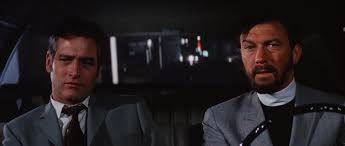
It’s 1970 in the Nixon-era South as the movie opens and we are introduced to a litany of characters in their thirties attempting to make their way in this new world of “patriotic enlightenment”. The action takes place in New Orleans in the present day. We are introduced to Paul Newman in a convention-shifting performance as Reinhardt, a self-proclaimed Liberal alcoholic who’s best way of making money is as a duplicitous Right-wing radio pundit. Reinhardt (oddly Germanic sounding) comes across a Female foil to his liking in the form of Geraldine, an oft depressed cocktail waitress played by Joanne Woodward. Lawrence Harvey makes a surprise appearance as a scheming fake Southern Minister named Farley who seems to be in cahoots with Reinhardt to some degree. Pat Hingle is a shady cigar-chomping Right-wing radio station owner and Conservative Media personality named Bingamon who hires Reinhardt. Wayne Rogers is Minter, Bingamon’s overly processed looking right-hand man.
Moses Gunn plays Clotho, a menacing sketchy African-American businessman involved with a welfare fraud scheme being looked into by pious Left-wing activist social worker Rainey, played by Anthony Perkins. Cloris Leachman is a bubble-headed conservative cripple named Philomene who likes to show off her chest. Don Gordon (the first time I saw this I thought it was John Saxon with a beard) plays a hippie troubadour named Bogdonavich who hangs out with Reinhardt and trades anti-societal barbs with him. The police in New Orleans in this movie have almost a Gestapo-like presence in this cinematic world, we hear constantly about a “New American patriotism” in the streets. The searing screenplay for “WUSA” was written by book author Robert Stone ( Author of the book “Dog Soldiers”, it’s film adaption being titled “Who’ll Stop the Rain”). Stone’s screenplay seems to intimate that the smartest people in the Deep South are there to exploit the mostly dim populace. There are hucksters on both sides of the American philosophical and intellectual divide.
New Orleans is shot at times by Cinematographer Richard Moore with a docudrama feel, including footage of parades, staged riots and a performance by an all-star New Orleans Jazz Band. Citizens party in the streets with no apparent social construct there, just the rhythm of the mint juleps they are imbibing leading them on. The bars are always hopping it appears, a Confederate-tinged secret police emerges early on in this film from the night life as a desperate Geraldine attempts to be angling a local man in a bar towards some side hustle transactional sex out in the street. A mysterious Man in a fishing hat suddenly appears with a methodical drawl and threatens Geraldine to scram or she can spend a night in the can. Rainey and Reinhardt (Where did Stone come up with these ridiculous names? They must mean something)take alternate paths to navigating this world. It shows in painstaking fashion whence Reinhardt blends in and only displays the slightest deviation from conservative conformity when opening his mouth in private, Rainey wears his piety of concern for his fellow man like a badge, from his manner of dress to his provocational attempts at conversation with all within earshot, he wants to appear to be a spark for social justice change.
The business that seems to be booming here in this enclave of Deep Southern heritage is that of monetizing a superficial spiritual relationship with the superstitious and ignorant Blue collar American Southerner. While Farley makes a living running disingenuous Holy services for anyone within collection or tithe serviced distance, his acid-tongued delivery and cynical squint make him a skeptical treat every time he appears on screen, he is simply here to scrape a few bucks away from dim bulb Americans in search of redemption while he makes generalizations about wide swaths of Americans based on their upbringing. Bingamon and his associate Minter look like dopey car salesmen, they are actually more like Southern business mobsters, the film has an element of menace that never stops pressing once the premise of malevolence has been breached. Bingamon’s wardrobe is what would be considered authentically conservative, the audience that he courts over the airwaves and in the streets is of the buttoned-down crewcut “Christian” variety, quick to label their opponents Communists and subversives, equally swift to label themselves patriots and true Christians. When a crowd of them is shown in one scene, a trio of Hippies attempt to perform music for them and are mercilessly booed by the crowd for speaking about peace and love for one another.

To display that the film has little preferential political affiliation, a side plot involving Rainey as a freelance advisor brought in to inspect the chances of Welfare fraud in inner-city New Orleans (his findings are eagerly and suspiciously broadcast by the fictitious radio station of note in the film , WUSA)and Gunn as Clotho, the Man apparently unrepentantly playing the system to his own financial benefit displays a kind of aggressively depraved mentality in this world inhabited by the Urban lower socio-economic class. That resources for the needy get rerouted with no protest to the greedy and opportunistic. The experience of observing civic graft, along with blistering criticism from Reinhardt drives Rainey to passionate and violent overreaction, his need for social acknowledgement engulfs him.
Author Stone’s probing script is full of perfectly placed lines, even moments of the awkward and the morose work here. Stone is getting at something here besides the obvious, that his complicated questioning characters are looking inward. Rainey thinks he’ll find the answers he seeks through working for and advocating for the system, which Reinhardt chastises him for profusely. Stone seems to be advocating for what do we see in this new insulated existence that is being offered citizens with a nationalist contour? There is nothing for the intellectual individual but to bind together and speak in hushed tones when they are together of their plight in the land that caters to the stupid and obedient. The most thought provoking interaction is between Reinhardt and Geraldine, for while Reinhardt may have cynical counter-culture brethren in Farley and Bogdonavich to confess his inner thoughts to, Geraldine only believes in Reinhardt.
Reinhardt and Geraldine’s relationship and conversation gives the film it’s greatest depth as the two of them attempt to use each other to make sense of their lives and how they fit into this questionable society they’ve chosen to attempt to hide in. Reinhardt can’t make up his mind who he hates more, fascists, or those who refuse to fight fascists where they stand and attempt to gain leverage with fascists through attempting to shame them. Reinhardt is a difficult guy to love, but his odd blend of social duplicity is just what creative and romantically frustrated Geraldine is searching for; someone beautiful that she can fix and in turn they will heal her. The two of them struggle to get their respected messages through to each other. Geraldine can’t get Reinhardt to realize that their love should be free of anger, while Reinhardt wants Geraldine to understand that anger is his business, cultivating fake outrage pays for their good time. Some of the freshest dialogue in this film occurs in the middle of the day on a rainy afternoon between Reinhardt, Geraldine, Rainey and Bogdonavich on topics such as what to do in life and where to go to make a difference.
The musical score by Lalo Schifrin is at times dark and mysterious when it needs to be, snapping us out of our stupor and alerting us that shit is indeed getting serious. The look of the film provided by Cinematographer Moore seems to have the film at times enveloped in a self-contained bubble, that a feeling of dread hangs over everything. The film’s allegorical climax I realize now is the total inspiration for the ending of the 1974 thriller “The Parallax View”, whereas the ending of the latter is part of a tight thriller narrative, the preemptive sequence in “WUSA” is intended to be more of an esoteric tone poem of a scene, the chaotic events being more about a general malaise that was enveloping the United States at the time of the making of the movie.
While the theater of politics is seen by this film to be just that, theater, it is Geraldine’s struggle to attempt to influence Reinhardt into believing that their love for each other can supercede the mediocrity of their lives at work. Reinhardt seems disturbed by his own paralyzed duality, disgusted by his own inability to speak truth to power, he can only hint at his true leanings through his stare and his inauthentic delivery. Stone’s script may be simultaneously a heavy handed take down of conservative American mythology as well as the questionable virtues of the welfare state, “WUSA” has a perspective that modern corporate-backed films don’t dare breach for fear of running afoul of one corporate sponsor or another.

As irrational as Reinhardt becomes when he drinks, and while there are times Geraldine’s Mother Nature persona predominates, for the most part Reinhardt’s perspective is the slanted and twisted super-ego of the movie. When his character is engaged in conversation with Geraldine, Farley, Rainey or Gordon, his true clarity of what goes through his mind breaks through. Reinhardt’s character is conflicted, these moments of clarity that we get from him when he is speaking with intellectual peers are sharp and concise. Newman is driven yet entirely vulnerable in this film, both he and Woodward are mesmerizing as a contentious questioning alcoholic couple.
What makes “WUSA” most uncanny for me as an entertainment is it’s ability to be timelessly relevant or maybe that’s the timing of watching this film 55 years after it’s release. Listening to the Nixon-era inspired trope-based characters, I couldn’t help but notice how similar the language was to near identical social issue conversations in the present day. “WUSA” is a political film that couldn’t be made now, nor is it a social film that could be made now, nobody is willing to make a film daring to criticize it’s own ideological side.
Leave a Reply