Let’s admit it, Western culture and more specifically Western cinema loves prostitutes, it’s not even subtle, we love hookers, especially if they’re hot and have a hardscrabble background. Marlene Dietrich plays an Austrian Government-funded hooker during World War One who is attempting to spy on Austria’s enemies in “Dishonored” from 1931. Bette Davis and Kim Novak both get turns as the tragic hooker heroine from two different versions of “Of Human Bondage” in 1934 and 1964. Jo Van Fleet plays John Steinbeck’s iconic literary prostitute Cathy Ames in the film adaptation of “East of Eden” in 1955. Then there is Billy Wilder’s “Irma La Deuce” from the early 1960’s where affable Jack Lemmon falls head over heels in love with Shirley McClaine’s “hooker with a heart of gold” character. Shit, in 1932, even Joan Crawford starred as a prostitute in “Rain”. In 1930, the silent one, Greta Garbo, starred as playwright Eugene O’Neil’s waterfront prostitute character, Anna Christie, in a film of the same name. The prostitute seems to be the role du jour for the Western culture’s Feminine anti-hero. Their Male partner in crime is typically a Male social outcast of some sort, one who doesn’t fit in to “normal” society.
Not one to shy away from film subjects with edgy parameters, maverick film Director Sam Fuller took the pysche of the American prostitute head on in an uneven yet refreshing melodrama titled “The Naked Kiss” from 1964. In this film, his heroine from start to finish is a Female character full of conviction, affection and crippling self-doubt named Kelly, who begins the film totally bald due to the malevolence and psycho control of her current pimp. Kelly is played by the alluring Constance Towers (who kinda looks like my late WASP Grandmother, but I digress) who delivers an absolute knockout portrayal of the troubled, yet hope-filled Woman. This is a provocative and powerful message-filled film, told from the perspective of it’s Female lead, who is driven by her conscience to pursue doing the right thing in a world seemingly dominated by Men who only think about themselves and their indulgences.
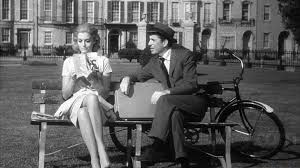
The film begins with Kelly behaving violently and irrationally as she flees the current city that she is hooking in to escape her dominating pimp. She gets off the Transit Bus in an anonymous small American town, looking for a fresh start. She pretends to be a travelling saleswoman, selling Champagne. While sitting on a park bench, minding her own business, Kelly is approached by a plainclothes Police Officer who solicits her, gives her a hotel room to stay in for the night, sleeps with her and then threatens her to get out of his town, he doesn’t want her kind sullying up the locals. They don’t want hookers in this God-fearing town, he intimates, take that shit to the town across the river, he demands.
The Police Officer, named Griff, (played by Anthony Eisley ) is kind of a half-friend to Kelly throughout the film, a married Man who alternates between threatening her, watching over her, wanting her and letting his inner misogyny get the best of him in relation to her, he can’t make up his mind. It seems like a Woman who knows what she wants and doesn’t necessarily need Male assistance is like Kryptonite to the Men in this movie. Griff’s persona is emblematic of Male characters throughout this cinematic tale, they are attracted to Kelly’s look and self carriage, yet frustrated by her lack of subservience to them and her desire for independence in thought. Fuller, by the way, authored the blistering and sometimes pointed screenplay, there are at least a couple of scenes where Fuller makes full use of artistic liberties in his storytelling, including an awkward and lengthy musical number, which is used to highlight Kelly’s abilities to inspire children with difficult futures ahead of them, as well as Fuller the writer brandishing more of his societal critique.
Fuller’s Kelly is not a dim bulb, nor is she a nymphomaniac. Griff orders Kelly to seek employment across the river from his town at a sleazy bar owned and operated by the corrupt and older Candy (played by Virginia Grey). Candy and Kelly have similar profiles and frames, it is overtly implied that Candy’s life is a possible fate for Kelly. Kelly balks at visiting Candy’s club after she has a moment in the mirror early on in the movie and decides to rent a room with the earnest and religious Ms Josephine, and Kelly’s road to redemption begins. Fuller goes full Female anti-hero with Kelly, Kelly we discover has a hidden talent; nurturing disabled children. The story transitions to Kelly working in a Hospital and being a spiritual and medical cheerleader for kids with defects that need support more than most. Kelly is doing God’s work.
“The Naked Kiss” reveals itself in the second half as an intense film noir, where the confrontation and dark content of the film are not about violent crime per se, but about the climate of sexual abuse and control that Women and children in America live in every day, even now. Fuller takes direct aim at the Male dominated power dynamics of small town USA. With Kelly beginning to have a normal and productive life in her new environment, we see that Kelly has now surrounded herself with kindly Hospital people and staff, disabled and innocent children and their thankful parents. She is isolated and removed from her old atmosphere, which includes no Alpha Males or go-getter guys. Kelly is living a life free of personal confrontation and drama involving Male control. She creates a cosplay situation for her disabled children, as she and the kids all pretend that they are all mates together on a pirate ship, complete with hats and pretend pirate talk. This is a metaphor for broken people coming together through a common struggle.

Kelly eventually decides to socialize again. Of course, in due part to her striking figure, conservative good looks and understated confidence she attracts one of the most important and eligible bachelors in town, a business man named Grant (played by Michael Dante). From this point on, the most I will say is that predictably Grant and Kelly hit it off. Grant tells Kelly that in his life he has rarely seen a woman with a blend of exquisite looks and great intellect. That last line reads poorly now in 2024, but in the 1960’s, nobody thought two shakes about it. The romance between Grant and Kelly is immediate, Kelly has been pining for a Man to come at her with at least some respect. Kelly, in a surprise twist, (because much more shocking twists are yet to come in this picture) admits to Grant fairly quickly that she used to be an A-lister at the World’s Oldest Profession. Grant is amazingly accepting and understanding, he seems enlightened. As things change for Kelly, in due part to her relationship with Grant and in due part to a situation that arises at work with a former co-worker named Buff (played by Marie Deveraux), who wants to dabble in hooking as a side hustle, Kelly becomes emotionally and physically involved.
Filmed in Black-and-White by Cinematographer Stanley Cortez, the film has an angular, lean look to it. Fuller features an extended sequence where Kelly sings with her children at the Hospital, the scene highlights the kindness and benevolence that Kelly seeks, she does not appeal for accolades as much as wants personal redemption through her work, her consistency and her sacrifice. Composer Paul Dunlap’s Jazz-infused score serves as an aural conduit behind Kelly’s actions and thoughts, his use of Alto Saxophone and other Woodwinds as lead instruments serve as the speaking out of Kelly’s soul to the audience.
The salacious nature of the payoff of “The Naked Kiss” created an aura for me about the film that reminded me of elements of Kubrick’s “Eyes Wide Shut” and Polanski’s “Repulsion”, the latter film being released around the same year as “The Naked Kiss”. Kelly’s existence in this Man’s world is on par with being a secret double agent. We aren’t sure how she’s going to react and we know Kelly likes to scrap and is all in for getting her ass kicked or put into submission by a Man of her choosing. The relationship between Kelly and Grant feels like the viewer has come to an acceptable fairy tale destination in the film, but as a viewer of Sam Fuller fare, one is aware that the ground is always shifting. Fuller ties everything together here in a devastating and remarkable way to make a thorough and monumental statement about what sinister bedfellows exist in the Halls of power and how these forces prey on the innocent, the naive, the vulnerable and the timid. Fuller’s Kelly is not only a Feminine sympathetic anti-hero, she metaphorically takes on the whole system when shocking developments reveal themselves. Without a slew of violence (though there is a little), Fuller still invokes profound commentary on today’s world and it’s penchant to overlook abuse of the less aggressive in society at the behest of the civically ambitious.
In the upcoming Month of October, I will be discussing another film from the mid 1960’s titled “The Witches” which stars Olivia DeHaviland as a Woman of Suburban stock and Middle Class values who does existential battle with rural Pagan Witches from both the First and Third worlds. I bring this up due to there appears to be a similar climate of social confrontation and perverted societal norms in both films, and only a good and righteous Woman has the stones to call them out. Kelly as the protagonist in “The Naked Kiss” is at first glance a socially accepted “normal-looking”(by WASP standards) beautiful Woman of intrinsic Western Suburban societal values who is taking on what could essentially be described as deep-rooted social and moral perversion and corruption.
Sam Fuller had a brilliant creative mind, also a spectacular sense of Karmic fair play. Whether it’s his mixture of provincial nationalism, street paranoia and sexual hyper-dynamics in “Pickup on South Street”, or his unflinching portrayal of War in films such as “The Steel Helmet”, “The Big Red One” or “China Gate”, or what I feel to be his underappreciated and extremely controversial attack on White nationalism and racism in 1982’s “White Dog”, Fuller holds nothing back, you know exactly what the fuck he is saying. In “The Naked Kiss”, Fuller lambasts the construct of 1960’s society in regards to the unspoken caste system of America between genders and how it’s ushered by those who use sado-masochism and intimidation. The manifestation of his Super Ego in this is a powerful and straight forward Feminine figure, complete with mystique, insight and nuance that only a Woman can provide.
Constance Towers is the delivery system and she does a marvelous and exemplary job of embodying Fuller’s seething under the surface heat. While his Male protagonists are typically quick thinkers who have no qualms in regards to being physical combatants, Towers as Kelly is on the same energy, she just does it in dazzling one-piece dresses out of a Montgomery Ward catalogue. Towers is firm and resolute, the difference with her character is she seeks love but not for material or status needs, she can provide for herself and status doesn’t seem to be a priority, she is not weaved from a Male-centered quilt.

Towers’ performance is what sparkles the most, the ancillary characters are almost window dressing at best, with the possible exception of the character of Grant, who is also complex to a fault. In some scenes, it’s almost as if Kelly is in a World of intellectual mannequins, her vibrance and energy dwarfs all those around her. When she enters a nightclub or a formal, heads turn, conversation diminish, all eyes are on her runway-model like frame and classic good looks and her perfect Golden hair is like a beacon of confidence and righteousness.
Sam Fuller was “woke” long before it was a thing, yet his personal form of “wokeness” seems to stem from a Hammurabian need for balance and equality. Fuller’s vision of America was a vision of a place where all of Humanity’s old sins are buried and retired, that America is where improvements to society would be adjudicated or bust. He, Sam Fuller, was here to show America and the World how to get things done in a decent, moral and sometimes necessarily demonstrative fashion. His commentary here on the Alpha Male dominated reality that Women and Children find themselves facing in the modern world is at it’s most extreme, scathing. Kelly is his avenging angel, she converts people to her beliefs by setting and modeling an example, not by malevolent coercion. She is here to reestablish a comprehensive belief in the power of an intellectual matriarchy.
Leave a Reply