It’s not groundbreaking observational science, but quiet Horror movies for me tend to be scarier and stay with me longer than loud ones. The early 1970’s Horror trilogy of Bob Clark comes to mind. I like the grim determination of early 1970’s Horror, the combination of imaginative plot circumstances and music featuring experimental sounds were much farther fright inducing than today’s over-budget-and-bloated flicks. There is something scary about silence, and in today’s ADD-influenced world, modern movies don’t contain much of it. The incessant need for the jump scare from today’s factory filmmakers gives the viewer the feeling that they have metaphorically entered a two dimensional haunted house when viewing such pictures, and the lasting effects are about the same, not very long once your heart stops racing from the adrenaline rush. One quiet film from the early 70’s that stuck with me long after the candy was gone was a Canadian effort made by a TV guy in 1973 and it’s a near-miss; it’s almost one of the memorable 70’s Horror movies, and for me has one of the creepiest sequences of all 70’s English-speaking 70’s Horror films. The scene has no gore or nightmarish imagery but is extremely tense and profound.
The movie in this instance is titled “The Pyx” and it was directed by Canadian TV Director Henry Hart. Hart’s work in this film is uneven, he is excellent at setting up atmosphere and tension however, and the style and look of the film are exactly the type of close-up heavy cinema I enjoy the most from the early 1970’s. The directing of the action scenes is where Hart’s efforts lack the most, it looks like something from a TV detective show. The movie was shot in thick, rich technicolor, much of the film takes place at night, it has the look of being shot in Cinemascope and Panavision. “The Pyx” is not just a thriller and a Horror movie, it’s a drug culture picture as well, part of the film’s pacing and tone seems to reflect drug use as part of the film’s narrative fabric. Not encouraging drug use, the action in the film centers around drug use at times and the flow of certain scenes coincides with characters being high or strung out. This hue of drug-infused haze is apparent in the somber mysticism of the opening credits and it’s theme music.
The movie opens with a misty and murky Montreal evening in the backdrop behind the credits as a swooping helicopter pan shot of the city reveals night time bustling auto traffique. The music in the credits is awkward and barren, it’s actually screen actress Karen Black singing some folk songs she wrote, singing along with an acoustic guitar accompaniment. She sounds like if someone hired Grace Slick to do a Sunday Morning church gig. Bare (Bear? Bere?) with me on this talking point, but I feel like the awkward musical component to the opening credits runs concurrent to the drug using rhythms of the overall movie. This movie had been chided by critics at the time as being ‘Klute with Satanists’. I think Karen Black’s music works well in conjunction with the theme of characters on drugs, in addition I believe it would have behooved audience members to have been on drugs to enjoy her vocal stylings without judgement or impunity.
As the somber and uneasy credit sequence ends, we think we see what nighttime motorists in Montreal have caught a glimpse of; a Woman plunging to her death off of a high-rise hotel roof. The film then migrates to being a police procedural mystery, with plainclothes detectives (played by Christopher Plummer and Daniel Pilon) trying to figure out why a beautiful Woman is laying dead in the grass at the base of a fancy hotel on a busy Friday night, and that she’s wearing some kind of ritual outfit.
The dead Woman is played by Karen Black in flashbacks (wait, isn’t she the headline star of this?) and her name is Elizabeth, the dreamy intellectual junkie prostitute. The film then begins a narrative that is a tad bit confusing, but after a few volleys of this format, I began to catch on. The movie has two threads going at once, that are taking place a couple of days apart. One is the tale of Elizabeth and how she got to be dead, the other follows the police as they attempt to figure out who or what killed her. For example, in alternating scenes the police interrogate the Madame of Elizabeth’s chic Montreal brothel, while Elizabeth is interacting with the Mademoiselle Pimpette in the next scene which is supposed to be from a few days before. The Madame (Played by Yvette Brind ‘Amour) is slippery and evasive with the Police, yet just the sort of abusive type you would think a Pimpstress of an Urban Brothel would be with a gaggle of junkie model prostitutes.
The Cinematography, by Rene Verzier, brings that early 1970’s wide-lens look, Director Hart has quite a few scenes where he lets dead air space do it’s thing and it’s generally effective. In one scene, Elizabeth is interviewed while she is requested to stand nude aboard a yacht down below deck by a nefarious client. The scene uses a serious and brooding work by Beethoven in this sequence as something being played at loud levels by the client as a way of intimidating and sublimating her. The client is attempting to make Elizabeth feel vulnerable and in addition wants to ask her uncomfortable questions about her and her family history. In another scene, Elizabeth scores some Horse and after we a get a gratuitous and tense drug using moment, she has flashbacks about her erudite youth, riding on an actual Horse. The ambiance surrounding the drug use scenes are scary themselves, or at least gripping in an abstract fashion. Elizabeth in her mind when she is high, goes back to her upscale upbringing, she has pleasant visions of spending time with a past sophisticate love (who we learn was also an eventual Heroin user). They literally ride Horses together (so to speak), they sit by a roaring fire together, they spend signature moments together that Elizabeth reminisces about as she lays down in her apartment, high as a space station.
The erratic script, by Robert Schlitt, shows Elizabeth to be complex to a fault. She’s upscale in origin, she’s beautiful, she’s a prostitute, she’s spiritual, she’s a heroin addict and most surprisingly, she’s leaning towards returning to religion to be saved, she attended a convent for a few years as a teen. Of course, she’s not rushing to give up smack yet, so her ambitions of a pious cleansing must wait. She visits her fellow hot junkie prostitute friend Sandra (played by Louise Rinfret) who has checked herself into a convent, where the Sisters have taken her friend in to break her addiction as humanely as possible. One watching at this point might wonder; aside from all the depressing and dark heroin addicted related behavior, why is this a Horror movie? You might think this was the plot for “Canadian Klute”, but the plot takes a sudden dark twist.

A shadowy wealthy client wants Elizabeth really bad for a rendezvous. The Madame says it’s really good money. In Elizabeth’s mind, there is something off-putting about the stranger. His chauffeur, however, (played by Lee Broker)is sketchy enough, his wealthy boss, the shadowy client, Mr. Keerson (played by Jean-Louis Roux ) is even more sinister. Even though the bread for this endeavor is fantastic, something in Elizabeth’s gut senses trouble. She appears to understand that this won’t be just another client that leaves a billfold on the night stand.
While the scenes involving the Police play like an episode of occult “Law and Order”, with non-descript shoot-outs involving anonymous henchmen, the subsequent tale of Elizabeth is the film’s strength, though it is somewhat of a narrative gimmick. The reveal of who wants to see Elizabeth and for what makes this film undoubtedly a Horror movie, and a 1970’s one, at that. Mixed in with the shocking and inspirational segment of “The Pyx” involving Elizabeth’s dilemma and spiritual predicament, is a handsome-looking yet droll series of confrontations involving the Police, led by Plummer, against nefarious and anonymous cult members. I believe if the action scenes had been shot by a more competent Big Screen Director, this movie would have a stronger legacy. Plummer, as Sergeant Henderson, by more than halfway through the film is of course, falling in love with the memory of the dead Elizabeth (Even though he never met her, he has only seen her corpse), even more so when he discovers what her predicament was.
Without giving too much away, Elizabeth is being sought out by a network of Satan worshippers, of whom it is discovered are not only embedded in positions of civic authority, but are also important ranking members of the Church as well. Because of a certain outstanding attribute of her anatomy (not what you’re thinking, unless you’re into devil worship) she is deemed to be a perfect specimen for a Black Mass to be performed on. A Black Mass, I discovered through this movie, is supposed to be performed on a certain portion of a Woman’s anatomy. In “The Pyx”, the wealthy client named Keerson deems Elizabeth to be the perfect object as a canvas to perform the Mass on, she would be payed handsomely and drugged up like a farm animal.
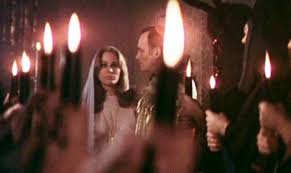
Once the film turns to the Satanists’ wooing of Elizabeth, her journey from then on has a tinge of palpable insidious tension, we can sense something ominous looming, Director Hart does a fantastic job at this juncture of the film. For a fan of the medium where metaphors substitute for obviousness in Horror, the portrayal of the Satanists and their protocols is jolting and anxiety inducing due to the fact that the Satanists in “The Pyx” are so calm and corporate, as if they had all been sedated by power without a struggle. We don’t get chants and demonstrative outbursts, we get measured, friendly smiling sell-outs of their own souls. Elizabeth strolls into this den of moral corruption with her eyes wide open and the future of her soul in peril.
Whether the viewer feels that Elizabeth’s struggle with her spirituality and her apprehensive flirtation with becoming saved by religion is pretentious or overly sanctimonious is debatable, I did not get a sense that the film was Bible thumping at all, I felt the religious angle was more about seeking avenues of self-help. The character of Elizabeth Lucy is a good girl gone bad, and now the gravity of embracing nihilism and self-absorption in the form of self-conscripting herself through drug use and lifestyle choices into the philosophy of Satan worship, or more succinctly a love of self above all else, she is recoiling in a moment of truth. The God of her childhood memories seems less destructive than the Devil of her adulthood. It is due to this quandary for the character of Elizabeth, that this film from 1973 really speaks to me.
Released the same year as “The Exorcist”, “The Pyx” ardently speaks to a pivotal time in Western Society (I was Five at the time) where there was still a foregone adherence to the Church as an institution of spiritual guidance for many, it still had the respect of an overwhelming majority. Yet the Bible and all things considered sacred were being second guessed by a burgeoning intellect in society that was becoming increasingly faithless. The feeling from the skeptical portion of society was vocalizing the thought that the church was a corrupt institution, pushing old stories to mass market guilt and shame to a malleable audience. The shiny object that is Satanism, while in reality just another perverted Religion, seemed to have growing appeal in the early 1970’s to the cynical, the skeptical, and the individual that sees the world as nothing more than a series of opportunities. Satanism in “The Pyx” is frightening not so much due to it’s apparent prevalence throughout the civic structure of society in this movie, but with the seeming ease with which one can embrace Satanism, the movie makes the chilling statement that Satanism can be a club that everyone can join secretly, without worry of being outted because anybody who is anybody is in on it. “The Pyx” makes powerful Satanists out to be like Kubrick’s “Eyes Wide Shut” crowd.
The editing in “The Pyx” (by Ron Wisman) is top notch, at times they go to a early-70’s docudrama feel. The film in a way speaks gruff truth to power. Henderson’s partner, played by Daniel Pillon, speaks to all of the criminals with the kind of disrespect that we wished we had for our High School bullies. Elizabeth gets more than her two cents in with her words, deeds and actions before the film is over, hers is allegorically the most important statement of the movie, the one with the most impact. As for Plummer, he is merely Canadian Harrison Ford in this, he’s bored with the Woman he sleeps with because they don’t have the courage and magnanimity of Elizabeth’s memory to him. He creeps around with a loosened tie and disheveled hair, forcing out confessions from bad guys at gun point or blowing them away to give the audience some sense of judicial satisfaction.

“The Pyx” is most likely one of my favorite near misses of the 1970’s; it has the spaced-out wide angled look of 70’s movies that I love, it doesn’t bombard the viewer with too much mood changing music, it gives you just enough. It has a fantastic message that it delivers near the end, to give one something to gnaw on conceptually. A reboot would be welcomed. In contrast to films such as “The Brotherhood of Satan” from 1971, where the Satanists are appalling old people in a creepy dungeon, or a film I reviewed last week, “The Witches” from 1966, where an occult ceremony looks more like a Fraternity hazing by the Drama Club, “The Pyx” contains a version of Satanism that’s slick-looking like Holiday retail. This looks like the most sterile Halloween Office Party ever, everyone appears obedient and serene, almost sedate. “The Pyx” is spooky in this regard; that while we get a Montreal through the eyes of the police dealing with miserable isolated folk hard scrabbling through their days, through the eyes of a wayward model we get the view of those that hold the strings of religious and civic power, doing so while engaging with heroin addicted prostitutes in Satanic rituals.
I felt the need for a brief explanation about the title of the film. Based on a novel from 1959 by author John Buell, “The Pyx” describes a Woman clutching a pyx in addition to a necklace with a golden upside down cross at her death. A pyx is a locket used during Catholic Church services, such as Communion. According to the book and film, the Satanists in their mocking of Christianity, would use symbols and items from Catholic services in their own rituals. Karen Black was a hot property at the time of this film’s release and it’s easy to see why. Showing an ability to do serious award-winning dramas in addition to mainstream movies, Black is clearly confident here, even when the material is pedestrian. Her performance in this is full of tortured energy; although she wasn’t totally convincing physically as a junkie in this, her mannerisms qualified as like that of a Woman with a pill addiction, so I’ll give her a pass. Alternate titles for this, by the way, ranged from the Arty sounding “La Lunule” for French-speaking audiences, to “The Hooker Cult Murders” for the drive-in crowd.
Leave a Reply