Films that represent the Old West of Anglo North American history are hard-pressed to not include an angle of menace, mayhem or violent conflict. To attempt to think of a compelling movie that concerns this period of American history without savage gunfights and malevolent confrontation appears to be a daunting task. Terence Malick’s beautiful “Days of Heaven” is one that comes to mind. However, I can now say I’ve seen another, one that is based on true events and doesn’t represent the North American West as a bullet-ridden melodrama and this film is damned compelling. Concerning a brief window of time in the life of one of History’s most famous North American bandits, “The Grey Fox” is a low-budget film with an NPR vibe from 1982 that despite it’s meager production values, is more effective due to it’s minimalist production. This movie does it’s best to recreate true events and feels extremely authentic. Making fantastic use of British Columbian backdrop and locales, the natural beauty of “The Grey Fox” has stayed in my mind long after the ending credits rolled.
The movie is a biographical tale about a true-life rogue, Bill Miner, a Man born in Kentucky in 1846. Through a series of errant lifestyle choices, Miner began robbing Stagecoaches in his late teens, pulling off his first robbery while the American Civil War was still raging. As is the fate of most, if not all bandits, Miner eventually ended up in jail. Unable to give up his chosen lifestyle of criminality, Miner subsequently wound up in Prison for decades, not being released into the public until the Century had turned to the early 1900’s and by this point, he was essentially by standards of the time, an old Man. According to the film, he seeks out his Sister in Washington State once he is released from jail. He tries to go straight by living with her and her skeptical Husband while he attempts to work as an Oyster Farmer. Yet, as we see in the movie quickly, old habits die hard. He visits an old-time Movie Theater that is showing one of the first silent movies ever made, ironically concerning a train robbery. Miner is captivated by what he sees on screen and he hates real work, but there are essentially no more Stagecoaches to rob, they don’t really exist anymore by this point.
Miner migrates a few miles North to Canada, saying adios to his Sister and Bonjour to robbing trains, Banks seem too dangerous. While in Canada, Miner finds cohorts to rob trains with, fake jobs to mask his identity, charming Suffragettes to date and he even befriends local Law Enforcement, helping them with murder investigations. On top of that, everyone seems to like him, Miner is a nice guy. Just as Miner can’t stop being a rogue nice-guy criminal, American law enforcement can’t stop pursuing transgressors on behalf of the Railway Companies that Miner is robbing. Even though the general public wasn’t bothered that Miner was robbing trains, since Miner only robbed the trains and not the passengers, Big Business didn’t take kindly to it, they hired Pinkerton agents to travel to Canada and root Miner out.
This quirky Canadian production, directed by Canadian Philip Borsos, is at once kindly and serene, but there is also a vein of excitement that runs through it, because Miner, played by veteran actor Richard Farnsworth, never stops being a criminal. There is action in this; train robberies, bar fights, a couple of brief gunfights. The real-life Miner was known as a Gentleman-Bandit, maybe the kindest dude one could ever get robbed by. I read somewhere that Miner was attributed to be the first known American bandit to tell everyone to put their hands up when they were getting robbed by him. While that seems slightly implausible, Miner was such a beloved figure by those that knew him, anecdotes such as these became part of his mythical legacy. Watching this movie, I was hoping he could just go straight and stop plotting these capers and then he could live a life of comfort, but he was who he was and wouldn’t stop being a criminal. Plus, regular work was too boring for him.
“The Grey Fox” by my estimation as a viewing experience was bolstered by at least four factors. The first thing that struck me was the look of this picture; because of it’s remote and exotic British Columbian locales, this has more in common with Malick’s “Days of Heaven” and Richard Pearce’s “Heartland” from 1979 than typical Hollywood Westerns. The look of the town where most of the action takes place, the dress of the townsfolk, the lighting, the trains as they roll through the Canadian landscape. There is a breathtaking shot of Miner and his girlfriend, played with integrity by unique-looking Jackie Burroughs, dancing to no music with the backdrop of British Columbian mountains amidst a Purplish dawn/dusk in the background. It is a gorgeous visual and exemplifies the sweet nature of both their relationship and the tone this film wants to set. For some reason, I was reminded of Scottish Director Bill Forsyth’s “Local Hero” by this movie, another film that celebrated the charm and nuances of intelligent and tight-knit communities living off the grid.
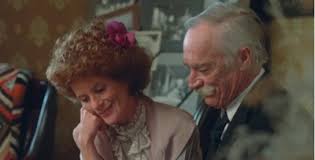
There is something to be said about a specific feeling that this film gives off. If you are looking for angry fare, this is not your movie. Yet the film is not so much saccharin as it is humane. These characters have integrity without being maudlin. This leads me to the second factor that I enjoyed about this film which dovetails into the third; the tone that the film sets and the richness of it’s supporting characters to Farnsworth’s portrayal of Miner. Jackie Burroughs as Kate, the Suffragette, is a Photographer by trade and while her character bristles against some of the town’s more rigid misogyny-driven characters, she is allowed to live her life on her own terms. The on-screen relationship between Kate and Miner is warm and believable. He loves her independence, intelligence and grace, she responds to his take-charge Masculinity, but also to his kindness, his willingness to accept her for who she is, they compliment each other.

Ken Pogue plays a shady local businessman named Jack Budd who helps Miner hide out. Pogue gives an important support performance, he gives off the appearance of a community-based businessman, he and Miner speak the language of under-the-table side-hustle criminality. They don’t want to hurt anyone, but they do want to cheat and continue to give themselves a better existence. They know how to be criminals without being openly demonstrative. Wayne Robson is Shorty, Miner’s robbery accomplice, he is sort of a caricature, he is more of a slower thinking everyman who is not as clever as Miner, but can’t help but get caught up in Miner’s get wealthier quicker schemes.
All the Law Enforcement characters here are memorable, they are neither soft nor stupid, they seem like Libertarian police. Starting with Timothy Webber as Fernie, the local Law Enforcement Officer. His friendship with Miner is cordial and full of respect, not knowing Miner’s true identity at first. At one juncture, you get a sense that there is such a bond of admiration between the Two Men that I had hopes they would work in cooperation with each other, but I had to remind myself this is based on true events, not fantasy. William Reineke as the relentless American Lawman is an excellent turn by an actor we don’t see much of in this, but when he is on screen we know he is accepting zero bullshit and he can detect when either locals are lying to him or attempting to deflect on Miner’s behalf. The ensemble of actors who play the Canadian Mounties, led by Paul Whitney as the lead Constable, are so jovial, steadfast, stoic and handsome, I expected them to break into a version of Monty Python’s “He’s a Lumberjack and He’s OK”. There’s no hate in this film, the Cops aren’t portrayed as surly or toxic, they don’t despise the criminals they are pursuing, which could be in part because Miner is such a local hero to all who come in contact with him, there’s not cause for animosity. That said, when the Posse comes for Miner, they and the American G-Men have all the vitriol of a School Staff escorting a miscreant to detention.
I had never seen Jackie Burroughs perform that I know of before viewing this film, she gives a genuine and heartfelt performance as Kate, Miner’s love interest. It was weird for me in some ways due to the fact that I recently lost a good friend to complications from Diabetes and his companion and Life partner looked and sounded quite a bit like Jackie Burroughs. She plays a literate and deeper thinking Woman, who seems as comfortable out in the open air and the wilds as she does dressing like the presumptive proper lady of her day. We want Miner to have a love interest, he’s either been in prison or with family or alone for the past 35 years, for chrissakes.
The Cinematography here by Frank Tidy is sweeping and tremendous, especially considering it was made on a budget of only 4.5 million dollars. Although it’s probably difficult to screw up filming the rugged landscape of the North American Northwest as a backdrop, there is an elegance to the look of almost every scene that is filmed outdoors here. Director Borsos splices in old time film clips from the early days of silent Cowboy movies for effect, the clips are not meticulously accurate to the accompanying historical events of the film, but they serve as a satisfying supplement to the events in the film that are described. The movie does not have a narrator, but occasional historical anecdotes prior to the chronology we are watching and subsequently describing occurrences in the latter part of the film and the aftermath.
The old-time film clips, which include Western Posses attempting to apprehend criminals while all are on Horseback, shooting it out, these scenes are incongruent. An image in color of an old-time train in action at dusk with interior lights on, chugging into a tunnel on a mountain side is a memorable visual, an image harkening back to an age gone by that seems to intimate a simpler, less paradoxical time. If there is a message here, it is Director Borsos’s interpretation of life in this area at this time in history. He appears to want to represent a more genteel era, not burdened with manic capitalism or social neuroticism.
Finally, there is the performance of Farnsworth as Miner, a star making turn. Born in 1920, Farnsworth had quite a few bit roles in Westerns. Here when he turned 17, he plays a Jockey in the Marx Brothers’ controversial “A Day at the Races.” After “Grey Fox”, Farnsworth got a ton of work as a Support, I recall him calmly as an assistant Manager in Barry Levinson’s great Hardball movie, “The Natural”. Here, as Miner, Farnsworth gives a transcendental performance, simultaneously subdued and electric. There are scenes where he gets rough, he smashes a Beer bottle over a Man’s head and shoots capable train workers. Farnsworth’s puckish stare and piercing Blue eyes denotes infinite optimism, it sells this performance as much as any of the dialogue he delivers.

We feel at home with him, we are comfortable with him, his candor and his down home folksiness give us a hero to root for, even if he’s portraying a Bandit. It’s one of those roles where it is hard to imagine anyone else in it. Even if he is portraying an outlaw. It’s one of those roles where it is hard to imagine anyone without them over doing it. Farnsworth has a reserve that’s not too demonstrative, we believe in this guy, his rugged sincerity allows the viewer to be transported back to another era. As an added bonus, the Irish Folk Band, “The Chieftains” play scrappy Irish-sounding Fox hunting music throughout, a perfect tone setter for a film that does not want to disturb us as much as it wants to inspire us to seek a gentler landscape.
Leave a Reply