Few things in this world are as distinctly American as Blues music. In regards to it’s depiction in cinema, the Blues has provided the soundtrack to numerous films, a debate as to who’s Blues music is superior and most authentic can stir up quite a row. With the recent success and subsequent discussion and analysis of Director Ryan Coogler’s “Sinners”, the topic of the Blues as an art form has once again risen to the surface, the idea of a film being immersed partially in the origins and inspirations of this American-born music fascinated many and led some to rediscover Director Walter Hill’s mythic love letter to the Blues filmed forty years prior that also engaged in supernatural elements surrounding the Blues. If you may recall, the 1985 film “Crossroads” centered around this American art form and featured a mythical musical battle in Hell with not Vampires (as in the Coogler directed effort) but the Devil himself, as if the eternal forces of Good and Evil were one again engaged in conflict through this musical medium.
Hill’s film featured a White Music School student searching for authenticity in his playing of the Blues by learning the life of the Blues, if there exists such a thing, through experiences on the road shared with a Black musician who had been through the trials and travails of “Blues living”. African-American writers such as August Wilson have written and spoken about that only African Americans can truly understand and articulate the Blues due to it’s profound roots extending to the wisdom and mythos of the Black Church, as well as the life experiences of being an African-American in a land hostile to them, dominated in many ways by a pernicious Anglo majority. So the viewers of Coogler’s and Hill’s films may want to dig deeper, to find an origin story on celluloid that strikes into the historic origins of Blues music, perhaps devoid of symbolic demons, devils and vampires.
I first viewed legendary African-American Film Director Gordon Parks’ “Leadbelly” in the early 1980’s, about five years after it’s 1976 release. Parks, if you may recall, is best know for two groundbreaking films; 1967’s “The Learning Tree”, which is a searing account of growing up Black in 1920’s rural America (Kansas) and which features an unbelievable musical score by Quincy Jones, and 1971’s “Shaft, a reimagining of the modern Police crime thriller featuring an African-American protagonist. “Shaft” featured an iconic film score which featured the talents of both Singer-Songwriter-Actor Isaac Hayes. With “Leadbelly”, Parks again features a dominating soundtrack written by Fred Karlin, and also this film contains countless scenes of the Blues being performed either in scenes in real time or as background. Either way, there is a constant drone of Blues Guitar pulsing through the veins of this movie. The drama of this real-life account of Bluesman Huddie Ledbetter is so sharp, devastating and profound however, that this is an intense dramatic biopic with a powerful musical background.
The movie is staged in flashback form, it begins in a hellish chain-gang prison in Louisiana in the early 1930’s as we are introduced to Ledbetter (as portrayed by actor Roger Mosely in a dynamic performance) who is serving time for his killing of a White Man in self-defense. Moseley had a distinguished acting career, but is probably best known for his work on a CBS Network TV show from the 1980’s titled “Magnum P.I.”, where he is the right hand man to the titular character played by 80’s heartthrob Tom Selleck. At the beginning of “Leadbelly”, Mosely as Ledbetter is pulled off the line of busting rocks with a sledgehammer in the blistering Louisiana noon day Sun by a couple of fellows with recording equipment, they have permission to record him singing and playing Guitar for a few hours. This was emblematic of how accomplished a Musician Ledbetter was regarded to be by 1933, that complete White strangers wanted to record him due to his legendary talent even though he was in Prison for Manslaughter, and for killing a White Man at that, the film depicts Ledbetter defending himself and his daughter against provocational racist White Men.
With each song that Ledbetter records, including some extremely famous popular Blues songs such as “Goodnight, Irene”, “The Midnight Special”, “Rock Island Line”, “Green Corn” and others, a tale of his past accompanies the music, each song has a story, what a life this Man led. The traveling, the performing, the relationships with Women, violence and ensuing Prison stints, Huddie Ledbetter had an unbelievable life and the crowning musical achievements of his life had still yet to transpire, those events when he toured as an accomplished and hailed performer were still yet to take place not until chronologically after the events depicted in this movie. Made a year after the volatile and disturbingly vile “Mandingo” by Director Richard Fleischer, “Leadbelly” still contains the horrific specter of American racism and oppression that “Mandingo” espouses; the judgement, exploitation and hostile cruelty by a White-dominated society in the first half of the American Twentieth Century is on full display here and it’s relentless.
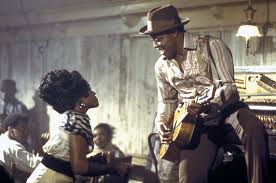
Director Parks, assisted by a keen script written by Ernest Kinoy, directs a film containing a roller coaster ride of emotions. At times, it is musically euphoric, others it is mundanely comic and many scenes carry a tragic gravity. Ledbetter leads a life filled with the pain, with loss and subsequent redemption, but the music always seems to provide him with a tangible goal to ascend to. Most of the life events we witness are of his life in Texas and Louisiana, starting in the earliest years of the Twentieth Century. A beautifully shot movie (Cinematography by Bruce Surtees)”Ledbelly”‘s sweltering portrayal of the Deep South gives us a portrait of a land of poignant beauty and instant danger. The first gig that we see Ledbetter play on, he is playing Guitar for a dance for African-Americans, three of Ledbetter’s circumstances and potential hardships come to the surface immediately. One is his incessant consumption of Hard Liquor, another is his penchant for wanting and getting the attention of the prettiest girl in the room, the third is his habit of getting into life-altering violence. In a moment of confrontation and duress, Ledbetter pulls a gun and fires at a friend in an argument over the same girl that he most likely impregnates that very night.
The local White Sheriff visits Ledbetter’s Father (played by Paul Benjamin), informing him that his son’s in trouble for firing a pistol at another citizen. Ledbetter’s Father and Mother inform Huddie that he’s better off going on the lam than putting his faith in the White Justice system and off Huddie goes on his Horse, into the big cruel world. He ends up in Shreveport, La in 1903, where he hooks up with a Brothel Madam (played by Madge Sinclair, another future CBS prime time mainstay, she starred in the Hospital Drama Series “Trapper John MD”). The Madam tutors Huddie in changing his Guitar playing style to be less Country and more for City folk, the sound and style of Ledbetter’s Blues playing seems to evolve in this film as much based on regional influence as it is the people Ledbetter comes across and their personal likes and dislikes.
Ledbetter takes up musical shop in a local Black bar in what seems like a suddenly thriving Black business district. His playing goes to a level where he feels bold enough to welcome all challengers to attempt to best him on stage. An old man steps to him with a 12-string Guitar (Ledbetter initially plays a 6-string) and in a fantastic scene, the Old Man proves to be easily Ledbetter’s equal. I have always loved this scene, in part because the scene teaches the viewer that in performing, anyone pure of heart and purpose can hang with anyone if they are focused enough and that performing belongs to no one individual, it belongs to all of us and it is up to each individual to do what they can in the moment that is given to them. The music is bigger than any one person, regardless of how spectacular they play.

After a rousing Guitar battle, the local White Police attack the club, Ledbetter beats up Police who are attempting to confront the Old Man, so Ledbetter and the Old Man hop a freight train to escape jail and Ledbetter is on the road again, this time to the fields of Texas. He is so taken by the Old Man’s sound on the 12-String Guitar, he buys the Old Man’s guitar off of him since his own Guitar was destroyed in the Police raid. This would be the instrument that proclaims Ledbetter’s signature sound going forward. Everything that transpires in his travels contributes to his music and his art as a whole.
In Texas, Ledbetter begins an off and on relationship with Lethe (played by Rhetta Greene ), a pretty field hand who knows that Huddie is a rambling musician and that their relationship will be temporary due to his nature. When Huddie hits the road again, this time bound for Tyler, Texas, he becomes fast friends with a blind Musician named Blind Lemon Jefferson, another future well-known Blues man. Jefferson is played by Art Evans, Evans would eventually star in Director Walter Hill’s “Trespass” fifteen years later. Jefferson informs Huddie that he feels Huddie has talent but that he needs to expand his knowledge of the Blues, that Huddie specializes only in “Whorehouse Blues” as he calls it. There is a repartee between Ledbetter and Jefferson. In one scene, Jefferson informs Huddie that Ledbetter reminds Jefferson of a Chicken tied to a fence post. “You cackle and run around a lot but you ain’t going nowhere.” Jefferson tells Ledbetter he intends to make it to Memphis or Chicago and put his music on record, a relatively newer invention at the time.
Director Parks delivers an engaging, inspirational, unapologetic and bittersweet character study. Ledbetter endures a paradoxical existence in this film; that of incredible triumph due to his music and substantial heartbreak and savage persecution due to his standing as a visible Black Man in the Deep South of Twentieth Century America with a self-inflicted appetite for Women, Whiskey, musical notoriety and an attitude of not taking shit from anyone, especially brazen and aggressive racist White folks. Ledbetter shoots a second Black Man, hitting and killing him this time, in another post-gig discrepancy, stabs a White Man while protecting his teenage daughter, attacks an unruly White patron at a gig with his Guitar, busts out of jail more than once and his shot in the shoulder during one of his prison escapes. This Man lived multiple lifetimes and still persevered, it’s almost beyond belief.
Parks stages some incredible sequences in the latter half of the film that both play as amazing dramatic theater and also provide social commentary on the Deep South of the early Twentieth Century. In one scene, Ledbetter returns to the street where he found musical glory years ago when he was shacked up with the Brothel Madam. The town was now shuttered and had become a ghost town, yet the only person he finds on the street is the Madam herself, now older and somewhat broken. Parks hints at what we now know from reopened history as the destruction of self-made Black communities after the end of World War I by White mobs and authorities. Whereas Ledbetter in this scene still carries hope in his heart of finding fame through his music, the Madam is desperately looking for inspiration and seems dejected when Ledbetter exchanges pleasantries with her and moves on, the dusty and empty streets signifying a time that has come and gone.
In another devastating sequence, Ledbetter’s Father discovers that his son is in prison for murder and attempts to buy his son’s freedom with money he has saved. He approaches the Warden of the chain gang in Texas while Ledbetter sits in an isolation sweatbox due to his most recent attempt to escape. The Father is now in ill health and his attempts to buy his Son’s freedom are rejected by the Warden. Ledbetter sees his Father through the slot in the hotbox, but is too ashamed to call out to him. The Father knows he himself will die soon and senses he will never see his son again, the scene contains elements of tragedy and regret that hangs heavily over the viewer as the Father slowly disappears out of sight, never to be seen by Ledbetter again.
While in jail, Ledbetter never stops playing his music and crafting songs that relate to his incredible life experiences. This leads him one day to be called to the Mansion of the outgoing Governor of Texas to play a song for him on the Governor’s Birthday. The Governor and all his guests are dressed in all-White and enjoying a hot day at the mansion as Ledbetter approaches with his Guitar and wearing his dusty Prison clothes. The scene with the Governor (played by John Henry Faulk) is one of complex and contradicting emotions. The haughty rich White guests, all dressed in White, don’t know what to make of Ledbetter when he appears in his disheveled and sweaty Prison duds. Once he begins to play, all are enraptured with his ability, the Governor preens and plays the role of a fat cat Aristocrat. Once Ledbetter breaks into a song about begging the Governor for a pardon, the entire entourage is engaged and amused at the display. The Governor sits in his wicker chair, smoking a cigar and laughing at Ledbetter’s clever lyrics.
At this juncture, Ledbetter had killed a Black Man, which the powers that be didn’t find as distasteful as if he had killed a White one. The Governor chomps on his cigar and is taken with Ledbetter’s performance, tossing him a cheap cigar to smoke as payment and indeed promises him a pardon at the conclusion of the Governor’s outgoing term. The all-White crowd seems to simultaneously adore Ledbetter as well as mock him for his ability, his predicament and his social standing. The scene is unforgettable, Ledbetter duly picks up the cigar and wanders back to the police car that brought him there as a wild-eyed little White child, fascinated by what he has just witnessed, follows Ledbetter to the edge of the fence that surrounds the Mansion.
The music throughout the movie is memorable and moving. The moments in the film where the score by composer Karlin uses strings to provide a tension-filled drone behind cathartic moments in Ledbetter’s life are overwhelming and powerful, just a fantastic dramatic score, accentuating the pain behind some of Ledbetter’s most famous songs with fleshed out full luscious string-infused chords as Ledbetter’s voice belts out songs meant to evoke more pleasant thoughts. With all the extraneous singing and Guitar playing occurring in the film, it would be only natural that a viewer would wonder whether Mosely is playing and singing himself, but it is actually the work of multiple accomplished professional Blues Men, including Hi Tide Harris, Sonny Terry, Brownie Mcghee, David Rosmini and David Cohen, all providing the other-worldly strumming and singing, they do a bang-up job providing an authentic sound and phonetic approach to every song they perform on.

Mosely give s tremendous performance; he’s physical, he displays a range of complex emotions, he’s witty, we truly get a sense of a Man who is both haunted and cursed by his own mistakes, yet never wavers in his optimism about the power and potential of his music. Mosely as Ledbetter never loses the core of his personality’s essence; he is mindful of both his own inequities as well as the parameters of the society he is enclosed within. Director Parks creates an extremely jarring biopic, one that is simultaneously full of hope as well as savagely cynical about the conditions of America’s racist past. Park’s film seems to intimate that as much as Ledbetter spent his life on the run due to his vices and the oppression of the Jim Crow South, his ability as a musician and entertainer literally provided him with a sort of “Get out of Jail Free card”, that the same passions and indulgences that drove him toward danger also steered him toward an existence that many of America’s poor, especially those who were considered helots by an accusatory culture, never came close to experience.
Leave a Reply