While this might not be groundbreaking insight, I sometimes have that simultaneously liberating and sobering feeling that what I am watching when I view a film and it’s portrayed events is that I am becoming privy to some screenwriter’s personal life’s past, that the more random the moments on screen, the more organic the origins of those cinematic moments I am watching must have been. On a frozen night in New York City in 1981, my Mother and my 11-year old sister Courtenay and I were on a week long visit to the Big Apple and we were frequenting movie theaters it seemed at least twice a day. This was a Saturday night a few days before Christmas, Manhattan was teeming with lit up activity amidst what felt to me to be the coldest temperatures I had ever felt by the age of Thirteen. Mom had taken us to a delicious Chinese Restaurant on this evening and now we were all ready for a nightly journey to the movies for an Eight O’clock show.
On this night, Mom wanted us to go see the latest film from cinematic titan Arthur Penn, the man who directed at least three movies that to me were memorable and profound; 1967’s “Bonnie and Clyde”, 1970’s “Little Big Man” and most importantly, 1975’s “Night Moves”. In addition, I forgot he also directed the super-charged 1966 film, “The Chase”. Those are some serious fucking films right there and as important and ground-breaking as “Bonnie and Clyde” is as a cinematic legacy, it actually might be my least favorite of those aforementioned movies. Arthur Penn did not make compromised movies, his films almost seemed to come from a super-ego, a giant super-ego with an articulate and well-read sense of humor. Characters in Arthur Penn films are intrinsically transparent, they contain an abundance of candor.
From a screenplay by writer Steven Tesich (The author of the screenplay for the recent hit at the time titled “Breaking Away”) 1981’s “Four Friends”, directed by Penn is at least on the surface two things; a tale of multiple analogous characters who represent different 1960’s American social archetypes experiencing the rollercoaster of historical and life-changing events that shaped the 1960’s in America and a series of personality-driven events that come off at times as warm, touching, painful and uncomfortable. The script and Penn’s sage-like vision makes for a film that does contain a couple of awkwardly maudlin moments near it’s end, but for the most part emanates a profound cinematic display that is coupled with a sincerity from it’s creators and the outstanding cast that was assembled to make this film feel authentic and not forced in the least. It’s interesting that this film was hardly noticed by anyone except film critics such as TV film critics Gene Siskel and Roger Ebert who hailed it as one of 1981’s best. Hardly anyone else went to see it upon it’s release.
This was a sweet and unyielding film at it’s core and I would argue that quite a few films in 1981 got lost in part due to the fact that there was a new American President in Ronald Reagan and a new tone and spirit in the United States of nationalism and conservatism. This had an effect on American film-going audiences and what films they wanted to see. Several movies from this year that appeared to be left of center were not embraced by audiences and in my opinion, they should have been. Milos Forman’s “Ragtime” was a fantastic historical drama from 1981 and it’s core subject was American racism in the early 20th century, Michael Wadleigh’s “Wolfen” (reviewed in this blog in 2024) involved the environment and karma for the American establishment in a Horror movie construct. The majority of the American movie-going public in 1981 was not interested in the plight of 1960’s intellectualism as shown by the poor box-office performance of at least three movies of note, in addition to the two I previously described; 1978’s “The Big Fix”, concerning a flower power refugee starring Richard Dreyfuss and a murder conspiracy involving Right-Wing bad guys, “Cutter’s Way”, also from 1981, an even better made and thought-out film than “The Big Fix” about a similar story line involving nefarious wealthy Right-Wing White people preying on the public and 1981’s “Inside Moves”, a movie about 60’s cast-offs attempting to move on with their lives in the early 1980’s. Hardly anybody wanted to see these movies, and such was also the case with “Four Friends”.
“Four Friends” begins in small-town Indiana in the early 1960’s as we are introduced to four main characters, each arguably representing an archetype; a detailed-oriented young Jewish lad named David (played by Michael Huddleston ), a tall and handsome sensitive WASP named Tom (played by Jim Metzler), an idealistic Slavic High School poet named Danillo (A character most likely based on screenwriter Tesich himself, played by Craig Wasson, the character is the son of hardscrabble Yugoslavian immigrant parents) and the creative, hard-headed and beautiful girl named Georgia they all are friends with (and maybe secretly in love with) played by Jodi Thelen. As stated before, the movie has surface events, but everything feels like it’s meant to contain dual symbolism.
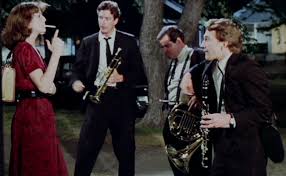
Thelen as Georgia, proclaims as a teenager that she is the reincarnation of famed dancer Isadora Duncan, and she embodies this by running through the streets of small town Indiana in the moonlight, standing up and dancing with her clarinet during High School band concerts (to the consternation of her Band instructor), initiating civil unrest against Industrial employers attempting to recruit workers at her school and intimating to her close Male friends that she wouldn’t be opposed to them having their way with her sexually all at once, if only they weren’t too guilt-ridden and fond of her to take advantage of her in such a manner. She appears to be a character created to signify the tenets of burgeoning 1960’s feminism in America and internalizing a free spirit out in the open. While more conservative classmates treat her as a kook and prospective promiscuous slut, the aforementioned Male protagonists in “Four Friends” adore her and love her, each in different ways.

The Jewish Male character David is the most grounded and pragmatic, the WASP Tom the most heroic as he goes into the Military and a tour of duty in the Vietnam War, the descendant of Yugoslav parents Danillo is the most ambitious and socially aware. “Four Friends” not only portrays these characters in their personal lives, it acts as a sort of travelogue through the turbulence of the 1960’s in America. We get scenes of student dissent, mentions of the Kennedy assassination (the first one), racism and subsequent brief glimpses of the freedom riders heading South to combat oppression, draft card burnings, Hippie acid parties, ruling class incest, immigrant festivals, public marvel at the sight of space travel, sexual liberation, etc. This movie almost teeters on the edge of a Disney-fied tour of the American 1960’s with nudity, frank sexual content, tragedy and cathartic violence tossed in.
At it’s core, the film’s main characters emanate a kind of hope that was procured in their small town upbringing, but their collective curiosity about the world leads them to see and experience things that they simultaneously treasure and learn to regret. As the film progresses, we se that the main focus of the movie is on the character played by Craig Wasson, but we also follow Georgia’ s life to a degree. I saw a weird trailer for this movie where it makes it seem as though the focus of the film is on the Male friends’ desire to be close to the Female one, which I believe if you see this movie was an odd way to market it. I believe the film is much more a bittersweet love letter from screenwriter Tesich and Director Penn to the time that was the American 1960’s; that it was an age where American institutional norms were being tested by an inquisitive generation. I recall watching this film at the age of 13, sitting next to my Mother and feeling her emotional engagement with this cinematic endeavor, especially the scenes involving the Yugoslav kid’s struggles with his stubborn parents, my Italian Mother had lived moments similar to this, I could tell, not because she had told me to this point but because I could feel her emotional investment in this movie through certain scenes.
It’s interesting that modern film streaming services call this movie both a drama and a comedy; while I wouldn’t argue the drama and dramatic angle of this film, while there are a few tension-busting laughs in this movie, I wouldn’t label it a laugh-fest, by any means. One facet of this film that may have hurt it at the box office is that there are few recognizable acting faces in this, with maybe the exception of Wasson, who was not a big name yet, there are no marquee names here. Faces that you may recognize from other films, for sure, but not major stars. The movie is quite frank about sex and desire amongst teens and twenty-somethings, but not in a salacious or callous way. The characters seem to all pursue romance in conjunction with carnality, this film takes the concepts of sex and intimacy as something very serious, not a dalliance by any means. while it is slightly off-putting that the characters don’t noticeably age, we see them look the same at age 18 as they do in their late twenties, essentially they all look like they are 30 throughout the entire movie, they just act more like teenagers in the beginning.
There are films to compare this to that are chronologically after and before this was released. “Forrest Gump” leaps to mind, although I would argue that this is a superior film to FG and a superior retelling of the 1960’s, especially if you embrace the idea that the Female character named Georgia from this movie is mirrored in FG as “Jenny”, except where Georgia is a liberated and fleshed-out metaphor, Jenny is merely a symbol who is eventually punished for her pursuit of liberation and sexual insincerity. We also get a vibe that she is considered wicked for not adhering to the needs and wants of the titular Gump. Georgia in “Four Friends”, by contrast, is honored and celebrated by comparison to a degree, wise Men seek her, her femininity is considered a beacon of inspiration, she’s the girl all the smart guys want.
Rather than recite all of the events of this movie, I would rather praise it’s performers and creators as well as describe certain sections and how they contribute to the whole product. There are a bevy of excellent peripheral character actors in this, outside of the leads of Wasson and Thelen. Scott Hardt is the hardened Yugoslav father who looks like he is doing a Lee J Cobb impression and he portrays a healthy metaphor, James Leo Herlihy is the creepy wealthy potential Father-in-Law. Reed Birney provides an important turn as a kind of brilliant Stephen Hawking-esque crippled College student who is Wasson’s roommate at Northwestern. When Wasson attempts to marry into a wealthy family, his father sees it as his son attempting to game the system in a way, which at first appears to be jealousy on the Father’s part, but we learn that for all his cantankerousness the Father has a keen eye for human patterns and behavior. Tesich’s portrayal of American blue-bloods is not a flattering one, by any means.
Another movie that this reminded me of was the 1978 film production of “Hair”, involving the culture clashes of America in the 1960’s between small-town Middle America, upper class America and the questioning and curiosity-driven culture of street hippies and minorities. “Four Friends” is a film bubbling with earnest sincerity, I don’t think audiences knew how to take it, especially in the moment it was released in 1981 when hardened conservativism was being embraced by the American public. Another section of the film seems to come directly from the nostalgic pen of Tesich as he sets up a segment of Wasson’s character’s life as he seems overwhelmed by his life’s experiences to this point and retreats to a more familiar existence in Pennsylvania that has been engrained in him; working in a factory as his parents had done and taking up with a Woman of ethnic descent (played by Natalija Nogulich, who’s a visual knockout). The scenes between the two of them are done with reverence and warmth, including on screen moments where Wasson’s character is welcomed with open arms by a wise and nurturing local immigrant community.

The movie has Wasson and the other “Friends” when they are younger at times, playing the melody from Dvorak’s “New World Symphony” on band instruments as if it is a theme song that symbolizes their origins and hopes for the future that they believe American will provide. This kind of melancholic symbolism may have been endemic of what turned audiences off to this movie in 1981, that audiences came looking for more escapist entertainment and didn’t want to be reminded of American historical tumultuousness. While Arthur Penn directed a heartfelt film, certain touches, like several clumsy attempts to shine a light on issues involving African-Americans in the 1960’s, came off as forced and forgettable. The personal stories of the main characters are powerful and serve as potent analogies for the messaging by the creative team for this movie. “Four Friends” should have had a second life in American history classrooms, but hardly anyone remembers it. With the exception of perhaps a patchwork ending which unfolds as if the whole production suddenly ran out of money and they had to cut the film prematurely, “Four Friends” definitely needs to be rediscovered by those that are curious about the American 1960’s and how it was portrayed, this film deserves a second and more fitting existence.
Leave a Reply