Funny thing about prison flicks, most of them are well done in my opinion, I’m hard pressed to think of a prison movie I haven’t liked, or at least had respect for. The notable exception being “The Shawshank Redemption”, which I would be willing to debate the merits of anytime. I would rather watch Leon Isaac Kennedy in “Penitentiary” or Jim Brown and Gene Hackman in “Riot” then the aforementioned maudlin 1940’s retro prison opus, or as my Mother once pronounced, “It’s a romance about Two men who fall in love in jail and sail away together on a boat.” Prison films, due to their subject matter, draw the viewer in quickly, we identify with the main character(s) and see ourselves in them, surviving the brutality and humiliation of the travails of being in lock-up, kind of sounds like public school the more I think about it, but I digress. I couldn’t watch too much of the excellently produced HBO prison drama “Oz”, too much sadomasochistic rape for me, even if it was presented as being partly allegorical.
Good prison movies seem to flow like war movies about platoons; there’s a diverse and eclectic populace and the factions within the social fabric clash eventually, typically with dramatic and potentially fatal results. In prison movies, it seems like the more a character seeks sexual conquest, the more likely he is to get killed or face retribution. Prison films include typically a caste system and moral compass where the timid are punished in the short run and the rapacious and short-range thinkers in the long. Behaving crazy gets you a rep and buys you time, Paul Newman in “Cool Hand Luke” comes to mind, so does Jon Voight in “Runaway Train” or Sean Penn and his pillow case full of coke cans in “Bad Boys”.
I recall my Father in the late 1970’s returning home from a film watching foray in Baltimore, where he claims to have seen a prison flick called “Short Eyes” at what he referred to as an “Action Theater”. I came to understand that he meant he saw this film at an Urban Movie House, where the regular folks, the city dwellers, went to the movies. The kind of place where customers tell each other during the movie to shut their crying babies up, where people yell back at the screen if it feels right. An interactive audience. “Short Eyes”, released in 1977 and directed by Robert M. Young is a forgotten movie in a strange nostalgic hiding place; too hood for the upper-class art film crowd, too esoteric for the grindhouse sect, this movie is truly in an intellectual no man’s land, which is a shame because it is a powerful watch, a ghetto stage play of sorts.
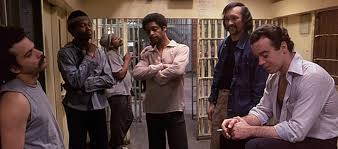
The film begins and ends with a cold view of a Big-City detention center, located in an unnamed East Coast Urban American City. The film was shot at the Manhattan House of Detention for Men (AKA “The Tombs”).Oddly enough, the monolithic shots of the jail at the beginning and end of the film reminded me of shots from Fritz Lang’s 1927 futuristic masterpiece “Metropolis” AND it reminded me of memorable stills from two of the most popular TV sit-coms of the late 1970’s, “Good Times” and “The Jeffersons”, both shows concerning African-Americans living in cities and the promotional shots of towered housing seemed to serve a dual purpose of representing both a sanctuary and stifling holding tank for their existence in Metropolitan areas. I believe the facility shown in “Short Eyes” is a detention center because all of the prisoners are still wearing their street clothes, they are in various stages of either being in the process of being sent to the Big House in a different part of the state or they are on their way to getting released in a short period of time. Either way, this is still like prison. There appears to be three distinct groups represented in the prison that stick together to a degree; Black prisoners, Hispanic prisoners, and White ones. The White ones seem more like Italians, Irish, Portuguese, etc, not too much Aryan Nation influence. This movie being from 1977, many of the ensemble actors are recognizable not so much as stars, but as ensemble cast members from other movies.
Based on a stage play by Miguel Pinero, “Short Eyes” is as much a procedural lock-up flick as it is a series of character studies of incarcerated Urban Americans. The titular character is played by Bruce Davison, he is the most White bread personage on screen. Yet, in a scene that plays like a 1930’s Gangster film confessional, Davison’s character confesses that he is indeed a serial pedophile, predominantly of Hispanic and African-American young girls. The film has an incessant claustrophobic feel to it, but the direction and the script are coherent, like a fictitious “Sixty Minutes” episode with a plot, there’s nothing awkward or amateurish here. Director Young’s film lives in a gritty and jaded head space, the characters are not so aware of their miserable situation that they don’t have moments of levity where they mock their own predicament.
Most likely the most famous name here in the cast is a smaller role played by singer Curtis Mayfield, who has a few lines of dialogue as an inmate as well as he sings in a jailhouse jam session scene early on in the film. The script, by Play author Pinero, here lays out a prison culture caste system based on temperament and fortitude of the individual. An interesting aspect as to the way the story flows; at times, the movie has a Latino character-driven narrative, whereas at other times, it feels as if the African-American characters are the protagonists, and then there are times when the White characters control the viewpoint of the movie. If there is a grounded and morally trustworthy character here by default, it might be the character of Juan, played by Jose Perez, an inmate who appears to be the least assuming and most virtuous of the inmates and guards portrayed here. There is a general malaise amongst the inmates that is simultaneously depressing and translucent, the candor that this film conveys in regards to human behavior is exact, here the fallacies of the characters are a pre-assumed disposition. A subterranean existence of Sadomasochistic dominance and posturing. The movie doesn’t do a psychoanalytic deep dive into the characters’ origins or backgrounds, the expectation amongst the prison population is relentless . not as a PSYOP, but as an innate standard. A code of the gangs that comes from a life of poverty seems to be a lifeblood philosophy that is embodied by all, well, almost all.
From the inception of the movie, we the audience are privy to an alter-society, one that runs itself with an unspoken understanding, but one that does not wish to be questioned or defined. When Clark Davis first arrives in this enclave, his host, Longshoe Charlie (played by Joseph Carberry) introduces him to the social dynamic that exists in the cell block. For this particular jail floor, the population is divided into three groups according to the jail tour guide. Prison movies often have inmates making a bunch of clever and well-thought out manipulative maneuvers to heighten the plot of these movies, but “Short Eyes” shows Men who are much more simplistic in their day-to-day lives; they’re not that deep, they seem more like juvenile delinquents than criminal masterminds.
What made this film most timely for me was the chasm among the inmates caused by the knowledge of a new edition to the cell block is an accused pedophile. The meaning of this in the modern day aside, Fifty years ago, such an accusation was a bridge too far, even for Hardened criminals, murderers, thieves, gangsters, drug dealers, all had criminal skeletons in their closets. Yet, among working-class criminals, the specter of a child molester was a deal breaker. Not only is this someone they can’t respect or assimilate into their prison eco-system, a person such as that is a target for scorn, humiliation and worse. A person who defiles innocence, a condition that most prison inmates still consider themselves embodying. A child molester (Or in prison lingo of the time, a “Short Eyes”) was deemed by the street to be the utmost of social pariahs. In this film the purported child molester happens to be White, Middle-to-Upper class and educated. Hasn’t killed anyone, but we the audience have seen him confess to the sexual molestation of multiple Female children, the majority of whom are not White. The character could be a metaphor.
In the last 30 years, whether it be the Joan Benet Ramsey murder, the Atlanta child killings of the 1980’s, the Penn State scandal or most recently, the Jeffrey Epstein scandal, there seems to shockingly exist a debate over how disgusting, tragic, depraved and deplorable child molestation is. It seems once wealthy White people become the symbols and potential beacons and bell cows of such behavior, suddenly the narrative in public has changed to debate how severe a crime against society child rape actually is. Color me stunned by this turn in public discourse, but apparently when some people’s favorite rich people and celebrities become involved, suddenly there is room for questionable arguments.

According to the portrayed caste society from the film, child molestation is deemed by the working class in the mid-1970’s as it was presented in previous iconic films of the past on similar subjects. In 1931, German Director Fritz Lang’s shocking manhunt film “M”, dealt with a notorious child murderer who is hunted by the police and the underworld for his transgressions against society. In 1956’s “Night of the Hunter”, Robert Mitchum plays a monstrous ex-con who will stop at nothing to terrorize two children, the film plays out like a fairy tale horror movie. In his underappreciated masterpiece “The Damned” from 1969, Italian Director Luchino Visconti shows a depraved future Nazi. played by Helmet Berger, molesting a young Jewish girl in a scene that plays out like an allegory, leading to the traumatized child to take her own life.
The world of the poor prison inmate is portrayed here as almost innocent of thought, though some inmates want to relieve their sexual frustrations on other less aggressive inmates, most of the inmates think like children, which adds reticence for them to show mercy to a child molester. The organized R and R of the prisoners includes a gathering in the commons where the prisoners have a musical jam, including a song sung by the aforementioned Curtis Mayfield. Inmates in this scene use old cans and chairs as drums, inmates sing and dance while other non-musical inmates watch and bob and nod their heads. Then there is organized gambling.
With cigarettes as commerce, the inmates organize races to gamble on where jail cockroaches they have captured are set loose on a makeshift miniature racetrack and the inmates bet on who will win the race. In another scene, trans prostitutes are escorted through the cell block as inmates hoot and holler at them. When a security guard accuses the inmates who seem aroused as being gay, some of the inmates protest the label, claiming they are only having fun. The officer responds, “Bullshit, if you’ll shuffle, you’ll deal!” The emotions of many of the inmates seems to waiver like children, where several speeches inmates deliver to each other include waif-like expressions such as “I like you” as if we’re not sure whether they are speaking from their childish id or they are hitting on each other.
Two inmates who act as trustees use their authoritative positions to solicit sex from less masculine prisoners. When their advances are repelled by other inmates, they set up those inmates to be placed in solitary confinement by planting contraband knives in their beds to be discovered by the CO’s (correctional officers). Prison justice amongst the population is always watchful and one inmate who sets up another to get busted has his arm broken in grim fashion by the collective. Nobody in this subterranean ecosystem is permitted to get away with anything that is deemed unjust by the rest. In this regard, an unspoken penal code is enforced through an unspoken accord between the prisoners and the CO’s.
Though the film does not carry an amateurish look, it at times has a docudrama feel to it. One’s guess is that the movie takes place during Winter time or an off-season time of year, everything has a cold and drab hue to it. I recall in my own experiences playing in bands that visited Pennsylvania state prisons in the mid-1990’s and that more than one prisoner (some were trusted to assist with visitors if their behavior warranted it) mentioned that there were many prisoners who were repeat offenders of minor crimes in part because they preferred the stability of prison to reality and life on the streets. That prison gave some Men a structure like school or the military that they found more reliable than the unpredictability of life on the outside.
The dynamics of the unspoken understandings between prisoners as well as prisoners and guards almost plays out like a variation of the esprit de corps, that even though this whole lifestyle sucked to a degree and was imminently precarious, there were still standards of sorts. One of those standards being that almost everyone there (guards included) came from a life of poverty to a degree, that the common thread and conceptualization of being broke, surviving and navigating ways to achieve necessary ends was a lifestyle for all. This is another tenet that the White titular character runs afoul of from the beginning. When the accused child sex offender first enters the compound, a guard named Mr Nett( played by Bob Maroff) debases him loudly enough in front of a substantial number of prisoners that word spreads fast among the inmates about who he is and what he may have done.
Playwright and Screenwriter Pinero has constructed an effective, jarring, at times playful, at other times grimly realistic script, based on his real life experiences in lock-up. The dialogue feels authentic, the pacing slow, but never dull, almost every action here has an eventual reaction. Director Robert M. Young treats his subject matter without glorification or sentimentality, everyone here is simultaneously hardened and temporarily vulnerable. The movie doesn’t deal in stereotypes or caricatures, only inmates through dialogue stereotype each other. Almost all of the performers here are familiar faces from other films, but typically cast as members of an ensemble. There are no Women in the cast, the ensemble cast is noteworthy, there are no weak links.
Starting with the guards, the main African-American guard is played by Keith Davis, who comes off as a military type with a Linebacker appearance, nobody wants or has beef with him. The main White guard, who I mentioned earlier, appears to immerse himself more into the on goings of the prisoners; not so much to be sympathetic, but as to make sure order and control is maintained. The superior officer, played by Mark Margolis, is a no nonsense character who demands obedience and won’t deter until he gets it. Though it feels like the inmates are given quite a bit of leeway and autonomy, the CO’s are just a few ticks away (almost) every time trouble among the inmates begins to brew.
The White inmates, led by Longshoe Charlie and Tony ( Tony is played by Tony DiBenedetto) come off as world-weary soldier types , nothing surprises them. They portray themselves in this ecosystem as the minority in a sea of Blacks and Latinos. The Black inmates, including the previously mentioned Mayfield, are played in part by Nathan George as Ice and Kenny Steward as Omar, the two of whom have verbal disagreements, but never to the point that they are not allied. Another Black inmate, El Raheem (played by Don Blakely) is of a Black power consciousness, wearing an African hat and spouting proverbs and parables about the evils of a society run by greedy and devilish White folks. The Hispanic inmates, led by Shawn Elliott as Paco, Jose Perez as the grounded Juan and Tito Goya as the more feminine prisoner “Cupcakes” seems to have the most depth of the characters, considering that the author of the play that this is based on is of Hispanic origins. They are envoys between the worlds of the Blacks, Whites and the guards.

All of the groups in finality have disdain for “Short Eyes”, for his character represents the order of the educated White power structure, yet he is now stuck in their world and at their mercy, why should they spare him? The dehumanized depravity of his alleged crimes makes him a social outcast and to top it off, he has the look, sound and background of the very system that has one way or another diminished and cut short all of their productive lives. If anyone receives no quarry in this world, it’s the White guy who is born with all the advantages and throws them away to give in to the most banal of lifestyle pursuits. “Short Eyes” is not a happy movie, not an easy watch, but it is well crafted and has profound things to say about the justice system of the Western world, the dynamics between the downtrodden of the ethnic working classes and is a crystallized look at the organization of raw and uncontrolled human beings when left to run themselves. As our modern society becomes more insular and controlled by cyber overlords, “Short Eyes” has a tremendous amount to say about the organic and unfettered human condition.
Leave a Reply