For those of us with Cold War childhoods, there were quite a few Hollywood movies that alluded to a potential cataclysmic nuclear war between the United States and Russia, but there wasn’t much of a depiction of conventional fighting, typically movies like 1965’s “The Bedford Incident” or the criminally underrated “Fail Safe” from 1964 showed everything leading up to an inevitable Armageddon of bombs dropping. When I was in Elementary school, I sat in amazement and horror as I watched Stanley Kubrick’s genius at work in “Dr. Strangelove”, but again no real battles, just a preclude to world destruction. 1980’s popcorn flicks like John Milius’ “Red Dawn” depicted a United States under attack the same way the Soviet Red Army had infiltrated and invaded Afghanistan in real life in 1979.
TV movies, however, gave us the blistering and unforgettable “The Day After”, a movie that scared the shit out of everyone, especially the sequence where viewers witnessed innocent civilians being vaporized in Kansas City. The film probably did as much as any pop culture event to terrify the public about the prospect of nuclear war. While “The Day After” was shown in the Spring of 1983, a less hailed TV movie had graced the pixelated airwaves of America the year before in late January and early February of 1982, a seemingly thrown together yarn about a sequence of events that fictitiously could trigger a doomsday type occurrence between the two superpowers as well. With a decent cast, hokey atmosphere and trendy sounding electronic music score, “World War III” seems relevant now, especially with rumblings of potential use of nuclear weapons again, this time by the United States and Israel against Iran, or Russia against Ukraine.
While the 1980’s, with the previously mentioned Russian aggression against Afghanistan in full motion and the tensions and anxiety of potential nuclear clashes between the Soviets and United States at their highest since the 1960’s, were brimming with resurgent paranoia over nuclear Armageddon, a similarity between the Reagan 1980’s and the Trump era has emerged; both administrations had high ranking members who believed in the end times as related to biblical prophecy. While some are speculating now that impatient heads of state such as Trump or Netanyahu or Putin may green light a nuclear strike to save political face, those of us living in the 1980’s had the same fears of ego driven leadership plunging the world into nuclear darkness.
NBC TV network pounced on this fear driven climate with a shlocky two part mini series in 1982, and watching it again over 40 years after it’s first airing , this movie, despite it’s obvious budget constraints, was transparent entertainment, yet oddly riveting. While not telling us anything new, the movie was blessed with a superior cast to most TV flicks of it’s ilk, the film was framed with a plot that a Seventh grader could have crafted. The dialogue was surprisingly plucky, the camera work and technical aspects were solid, the film was following a growing movie soundtrack trend that I thoroughly appreciated growing up in the early 1980’s; an all electronic score which at times almost sounded experimental.
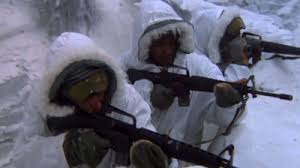
The plot is so basic, flimsy doesn’t even do the word justice. It’s Christmas time in the early 1980’s and the United States, in retaliation for Soviet aggression in Afghanistan and elsewhere, has placed a crippling grain embargo on the Soviet Union. I always thought because of it’s vast countryside and resources, the USSR didn’t need to rely on other countries, let alone it’s biggest rival, the United States, for grain , but what do I know? China couldn’t help them out? There’s no fields of wheat in Ukraine they can skim? Just bear with these plot eccentricities, otherwise, there’s no movie. The Soviets, through infiltration into the US Military likened to the Don Siegel directed thriller “Telefon”, from 1977, land a Forty man Special OPs unit into deepest, coldest Alaska. The mission? Extort the Americans into lifting the grain embargo or the Soviet paratroopers will seize and wreak havoc on the Alaskan pipeline, costing the US billions in damages.
Meanwhile, back at the frozen ranch, American soldiers at remote outposts are celebrating the holidays and are welcoming to the base a kick-ass officer, Colonel Jake Caffey, played by TV Cop Show star David Soul, whose character just happens to be freshly divorced and also happens to run in to his ex-girlfriend at the Holiday party, the alluring and ambitious Major Kate Breckenridge, played by Cathy Lee Crosby. (Yes, Bing’s real-life daughter). While Soul and Crosby exchange cringy dated dialogue upon meeting each other again, the staging of the scene is so campy it actually works in a sort of retro setting, like early John Carpenter movies. Picture the kind of transparent delivery, staging and pacing of 1950’s action movies where the film takes a break for a romantic verbal and contentious tryst. Soul and Crosby are both so blond and attractive, the fact that their scenes together come off as derivative and unoriginal is counteracted by both actors looking so conventionally appealing and trying so hard to make the pre-packaged material crackle.
There were points in this movie’s favor that made it click for me despite it’s obvious flaws that were of a simplistic and two dimensional manner. One was it’s blending of retro-action movies in terms of their tone, speed and pacing of dialogue. You could have filmed this in Black-and-White and told people it was directed by Robert Aldrich when he was having a bad weekend and nobody would have blinked. The flick seemed to have reverence for old-school cold war action flicks like “China Gate” and “Ice Station Zebra” while using contemporary gear and terms for the modern age.
So, Soul and Crosby and a ragtag group of Fourteen regulars from the Alaskan National Guard have to go out on a detail to search for a missing Guard contingent that was performing maneuvers out in a blizzard in the remote and isolated Alaskan countryside. Upon searching for the missing Guardsmen, they spy the evil Soviets through their binoculars, the Russkies have illegally crossed into US territory. The Soviets are armed, they are extremely dangerous, they kill everyone that moves and they are led by an officer played by International acting star to be, Jeroen Krabbe.

Eventually, the fates give us a series of gun battles in the middle of the frozen Alaskan tundra setting between the US and USSR over access to the Alaskan pipeline, one of the shootouts playing out in what looks to be a storage room on the NBC Network backlot or an Elementary School classroom, US and Soviet troops blaze away at each other with semi-automatic rifles from a distance that looks to be a scant few desks away. I think I was engaged in Elementary classroom games of “Red Rover” that involved more space being used. While a cavalcade of TV supporting actors are getting mowed down in these scenes, the film has a totally separate dual story line transpiring in which the Prime Minister of the USSR, played by Brian Keith (Who, while intending to play a Bolshevik with a Russian accent, comes off sounding like he just lapsed into his role of Scottish commander from “The Mackenzie Break”) engages in a negotiatory battle of wits with the President of the United States, played by Rock Hudson.
Both Keith and Hudson are actually really good in this, far above what this material deserved. Both had big careers in TV as well as movies, so this was neither a stretch nor beneath them, their performances give the movie a professionalism and a legitimate look and feel that sells the hokey material. While Keith is somewhat of a Russian stereotype, Hudson is like America’s first openly closeted President. He sleeps in bed by himself, tossing and turning, having nightmares. He is dashing looking and self-effacing by day, he’s America’s first Gay president who hasn’t come out yet. (No affront meant to fans of Millard Fillmore.)
The movie is not quite Three hours long, it was stretched out over Two nights. The direction by David Greene is effective and workmanlike, he uses the elements to his advantage, the scenes in the Alaskan outdoors are eye-catching due to the White out conditions, the best use of the conditions as a backdrop puts portions of this movie in like another dimension due to the visuals and the perception of an unyielding tundra. Scenes are either outdoors with snow-covered backdrops, inside backdrops or on sound stages acting as snow encased terrain. I doubt there was much of a budget spent on filming this.
There are some recognizable names in supports here; Katharine Helmond makes an almost irrelevant appearance early on as a Barbara Walters-like news reporter. The always efficient Robert Prosky plays a Russian High-ranking official (why is he a dick in so many movies?), one of the actors featured in “Kentucky Fried Movie”, Marcus Makai is an Eskimo National Guardsman, Nicholas Coster is the US Air Force head, James Hampton is one of the President’s advisors. Due to the film’s lack of ambiguity, the film reminds me of a film starring Ken Wahl that was released later in the same year in theaters titled “The Soldier”, what both movies lacked in depth they supplanted that with atmosphere and ambiance. Both films had synth-laden scores, “The Solider” was scored by Tangerine Dream. In “World War III” the music provides an introspective isolation to the material. The French masterpiece from 1977, “Le Crabbe Tambour” carries this same presence with it’s use of cold distant visuals and reflective overpowering music.
The haunting electronic music score by Gil Melle, coupled with the bleak, yet hypnotic expansive shot settings of the Alaskan tundra by cinematographer Stevan Larner gave this seemingly innocuous TV movie a vibe somewhere between “The Soldier”, the 60’s cold war paranoia of “Fail Safe” and the John Carpenter Horror masterpiece “The Thing”, the latter being set to be released less than Six months later in the Summer of 1982. While the script by Robert L Joseph is hammy at times, the dialogue is crisp and reminded me of past cold war thrillers that had been seen to this point, such as John Huston’s 1970 film “The Kremlin Letter”, 1965’s “The Bedford Incident” and 1968’s “The Shoes of the Fisherman”.
For a TV movie, the tech credits aren’t bad at all, the shootout scenes are credible, though one crucial ambush scene where US soldiers hide in unused pipeline tubes (in the film, the idea is attributed to US officers’ experiences in Vietnam, that it was an ambush procedure used by the Vietnamese) seemed odd after you realized the element of surprise is over, the US troops are sitting ducks for Russians who can move about freely. This movie is pre-CGI, so the shoot-out scenes look real, TV audiences at the time weren’t used to wounds and blood opening up in shootout scenes in TV movies, so this aspect made the movie appear more like a theatrical release and less like a TV show. The gun play scenes were as legit-looking as anything that was playing in theaters at the time.
As for the leads, Jeroen Krabbe is a commanding presence, you can see why he had a successful theatrical acting career, he brings a credible persona and appearance as a stoic Russian ground troop commander. David Soul literally sounds like William Shatner every time he speaks in this; his delivery, his range and temperament, one wonders if Shatner was considered for the role at some point. Soul’s character does carry a sort of “Captain Kirk” tone and stratagem to him. The girls in this movie don’t have much to do, Katharine Hellmond is maybe on screen for Five minutes, Cathy Lee Crosby looks dazzling in a Military uniform and compelling firing her M-16 at snow fatigue-wearing Russkies.
Robert Prosky is a cartoon Russian villain, looking and sounding like a Russian edition of Newt Gingrich combined with Mr. Snowmeiser from “The Year Without a Santa Claus”. Brian Keith growls and postures as the Soviet Prime Minister who is a combination of hard-line diplomat with a touch of humanitarian introspection under his hardshell exterior. He has an onscreen son in the film who speaks in Hollywood-ized Russian cliches, the Russians speak with each other like Soviets from a James Bond film. Finally, there is Rock Hudson, who seems to be channeling Henry Fonda from “Fail Safe”. It’s actually, for a TV movie, a pretty damn good acting turn by Hudson. By this point, Hudson was mainly known for TV work like “MacMillan and Wife”, his shocking AIDS diagnosis was still Three years away to the public, so there was no off-camera stigma attached to his acting legacy yet. Hudson gives a thoughtful performance as an American president that seems and feels like a combination of Gerald Ford and Ronald Reagan. Hudson and Keith together have chemistry of something reticent of Two old chess players, bristling and scoffing at each other’s moves. In one scene, Hudson shows real emotion as he begins to tear up in an emotional exchange with Comrade Prosky.

“World War III” was not a great movie, but it was a surprisingly solid one and took unusual narrative chances by it’s use of the mesmerizing music score, it’s frozen Alaskan visuals and background and it’s occasional moments of introspection as it rhapsodized on the thought of nuclear war and it’s potential effects on the global populace. While “World War III” does glorify and romanticize it’s action scenes to a point, it’s not a gung-ho film about modern warfare. The violence here is portrayed as grim, adversely consequential and potentially tragic. The movie puts forth the idea that within the Governments of the world that are nuclear armed, there is an existential struggle between diplomatic pragmatists who will risk teetering on the brink of Armageddon only as a negotiating tactic and those whose egos are two obsessed with winning at all costs to not attempt to pull out every stop in order to claim total victory, even if the results could possibly lead mankind to have nothing left to rule over.
Leave a Reply