It was mid-July of this year, I was returning from a family vacation in New England with my twenty-something son and my teenage daughter. My son Gabriel booked us a hotel room for the night in Scranton, Pa at the local Holiday Inn Express. After dining at an Asian buffet in the closest strip-mall to the hotel right before closing (they were literally tearing down the buffet as we were filling our plates, I thought with the precision and quickness that the workers were taking things apart, maybe they were about to transform the room into some kind of after hours gambling hall, like in the Sting or some shit, but I digress), it was off to the hotel where of course, the pool was out of order, so what was left to do was perusing the set-up for the following morning’s free continental breakfast in the lobby and chillaxing in the comfy hotel room with the air conditioner set to World War I Prop Plane sound mode. One of the full circle wonders of today’s future shock society is that kids today are so buried in their phones and their laptops, that they have no interest in the hotel TV anymore.
After a leisurely post-retail closure time walkabout around the nearby strip mall and Walmart parking lots, puffing on a joint while truck drivers with Caribbean accents gathered and set on the side of the curb near the hotel, smoking cigarettes in the humid mid-Summer night time, there must have been thirty trucks parked near the hotel, I had a TV remote and a big fluffy bed to spend the evening with. Clicking the remote on to TCM, I noticed they were showing a Shirley Temple movie. I realized in that moment, I had never actually watched a Shirley Temple movie, not one. It won’t be long before her earliest movies are a hundred years old.
I started watching “Little Miss Marker” from 1934 at somewhere in the middle and the mix of road lag, high test Massachusetts dispensary weed and manic hysterics in the film made for a very abstract watching experience, I thought maybe somebody sprayed my joint with angel dust. One thing was for sure, though; Shirley Temple, when she appeared on screen, was just adorable, there was something mesmerizing about her, but it wasn’t passive, languid or submissive, she was wise like a grandmother but innocent like a puppy. Watching every syrupy delivery and bubbly enthusiastic outburst, I thought to myself no wonder millions of Americans fell haplessly in love with this amazing little girl on the screen, especially as Americans were struggling and suffering at the beginning of the Great Depression, she was like a pulsing light in a deep dark tunnel of financial despair. Shirley Temple must have seemed like a tinkerbell-type cheerleader, sent from the beyond to cheer America up. There is something infectious about her charm, especially her earlier films (although they are also extremely and depressingly racist in parts), a happy accident for Hollywood in the short run.
A few days later, I couldn’t shake the images and tone from that section of “Little Miss Marker” that I viewed in that hotel room, I subsequently found the film on my favorite rogue Russkie Youtube site and watched it this time from stem to stern. After viewing it, I went on a mini-binge, watching three more Shirley Temple movies from 1933-1936. As for “Little Miss Marker”, I discovered it not only had received a dreadful remake in the early 1980’s (with Walter Matthau), it was a plot based on a Damon Runyon written story. A yarn that as a film plays as both surprisingly cynical as well as charming and at times, inspirational. Temple gives a performance that quite frankly boggles the mind when you realize that she was Five and Six years old during filming.
Before I dive further into “Little Miss Marker”, I found myself after watching it wanting to see more Shirley Temple movies, the girl was a phenomenon. One distressing fact I learned was that in at least three of her films, including “Little Miss Marker”, “The Little Colonel” and the “The Littlest Rebel”, these movies were extremely racist, including one appearance where Temple appears in blackface. The racist moments in “Little Miss Marker” were shameful in that besides the offensive imagery, they were totally unnecessary to the story. I think I would give 5-year old Shirley a pass although I am sure her Mother, if she found the material offensive, was probably given the choice by the studio of deal with it or we’ll get another Five year old. Shirley Temple movies, especially the early ones, had some strange shit going on in them including the overt racism. As Temple herself disclosed in an interview years later, she was always seemingly playing an orphan, or as I came to learn watching a few of her early pictures if she’s not an orphan at the beginning of the movie, she soon will be.
Into this strange formulaic entertainment mix of racism and child abandonment by suicide is a vein of overt child sexual imagery in Temple’s early films that seemed quite inappropriate to me, considering that Temple was as young as Five at the time. In “Baby Burlesks”, a collection of short skits involving little children playing symbolic characters, Temple plays a nubile and scantily clad waif named “Polly Tics” who appears to be attempting to snuggle with a young scantily clad Male child who is playing a young politician. I hear the argument that this is no worse than designer jean ads on TV in the early 1980’s, etc., however, it’s still creepy imagery, and definitely not cute, actually, the polar opposite.
In “Little Miss Marker”, as well as in “Curly Top”, Temple’s Five or Six year-old nipples are exposed more than once on camera. Again, this is highly questionable if you ask me and certainly by today’s standards. Despite the sketchy dynamic, Temple is a dynamo in these movies; too young to be self-conscious and full of restless positive energy. Hollywood and TV have attempted to capture her energy in a bio-pic, but it’s quite a task, you can’t CGI or cast an instinctual acting even Eight year old like that, her natural appearance is difficult to recreate in part due to her talent beyond her years. I read in a separate interview with Temple where she claimed child actors in the 1930’s at the studio she was contracted to (at age 4 and up) were put in sort of solitary confinement if they acted up on set. That if she misbehaved during shooting, the studio she worked for would have Adult employees place her in a Black wooden box meant for ice storage until she settled down. You could see children breaking down psychologically under such conditions, but Temple was made of sturdier stuff. She has given a ton of credit in interviews to the moral and ethical guidance of her Mother in navigating her Hollywood career from being a child star and on.
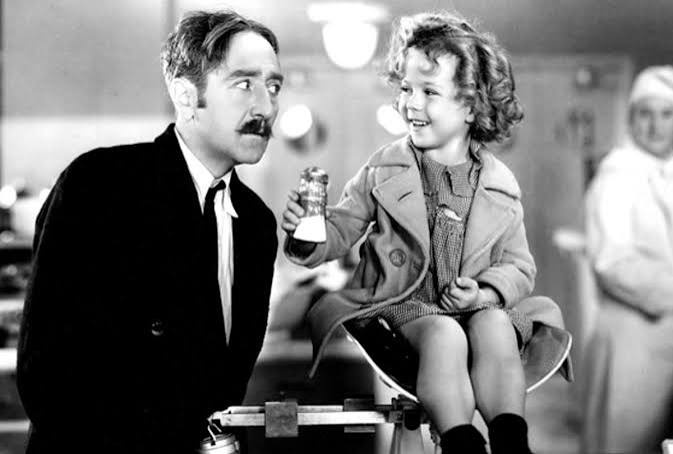
1934’s “Little Miss Marker”, directed by Alexander Hall, starts as a grown-up movie about the murky lifestyle of organized underground gambling, we are introduced to two underworld gambling figures, one is a front-lobe meanie played by the ubiquitous Charles Bickford, the other is a more reserved type, played by movie protagonist Adolphe Menjou. Into this den of inequity comes a desperate low level gambler, played by Edward Earle, with his precious Six-year old daughter in tow, a little cherub named Marky, played by Temple. In a risqué moment, the Father-low level Gambler wants to make a twenty dollar bet on a horse (we know that the race is rigged and that the father is going to lose), but since he doesn’t have the money on him, in a moment of brazenly bad parenting, the father leaves his daughter with a bookie played by Menjou, named Sorrowful Jones, as collateral. Hence, Temple as Marky is a twenty dollar marker on a horse, or in this case, little miss marker. Marky somehow gets a glimpse of one racehorse in particular, owned by none other than the sketchy figure played by Bickford. Marky has been raised by her parents on stories of King Arthur to put her to sleep so her imagination has her believing the horse is the Charger from King Arthur’a court. She is six, after all.

After the father loses the bet, he FUCKING KILLS HIMSELF off-screen, leaving Marky as an orphan. As I am learning, key components of early Shirley Temple movies were to have moments of extreme tragedy and sadness, in part to have emotion filled scenes where Shirley breaks down and cries, the kind of crying that would melt your heart. I was rather stunned how much tragic death was in early Shirley Temple films, it was part of the formula. Like watching a small child fall to pieces emotionally was some kind of fetish, a primal energy that people perversely enjoyed. These creepy components and then the fact that so much of the time she’s wearing short, tight little outfits that expose her underwear as strange Men are always passing her around and putting her in their laps, it just looks real sketch by today’s standards, like she’s part puppy, part baby bar maid.
Without going into the complete plot synopsis, since Temple has no parent or guardian, Menjou as Sorrowful Jones decides that now that he is temporarily struck with little miss sunshine, why not make her the de facto owner of the racehorse (owned by Bickford, who is on the lam from the fuzz for various transgressions) and neither Temple nor the authorities will be the wiser since the horse has a big race coming up that Menjou needs to dope him up for so he can win. Things get altered when Temple’s relentless cuteness (and catchy song-and-dance numbers) melts the hearts of Menjou and that of a club singer and gold-digger named Bangles Carson, played by Dorothy Dell. Both adults become smitten with Temple to the point that they want to Marky to retain her innocence and sense of imagination. In addition, both adults have regrets about the path in life they are on and want to go straight, due in part to the time that they have spent with Marky.
The Woman begins to mentor Temple, which of course comes with a song and dance number. Menjou begins to take fashion and grooming advice from Temple, in addition, he hates to hear her cry and he wants to reinvigorate her sense of child-like imagination. These two jaded adult characters begin the film miserable and negative, when they see each other early on they have demeaning pet names for each other, they have nothing but contempt for their fellow contemporaries, but the presence of Temple transforms them both. They don’t want to see Temple go down the path they went as children, simultaneously they don’t want to go down the path of life they are on anymore. Temple’s presence and aura has transformed them into not only wanting to change their own lives, they want to improve Shirley’s life as well in exchange for changing theirs.
“Little Miss Marker”, in my opinion, is hampered as a film for it’s galling need to include unnecessary and offensive racist sequences, scenes that could effectively be removed from the movie and not only would they not be missed, the scenes being missing would have zero impact on the picture’s effect or messaging. Besides these absolutely needless superfluous moments, “Little Miss Marker” is a blend of slapstick comedy, catchy musical numbers and allegory-filled dramedy. The film was a critical and financial success in it’s day. Through the haze of all the conflicting genres here and Temple’s dominating performance, the messaging in the story from author Runyon’s tale is that of a child’s innocence forcing adults to look at themselves and want something in life better for themselves, including caring for a child. A tale of redemption and rebirth under a witty demeanor, the movie does contain at least a couple of early sequences where nothing of importance transpires, meaningless exchanges involving grown-ups. Menjou and Dell are initially motivated by their unsavory side hustles, they become smitten with Temple and the feelings of self-redemption that her presence instills in them, they become infatuated with the idea of restoring her sense of innocence and fantasy/imagination.
They stage a Knights of the Round Table-themed dinner party in her honor, complete with adults they have coerced into attending wearing medieval costumes and they even dress the racehorse in medieval garb, telling Temple that the horse is the Charger from King Arthur’s court and that she may sit upon the horse and have a walking promenade inside the restaurant where the party is held. This set up leads to an incredibly emotional turn of events and a powerhouse climax that caught me off-guard with its intensity. Because of it’s racism, “Little Miss Marker” is certainly a flawed film, but the penultimate and climactic sequences of this early 1930’s film are unforgettable, the whimsical tone of the movie vacates in the home stretch, it must have packed quite a punch with audiences in 1934 looking for hope. It’s amazing to me, however, that Six-year old Temple had the poise, understanding, comic timing and mental acuity to be as engaging as some of the great comedians of her moment, such as the Marx Brothers, W.C. Fields, Mae West, Charlie Chaplin, Buster Keaton and Harold Lloyd.
In retrospect, the first-time viewing of “Little Miss Marker” for me supplied me with some reverence for the film; though, the child exploitation moments seem cringe and the racism portrayed here is inexcusable. Overall, I felt most comfortable in the aftermath of this picture with a new-found exuberance and respect for the work and phenomenon that was Shirley Temple. Her past press clippings and deity-like presence in Hollywood self-promotion does’t do her true abilities justice, she was a true transcendental talent, like a Louis Armstrong or Houdini. She has this kinship on screen with animals, she’s always got a dog or a duck or a pony by her side or nearby. I watched an interview that is available online from the past where she stated that once she was the headliner in films in the mid-1930’s, the studio she was employed by at the time insisted she eat her lunch away from the adults, that the lunch room of a Major Motion picture studio was no place for a Seven-Year old that was worth millions. An outdoor area with farm animals she could visit and interact with was set up nearby for her to have her lunch, that story really stuck with me. I felt a sense of a confluence of old-fashioned values on the part of the studio in regards to preserving innocence, but the catalyst is pure profit; Shirley Temple was cinematic gold at the box office, gotta protect your investment, if you’re smart.
Temple was such a commodity, Hollywood was wisest to treat her with kid gloves, that Temple became too self-aware to dominate, abuse or exploit.Temple’s performing ability, poise, self-confidence and lack of self-consciousness at age Five is nothing short of fucking amazing. I compare Temple to Armstrong not because they are identical but that both were so exceptionally talented and mesmerizing as performers that the White Male dominated entertainment world had to accommodate them. Certainly a larger leap for progress in the case of Armstrong by White society, but in both instances, there were those that wished to exploit and demean both Armstrong and Temple through various methods of mis-representation and both the talents of Armstrong and Temple were transcendental and impervious to this sort of exploitation. In the cases of both artist/performers, their bodies of work far surpassed the idea of they’re being legendary due in part to their breadth and quality, especially Armstrong.

I may delve further into a take on a later date on Temple’s culturally iconic and controversial dance moments with Bill “Bojangles” Robinson, well-known watershed and unplanned moments in American cinema history, the first of which was done in a family film that made the Confederacy to look cute and cuddly, “The Little Colonel”, from 1935. The legend I have read spoke of Temple and Robinson due to perform a tap dance on a staircase together for the 1935 film but the two of them were not supposed to touch, there was a fear that Southern theater owners would refuse to show the movie if such a scene were in the movie. A young Temple, maybe Six or Seven years old during shooting of the scene, instinctually grabbed Robinson’s hand during filming and the rest is history, the scene was so charmingly persuasive and wholesome that the filmmakers kept it in, screw the South. Temple was an artist with a talent and a power to change the world, if only slightly, with her ability to project innocence as a costume of virtue that cloaked her instinctual universal-class ability that for a few years in the 1930’s, captured the imagination of the world.
Leave a Reply