Although the history of Western cinema has contained plenty of scenarios of underdogs in sport, it would seem that the true peak of underdog sports films transpired in the latter half of the 1970’s, with some after shocks occurring on occasion, but the height of interest in this societal entertainment fad has waned. In the first few decades of the 21st century, the fascination with the underdog has dissipated, we are a culture of front runners. In this era of analytics, steroids, influencers and branding, the underdog doesn’t bring forth the same sort of societal pathos that it once did. We are a nation of overachievers who identify and cheer for the over dog, we even attempt to characterize our favorite political over dogs as having some glimpses of populist ties and commonality, which is laughable. We really don’t want to rally around anyone who has to struggle for success anymore.
Ironically, the film that gets most identified as the poster child for 1970s underdog phenomena is a film about a White guy succeeding against the odds of triumph in a sport dominated by non-Whites, that film being “Rocky” and the sport being Boxing. This setting appears eyebrow raising when you take into account that most of the money, prestige and power in Boxing was controlled by White people. “Rocky” appealed to a working-class White audience who had a difficult time supporting and identifying with real-life athletes who did not look like them, though society’s true sporting underdogs were not White. By the mid-1970’s, if you were a White Man who needed to succeed in Boxing, it was deemed that easier ways of making a living must have been beyond your grasp. Yet the working-class hardscrabble fantasy of “making it” in such a Plebian sport such as Boxing still caused a stir in the eyes of the Blue Collar class.
The need for cultural triumph and validation through the sporting vocations of the working poor was still a tangible fantasy for White America in the late 1970s. In present day Middle to Upper Class America, the potential Sports Career of a White person is deemed either frivolous by the status quo or that person is considered ego driven or it’s deemed the family hasn’t done enough to secure a future for that individual in an easier vocation. Success in sports nowadays is in unspoken terms considered a path to success for the lower classes, including minorities and others battling oppression and cultural belittlement.
Yet akin to a young career in the military, or some other harrowing line of work, a life in sports or entertainment is a dream job to many to avoid the servitude of a drab existence in corporate America. The underdog sports film, especially those of the late 1970s, told tales of Americans who sought their fame, fortune and possible relevance through performing for a niche audience who sought inspiration through a kind of physical poetry. In 1972’s “Kansas City Bomber”, for instance, Raquel Welch is a single Suburban Woman who seeks empowerment and emancipation from a Male-dominated society by performing as a violent, self-promoting Roller Derby Queen. In 1976’s “The Bingo Long Traveling All-Stars and Motor Kings”, Billy Dee Williams leads a fictitious ensemble of some of the South’s best Negro League Baseball players during the depression era 1930’s through barnstorming across rural Black America. The team struggles to promote itself separately from the Baseball White and Black establishment powers, I will be reviewing this film at a later date as it is one of the best and most relevant American films of the 1970s. Underdog sports films weren’t just about societal underachievers and malcontents, they were about cultural rebels who wanted to forge their own way in the face of the oppression of the overclass.
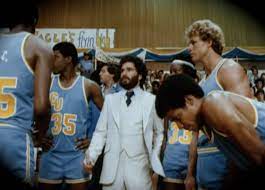
One of the lesser known and certainly lesser valued films of this cinematic trend was a minor Comedy from 1979 titled “Fastbreak”, a Comedy about Basketball. The underdogs of “Fastbreak” are Jewish, African-American and some mild, not-so-subtle references to misogyny, LGBTQ members and even transsexuals. “Fastbreak”, directed by Hollywood veteran director Jack Smight, ( A Director my Father regularly mercilessly trashed to me based on a single viewing of a 1960’s serial killer film titled “No Way to Treat a Lady”) combined several entertainment trends of the late 1970s, aside from the underdog sports film template.
For starters, it starred Television sitcom (industry slang word for “situational comedy”) sensation Gabe Kaplan, who was a success on an ABC sitcom about a wise-cracking public school teacher named Mr. Kotter, the show ubiquitously titled “Welcome Back, Kotter”. Close your eyes when you watched this show and Kaplan sounds like Billy Crystal before Crystal became famous. The show had a vaudevillian tinge mixed with the cadences of ethnic stereotyping, Kotter and his students were all either Jewish, African-American, Italian and/or they were impoverished, the show featured a young John Travolta as well. Secondly, there was a hot Dramedy on TV at the time titled “The White Shadow” (On CBS Network) about a quirky Irish-American ex-NBA player (Played by real-life ex-Collegiate Basketball player-turned Actor Ken Howard) who attempts teaching and connecting with young student-athletes in an impoverished Los Angeles neighborhood. Future Hollywood filmmaker Kevin Hooks was a regular on this show.
“Fastbreak” seemingly took these two Tv show themes and blended them into a flimsy story about an Adult Jewish dreamer who works in a Delicatessen in New York City yet still harbors a longing to become a Basketball coach as a career. He scours the wanted ads pages of the United States looking for a potential Basketball coaching job, hopefully at a College or University. His never-ending sales pitches catch the eye of a fledgling College run by rural nepotistic wealthy WASPS, who see the quickest way to moving up the ladder in the Collegiate world of prestige is by fielding some sort of successful sports team that would draw more students to their campus.
Led by car-salesman type College President Altan Gutkas (Played by John Chappell), the fictitious College of Cadwallader in Nevada is willing to cut all ethical corners to achieve this goal, including a laughable business proposition to the naive and eternally hopeful coaching prospect named David (played by Kaplan). Pay is Sixty dollars a game (That the team wins), with a three-year contract extension worth 30K a year (good money in 1979)if David can coach the Basketball team to beat the best team in the State. The best team in the state of Nevada in this film is a make-believe team called Nevada State, but any Basketball fan of that era knows that the filmmakers were referencing a real-life powerhouse College Basketball team that resided in the State of Nevada, the UNLV Runnin’ Rebels, coached by iconic Coach Jerry Tarkanian (who was referred to in the HBO’s mini-series about the Los Angeles Lakers of the 1980’s called “Winning Time”).

The job offer is ridiculous, but if David didn’t take it on, we wouldn’t have a movie to watch. David is allowed to get his potential players from anywhere and their grades are considered superfluous to the higher-ups at the College. The script (penned by Sander Stern and Marc Kaplan) pokes fun at the idea of institutional corruption when it comes to athletics and grades. The film certainly caters to the ideas of racial stereotypes and a litany of these come forth throughout the film. David recruits athletes who have been marginalized by society, all of whom happen to be African-American. They all are struggling to support themselves after High School as well, the script suggesting that it is an unspoken widely held belief that to be young, talented and Black in America (and especially living in New York City)one has to be living in a manner that Middle Class Americans could never understand nor begin to experience.
Of David’s recruits, the first is his best player, nicknamed “Hustler”, because his chosen survival vocation is hustling people older than him at Pool, like the Paul Newman character in the famous Billiards movie. The character of “Hustler” is played by none other than transcendental Pro Basketball player Bernard King, who went on in real life to be regarded arguably as one of the greatest shooters and scorers in the history of the sport. King, at the time of the film’s release, was an active Professional Basketball player on the New Jersey Nets. King’s performance in the film is extremely upbeat and sturdy, considering nobody knew he could act, I always felt it was a remarkable performance. It is almost laughable when you consider what a great Basketball player he was in real life that he would be portraying a down-on-his-luck nobody living in New York surviving off of Pool hustling.
The second character was portrayed by another actual Basketball player, this one had been a successful Collegiate athlete (he played for a couple of versions of John Wooden’s National Champions at UCLA between 1966-1968 alongside the legendary Lew Alcindor), his name was Michael Warren. Warren had a successful acting career, most notably his work on the acclaimed NBC show “Hill Street Blues” in the early 1980’s. Warren’s character in the film “Preacher” is surviving as a Religious scoundrel and Religious Semi-celebrity. In the film, his characters’ lifestyle has led him to run afoul of his higher-ups in the murky world (as it is portrayed in the film) of Urban religion, a not-so-subtle reference to the perceived violence that accompanied news events involving the American Nation of Islam in the 1970s.
The third fictitious recruit is a former High School Basketball star turned street recluse named DC Dacey, played by Harold Sylvester. Sylvester also had a distinguished acting career after this film, he starred alongside Richard Gere in “An Officer and a Gentleman”, amongst other films. The fourth and most ridiculous premise of a recruit is played by real-life College athlete Mavis Washington (Basketball star at California-Riverside), she plays “Swish”, a Female athlete who somehow doesn’t initially have an issue with the idea of pretending to be a Man to get onto Coach David’s squad. As Roberta James, she agrees to David’s insane idea that she is so talented that she will be able to compete with Men and will be able to impersonate a Man for the next four years. Again, without the leaps of faith, we would have no film. The name “Swish” of course, having a triple meaning here of referencing the sound a ball makes when it goes through a Basketball net cleanly and a term that Men use for both the physical poetry of the movement of a Woman’s behind as well as the characterization of the walking mechanics of a Man who is perceived to be a Homosexual.
Yet, these are the film’s protagonists, all societal underdogs. What’s even more ironic is that all of their perceived vices ( copious Marijuana smoking, under the table gambling and hustling) are all “vices” that half of America’s teens and twenty somethings engage in now regularly and legally. “Fastbreak” gives us characters that we can all get behind and root for and they are deemed savvier and infinitely more street-wise than the mostly White WASP populace that they are “hired” to entertain. Chappell as Gutkas and his socially awkward wealthy Hillbilly wife (played by Rhonda Bates) are seen as cunning hicks, dorks who know how to wheel and deal. When Bates meets David, she remarks that she has never met an Ethnic before, except of course, her Mexican gardener. Richard Brestoff plays Howard, the team manager, a tone-deaf Nixon supporter who is routinely attempting to get David to sign off on Howard performing dirty tricksters type operations in support of the team’s needs.
The tone of the film’s humor is obviousness, in a 70’s sitcom manner. Most of the jokes you can see coming a mile away, one’s tolerance for stereotypes would set precedence for one’s ability to enjoy this movie. The dialogue is not unlike a typical episode of “Barney Miller” or “All in the Family”. In one scene, Hustler takes David to an abandoned building to meet DC, David reacts to the site of the abandoned building where DC squats quipping, “Hey, Hustler, I wasn’t planning on recruiting any rats this season, they eat too much cheese”. When David and estranged Jewish girlfriend Jan(Played by Randee Heller, Daniel’s Mother in the “Karate Kid” movies) decide to take a shower together after David says that he has a good feeling about his new Basketball job offer, Jan retorts “I’m going to give you a good feeling, I’m going to wash your Cadwallader.”
As occasionally tiring and cliche as the characters and situations of “Fastbreak” are, we can’t help but root for the protagonists and their causes. Burt Remsen as the crusty old coach of villainous Nevada State, Bo Winnegar, is a memorable antagonist, Remsen is his usual scene stealing self. He represents the establishment and it’s haughty stance, but he’s also a regular guy with regular vices, which plays into David’s hands. The field of athletics is portrayed as a giant equalizer, the moment and living in the moment is everything.
The film, however, delivers quite a few remarks on race and homosexuality that are cringey, at best. My thinking is that the filmmakers were anticipating a working-class audience that was going to accept racial and homophobic slurs as more indication of the characters that were being portrayed rather than a philosophy that was being embraced. When David sends in some of his lesser White players off the bench during a crucial game to chastise and provoke Black players on the opposite team to violence so that those Black players will get kicked out of the game, Hustler scolds David and demands accountability. When Men confide in each other that they are strongly attracted to Swish, there is a constant need on their part to define themselves as not being Gay, that somehow being Gay would make them lesser Men.

Where “Fastbreak” carries flaws due to unoriginality (Siskel and Ebert proclaimed it to be a 95-minute sitcom episode) and moments of tastelessness and the prevailing attitudes of the late 1970’s, there is something endearing about it that makes it cheerful and memorable. Kaplan, King, Washington, Sylvester, Warren, Remsen, Heller and Connie Sawyer as David’s obvious Jewish Mother all give heartfelt performances, we care about them, we want them to win. With a catchy Disco soundtrack by David Shire and a title track by Soul Duo Billy Preston and Syreeta, if you are still watching “Fastbreak” by the time the Basketball games start in the film, you’re engaged.
The Basketball action in “Fastbreak” is quite frankly, some of the film’s strongest footage. Warren was a dynamic Guard in College in real life and it shows. Washington was born in the wrong era, she would have easily made the WNBA, and Bernard King, depending on who you are having a Basketball History discussion with, was maybe the greatest mid-range Basketball shooter of all time. This made the Basketball footage in “Fastbreak” some of the best staged Basketball footage this side of a Harlem Globetrotters show to it’s time and beyond. As a viewer of Pro and College Basketball, I still get giddy every time Bernard King touches the ball in this movie, he made professionals look diminutive at times with his skills, let alone Hollywood actors. Future UCLA Head Coach Larry Farmer appears in this movie as well, along with Laurence Fishburne, who gets an acting credit, but I am still not sure what scene he is in.
Mavis Washington as Swish, is incredibly legit-looking as a Basketball player, there had never been a Female up until 1979 that had played Basketball like her on the Silver Screen that I am aware of. When the climactic game in the film occurs against Nevada State, Swish is given a moment to shine with the Disco music pumping and the dramatic slow motion camera action in full effect. Given that her character may be the biggest underdog in the film, we are given one of the greatest sports underdog moments in movie history; an androgynous, yet sexy-looking Black Woman, pretending to be a Man, competing against macho establishment Men while the Disco “Rocky”-like soundtrack music thumps, holds the entire success of the film’s mission in her hands as the Jewish and African-American characters who have bonded together hold their collective breaths and clutch their philosophical pearls in anticipation of whether they are going to fail or succeed, it is a wet dream moment in Underdog film history.
Leave a Reply