Filmmaker and Screenwriter Paul Mazursky seems like he was a profound and deep-thinking cat, he passed away in 2014 at the age of 84. He couldn’t just make a movie about a subject, his films were wry comedies about a bunch of subjects and sometimes several styles of film within one film as well. For a Male Hollywood filmmaker he seemed quite sensitive to Women’s issues, it’s like he understood their point of view while retaining his intellectual version of masculinity. One of his earlier films from 1969, “Bob and Carol and Ted and Alice” is about free love and swinging, yet the movie doesn’t really ratify the whole concept, he actually gives the viewer plenty of evidence not to dabble in such a lifestyle. Not from a moral or religious perspective, but because the tenets of free love seem to fly in the face of the idea of genuine love for one’s chosen partner. That free love demeans the concept of devotion.
In 1973’s “Blume in Love”, Mazursky’s title character, played by George Segal, is the sympathetic hero but also the pathetic one; he can’t get back with the Woman he loves played by actress Susan Anspach due to the fact that emotionally she has defeated him. He has lost his man card to her, he can only wallow in his memories. Mazursky’s films tackled serious modern neurotic problems with humor steeped in philosophical wisdom to dull the pain. Mazursky’s films are full of therapy, much like Jill Clayburgh’s character’s shrink in Mazursky’s “An Unmarried Woman” from 1977, a Woman who listens to Clayburgh’s character’s problems and fires back answers with the precision of an MIT classroom instructor.
Mazursky had a career 2nd wind in the Reagan 80’s that as time goes on, those that understand and recall the atmosphere of that era in the United States, Mazursky’s films really charted their own headspace. “Moscow on the Hudson”, “Down and Out in Beverly Hills” and “Enemies, A Love Story” are all not only well put-together films, they encapsulate multi-dimensional messaging in addition. In “Moscow on the Hudson”, for example, Mazursky gives us a character played by Robin Williams, who joins other characters who feel a calling to America and it’s bright lights in search of a “Better life”. Most of the Americans that Williams’ Russian-born character seeks validation from are Western establishment types, who are portrayed as superficial and insincere. Williams’ character and his inner circle (his girlfriend and a kind African-American family that takes him in) are all minorities and accept the struggle that is before them, knowing that they are currently lower on the American business totem pole. Williams’ character is like a child who believes the success he has seen on American television and film will happen to him with the application of the right amount of hubris.
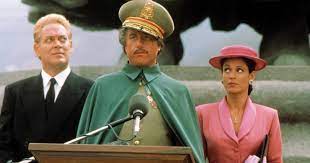
Another of Mazursky’s 1980’s films was many things, I would sub-classify it as a screwball political satire comedy, the film being titled “Moon Over Parador” from 1988. The premise on the surface (The film was mostly shot in Brazil) sounds like an updated Comedy idea from the 1930’s: A Hollywood actor gets propositioned by a Foreign Government to pretend to be that country’s president due in part to his uncanny ability to imitate the president and the president’s untimely demise during a potential revolution in the country by the nation’s underclass. The powers that be in the little fictitious Latin American nation of Parador don’t want to upset the masses, they decide that for awhile they are going to keep the status quo with an imitation of the real, now dead, dictator. The actor falls in love with the dead dictator’s former mistress, comic situations ensue. You can rest assured, however, that this witty vehicle is going to venture over into other areas with pointed messages behind smart-assed whimsical veneers.
The movie opens with atypical New York shit-talking and banter between several New York actors at a casting call, looking for work, the most notable of the actors is a short fellow named Jack Noah, played by Richard Dreyfuss. We are whisked away by a Noah told flashback (to two other actors listening) that chronologically covers a year prior, when he was making a film in the Latin American nation of Parador. It is not defined whether Parador is supposed to be South or Central America, it seems by several inferences that it is geographically supposed to be Central America, although the actual locale is Brazil. Dreyfuss is performing a love scene with a young actress (played by an even younger Dana Delany). They are watched on the set by the dictator of the country (played at times, when he is speaking, also by Richard Dreyfuss, in other scenes where he doesn’t speak, he is played by Dreyfuss’ real-life brother, Lorin Dreyfuss). Also in attendance is Parador’s Minister of Internal Affairs, played both hilariously and menacingly by Raul Julia.
When Delany’s character outs Noah as being able to perform an amazing impression of the Dictator Alphonse Simms, she does it mostly out of self-preservation, believing it will quell any notions the Dictator had of molesting her in public. Noah performs an impression of the Dictator, the Pandoran higher ups are impressed and amused. Soon the hard partying Dictator will die of a heart attack and Julia’s character (named Straussman, of all things, sounds a bit German) as the spokesman for the ruling class families that run and control the country, offers Noah a job to impersonate the dead Dictator indefinitely. A film made during the tail end of Ronald Reagan’s 2nd term in office as United States president, the parallels of a movie about an actor pretending to be president were obvious and humorous in that regard. The reinvention of the screwball comedy is noticeable as well, as a subplot of the romance between Noah and the dead Dictator’s mistress, named Madonna and played by Sonia Braga transpires.

The film is also about the politics of countries in South and Central America, especially ones that have dealings with the United States. In addition to showing the disparities between the classes in Latin American countries, the film muses on the subject of fascism, and how many people are actually ok with it as long as it doesn’t disrupt their own lives. Many seem to confuse fascism as a form of self-discipline. In fictitious Parador, fascism seems to function as long as there is great weather and bread and circuses for the masses for distraction. The only people suffering seem to be the extreme poor, and only the subversives in the country champion their plight. The film contains quite a few Nazi jokes, Nixon administration references, Neo-Con insinuations, the culture of 1980’s Westernized political conservatism is poked at by the screenplay, which was written by Mazursky and Leon Capetanos.
Raul Julia as Straussman, the smooth Government heavy, smokes a pipe like Nixon aide E. Howard Hunt and tauts his Harvard bachelor’s degree. Tourists in German Oktoberfest outfits frequent the local airport. The General Dictator lives a sort of fairy tale existence while the real power of the country lies in the hands of the “Fourteen Families” that run Parador in a clandestine manner. The role of dictator is essentially an actor anyway in the power structure of Parador. The Dictator has spent his nights partying and carrying on, he’s coddled like a spoiled little prince at night, used mainly to make speeches and commercials to manipulate the public. Singer/Dancer/ Actor Sammy Davis, Jr (A Nixon supporter in real life) appears in this movie in his best Vegas tuxedo as a favorite of the Dictator and Davis performs at large social events for the masses, exchanging superficial “I love you’s” with the Dictator in front of the populist gatherings.
As I was watching this film, I did stop and think during moments “wait, is this movie talking about a fictitious Latin American country, or is this an analogy?” It appears that Mazursky was having fun with this vehicle and used it for simultaneous messaging. The movie contains an all-star cast of sorts: Dreyfuss, Delany, Julia, Davis, Jr, Braga, Jonathan Winters, Fernando Rey, Charo, Ed Asner, Dick Cavett and Polly Holiday (who, at the time was a very popular American TV actress from the CBS sitcom “Alice”). Winters, as the local CIA attache’ is hysterical, I agree with Roger Ebert when he remarked that Winters isn’t on screen enough in this movie, something about Winters’ delivery is just infectious. Years of performing and joke telling made him rock solid, akin to a Rodney Dangerfield or Don Rickles, just flawless, with no hesitation. When Winters utters the simplest phrases that accentuate his American diplomatic tackiness, such as oggling over Braga’s “hooters” or mentioning that he has to “take a dump”, I wanted more, he is only on screen 5 or 6 times, each time it takes the entire film up a notch.
Braga is quite alluring, sympathetic and charming in the quintessential stereotypical Sonia Braga role, the exotic dancer with the heart of Gold. Her character named Madonna is also a child of the barrio and secretly wishes to right the philosophical wrongs of the country’s government manifesto, especially those aspects that are aimed at controlling the country’s poor. The film edges into the territory of being a liberal political fantasy. Braga and Dreyfuss have a quirky romantic chemistry. Though she seems decidedly taller than him, we don’t think they are really going to last, just a romantic comet for our temporary enjoyment. They have old school screwball comedy energy together, like Irene Dunne and Cary Grant, or Tracy and Hepburn, there is patience and understanding in the dialogue, the dynamic between them plays out well in this idiom.
Veteran performers such as Fernando Rey, Charo, Davis, Jr and Holliday bring a fresh entertainment jolt with their presence, Mazursky creates almost an American variety show energy with his cast, I always thought Holliday was funny and unique and in her brief scenes in this she is hysterical as Winters’ often inebriated wife. Mazursky always seemed cutting edge to me to the point that casting the movie the way he did gave it a freshness and a retro feel to it’s rhythm. Davis, Jr appears early in the film, singing arrangements that I assume were penned by film score composer Maurice Jarre. Jarre writes a bouncy, happy score here, it could have been the music for “The Three Amigos” and nobody would have noticed. The scenes with Davis, Jr are well done musical numbers and provide a certain amount of self-satire. The original Paradoran National anthem sounds like a blend of “Here Comes the Bride” and “O, Christmas Tree”, Noah as the dictator changes the National Anthem to make it sound like “Besame Mucho”.
Finally, there is Richard Dreyfuss as the lead character and super-ego of the movie. Dreyfuss’ performance is glib and self-effacing, it’s hard not to find yourself imitating him long after the film is over, especially when he is constantly changing his voice to a gutteral growl to appease Straussman. For at least 80 minutes, the movie keeps a rapid fire of steady jokes pace, the pace interrupted by a sequence in which the revolutionary guerillas interrupt an event where the Dictator is speaking. The veracity of the action is so convincing and accurate-looking, all of a sudden everything isn’t funny for a moment.

“Moon Over Parador” contains quite a few inside jokes. In a potential “1984” and pop-culture reference, instead of everyone in the country having to do morning aerobics in the morning isolated, Noah as the Dictator takes his 1980’s aerobics-craze sensibilities to the people and implores them to change their unhealthy National diet and partake in silly morning “Richard Simmons”-style morning aerobics with Noah leading the exercise over a National TV news feed. Eventually Noah becomes bored with playing the same character every day and begins reading the wanted ads of the New York Times in private, searching for roles he wants to play and return to his old existence, a comment on actors and their restless contrarian nature.
The film continues to drill down throughout on the parallels between the world of theater entertainment and political theater. When Noah threatens to not follow through on a task given to him by Straussman, Straussman threatens to kill him. Noah responds “You ought to be a Director.” Winters as the CIA contact gives a blistering speech on United States foreign policy doctrine historically to Noah as the Dictator (not knowing that Noah is portraying the Dictator, Winters still thinks the Dictator is still alive). The speech seems to mirror the actual involvement that the United States has taken in such countries as Cuba, the Dominican Republic and Venezuela, just to name a few examples. The chemistry between Noah as the super ego extension of the audience and Straussman as the representative of Neo-Con Neo-fascism is enlightening and perhaps the best banter and chemistry of the film. Mazursky’s version of Orson Welles and Joseph Cotten performing philosophical bantering battle over hot-button topics of the day. Braga as Madonna attempts to bend Noah’s ear to the plight of the poor of Parador and their rightful legacy to prosperity makes for serious dialogue in comedy sheep’s clothing.
The screenplay never stops winking at the audience while delivering real-time humanitarian and geo-politically tinged humorous observations. It’s as if Mazursky took elements of Oliver Stone’s grim diatribe film on El Salvador from 1985 and changed it into a biting satiric comedy. I am not sure a movie like “Moon Over Parador” gets made in today’s corporate and fascist-friendly climate, the film takes so many swipes at corporate interests, American imperialist policy and the Foreign super-wealthy. When I consider the film’s glib tone, I can’t help but think that the next time a former actor or performer (taking into consideration that the courageous leader of today’s embattled Ukraine is a former stage performer) takes over the presidency of the United States, that he or she may well be a shill for the super wealthy as in Mazursky’s script here and the results may end up being not funny at all.
Leave a Reply