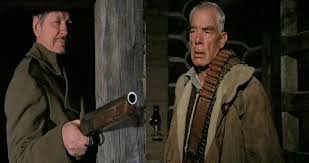
While this review is not intended to be a nomination of this film as a Christmas or holiday movie, since many online have such compelling arguments over what the parameters for what qualifies a film to be considered a holiday film or not, I would consider the events of this film to be pertinent, since the real-life events depicted in this movie supposedly took place between November of 1931 and February of 1932. I only believe the modern culture has begun these frivolous debates due to the Male loner crowd feels left out of the deluge of Holiday films from Cable, even my 78-year old Dad watches Lifetime Christmas movies and portends to weep like a baby with a new scratch from a cat. The old tradition of watching profound fare, such as “It’s A Wonderful Life” or “Holiday Affair” on network TV was being shown the door by countless films on Cable about Women in their 30’s and beyond meeting the Metrosexual Cowboy of their dreams, who just happens to be in town, and hooking up with him under the mistletoe.
While there are no Holiday decorations in this movie, this early 1980’s action movie, is based on a true story, or a true series of events. “Death Hunt” from 1981,(AKA “Arctic Rampage” and “Yukon”) was directed by Peter Hunt, who also directed “On Her Majesty’s Secret Service”, amongst other works. The film wants to be perceived to be in acquaintance with macho male culture, the idea of Men living in the wild (in this case, the Yukon of the 1930’s) for some is a kind of Masculine fantasy, where there are no rules or laws. Men living off the land and setting their own parameters. “Death Hunt” is structured like a Western, has locales and sets and costumes like a period piece and is also a Charles Bronson action movie. If you are familiar with Charles Bronson action films, you know that they typically consist of the same properties; high on action, short on dialogue and they usually contain a high body count by the story’s end.
Loosely based (Emphasizing loosely, for sure)on the true story of Yukon fur trapper Albert Johnson, known to people in the area of Aklavik, which was a Canadian Northwest territory, as the “Mad Trapper of Rat River”. In real-life events, Johnson was accused by other trappers of sabotaging their equipment and impeding their ability to make a living trapping. When Royal Mounted Canadian Police were called in to confront Johnson, Johnson eventually shot two of the officers in separate events, killing one. This led to an almost 2-month manhunt through the Canadian wilderness and the Canadian Rocky Mountains. It is believed some of the manhunt took place in the midst of temperatures that at times reached -40, which seems incredible. The pursuit of Albert Johnson by Canadian Royal Mounted Police lasted 48 days through rugged mountainous terrain.
Twentieth Century Fox, of course, took liberties with this tale and transformed it into a nihilistic Sam Peckinpah-esque shootout pic. Screenwriters Michael Grais and Mark Victor penned a version of the Albert Johnson story with some of the true-life events left intact. The pursuit of Johnson did include a real World War I era biplane to locate his position in the mountains. Dynamite was really used to blow up Johnson’ s cabin and Johnson did survive the attack. There were quite a few liberties taken with the storytelling as well. The real Johnson was characterized as a Scandinavian who spoke broken English, he is played in the film by Charles Bronson, and the character in the film is described by Canadian authorities as having an extensive US Military record, he’s an ex-Military bad-ass. As I was describing this movie to a friend, I explained that Bronson is a “Pre-Rambo Rambo” in this film. Bronson’s Johnson is a zen hermit who lives in the Canadian Mountains, he has a nifty collection of rustic threads that look like the Winter collection from Gander Mountain. He lives in a quaint Mountain cabin that looks like an enlarged tiny house that you find for sale in the back pages of an Airline magazine. Bronson as Johnson is living his best zen loner life.
One of “Death Hunt”‘s best attributes is its’ use of the Canadian Mountain locales. The cinematography for “Death Hunt” by James Devis is breathtaking, much of the filming was done near the mountains close to Banff in Alberta, Canada. Long drawn-out pans of the snow covered Mountain ranges (seemingly taken by helicopter) are spectacular and along with Jerrold Immel’s music score (which sounds quite a bite like a John Williams’ impersonation), the opening credits of “Death Hunt” have a majestic quality to them, both Devis’s and Immel’s work throughout the film are superlative. As the credits wind down, we are introduced to a stoic, no frills Johnson, riding on his horse, down from the mountains to the nearest town along the Rat River. The town, of course, is a hive of scum and villainy, mostly desperate men looking to make a fortune from trapping and/or panning for Gold, with not too much success at either trade. Johnson happens upon a group of these wretched individuals, led by the brutish Hazel (played by action film mainstay Ed Lauter)as they are fighting their dogs to the death during the day, because back in them days, Dog Fighting was not a felony, it was just considered to be a real shitty thing to do.

Johnson does not appear to like most people, but he does appear to have a fondness for dying animals. He pins Hazel to the ground with his boot in front of everyone at the Dog Fight and throws $200 in Hazel’s face to take the Dog in the Fight that is near death. After Johnson leaves with his new Canine friend to take him back to the Mountains and heal him back to health, Hazel swears vengeance on Johnson for humiliating him in front of his cutthroat peers. When Hazel attempts to enlist the aid of the local authorities, namely the Royal Canadian Police, the local Police tell him to get over it and forget about it. The Police are led by hard-drinking Sgt. Millen (played by hard-drinking Lee Marvin), Sun Dog George Washington Lincoln Brown( played by an energetic and philosophical Carl Weathers) and fresh-faced newbie Constable Alvin Adams (played by Andrew Stevens). Hazel and his hardened incell cronies decide to take justice into their own hands by descending on Johnson’s outdoor cabin themselves, which for those in the know about Charles Bronson films, know it’s an errant thing to do. A well-armed and well-prepared Johnson blows one of the theoretical invaders’ domes off and the ensuing violence and constant chase scenes of “Death Hunt” are off and running.
”Death Hunt” was savaged by critics as dull, predictable and lethargic upon it’s release, it was originally supposed to have been directed by Robert Aldrich. Aldrich balked at the project when told of the film’s production budget, he thought it should have had a bigger budget, so he quit. “Death Hunt” seems much more appealing in the rear view mirror of time. For starters, the look of the film is engrossing. With real Canadian Mountain locales, long drawn out shots of Mountain panoramas, the visuals are snowy eye candy. Immel’s score is perfect, it builds tension when it’s needed and accentuates chases and pursuits. Dog-sled teams go after Johnson through the icy tundra to pulsing cadences by the Orchestra and the unsettling sound of dissonant screechy strings are used to set up shoot-out scenes. During scenes of long sequences of compelling dialogue, there is no music cluttering up the effectiveness and gravity of the spoken word. Although I would have preferred Aldrich at the helm to smooth out some of the clumsy narrative transitions in the film, Director Hunt does a respectable job of story telling, though some of his methodology is predictable and telegraphed.
The film essentially gives us three points of view: One is Johnson, the lone-wolf and well-dressed zen survivalist. The second is that of the jaded and coincidentally group that is full of espirit de corps, the Royal Mounted Police contingent. Finally, there is the mangy militia of locals who seek to catch and kill Johnson for the bounty that has been put on his head. The behavioral dynamic of the local militia seems extremely similar to the bumbling bounty hunters from Peckinpah’s “The Wild Bunch”. The locals are portrayed as a bunch of greedy rubes; short on intelligence and imagination, long on greed and short-sightedness. It’s interesting that while I would never put “Death Hunt” on the same par with Michael Cimino’s brilliant and haunting “Heaven’s Gate”, “Death Hunt”, made the same year, has a similar genuine historical look to it, the details given to make the sets, characters and mannerisms appear to look like the 1930’s in the Yukon are quite believable and effective.
Bronson as Albert Johnson is a typical Bronson American Samurai performance. While many of Bronson’s action films from the 1970’s through the early 1990’s kind of blend together for me, Bronson’s screen personality is endearing. As viewers we don’t want a variance, we know what we are going to get with Bronson and we prefer it. Bronson is statuesque, a man of few words, but he always looks dazzling in some chic Eskimo gear while holding a rifle or catching a fish out of a frozen lake with his bare fucking hands. Bronson was 58 years old when “Death Hunt” was released and he looks fantastic; debonair and rugged. His cabin looks immaculate, with perfectly procured Jerky strips hanging astride his cabin. Johnson is always improving his property (when he’s not on the run from the fuzz) like a renaissance hermit. In addition, he creates a well fortified Cabin, even surviving a dynamite blast by digging himself a foxhole in the middle of his dining room floor.
The best dialogue scenes in the film involve the police contingent, led by Lee Marvin as Edgar Millen, the Police Sergeant. The only women we get in the film hang out with the cops, it seems. One is played by Angie Dickinson (In a totally wasted role, from what I read she only made the movie to star along with Bronson and Marvin.), her character is a lonely widow who becomes smitten with Millen. Tantoo Cardinal plays “Buffalo Woman”, a chubby Eskimo who desires being passed around the Royal Mounted Canadian clubhouse for sex by the officers. In one witty exchange between Millen and Sun Dog, Millen admits that they all may be too old to keep up with Buffalo Woman’s sexual appetite. Sun Dog declares that Millen must be speaking for himself. Marvin as Millen pauses, takes another shot of Whiskey and retorts, “I am speaking for myself”. The scenes of camaraderie and ball busting among the Mounties and their entourage involving Marvin, Weathers, Dickinson, Cardinal, Stevens and Jon Cedar carry a surprising amount of humor, candor and philosophy. Weathers as Sun Dog wears down Adams on the idea that he should have sex with Buffalo Woman due to the fact that Dickinson is taken and there isn’t another Woman for potentially hundreds of miles, and Weathers needs a break.

Other notable actors in the film are Henry Beckman as creepy Bill Luce, who may or not be committing crimes that Johnson is getting blamed for due to his notoriety. William Sanderson(The little lonely guy who finds Darryl Hannah in “Blade Runner”) and Maury Clayton as two of the greedy locals are familiar faces and do a solid job as members of the militia. The largest advantage that “Death Hunt” has for me is the test of time, films nowadays do not have the convincing look and authentic feel for this kind of genre anymore. The characters in this look and sound like hardscrabble Men, there is a persuasive hue of old-World macho culture in this film. Shoot-outs in this look and sound authentic, there is no CGI, so when Bronson blows a hole in a potential cabin invader, it is extremely potent looking. When Weathers as Sun Dog (In the film, his character is a former Baseball Player, in real life, he was a member of the NFL’s Oakland Raiders)makes a perfect dynamite toss that destroys Johnson’s cabin, Johnson rises from the destruction like a vengeance-filled character from a horror movie, the night time scene is chaotic and exclamatory. The long scenes of snowy pursuit set up the scenes of fast brutal gun violence with an unnerving sense of anticipation. While it will never by confused with a profound cinematic standout, for all it’s visual splendor, “Death Hunt” would have made a fantastic Omnimax film.
Leave a Reply