The year 1977 had a look to it that was distinguishable. I was nine years old then and my sister and I took a mid-Summer cross-country trip with our Grandparents on my Father’s side from Boston to Seattle which included driving and staying through wide swaths of the Northern Midwestern States and Canada. Wide-bodied hard metal gas-guzzling cars were everywhere you went in those days, Granny would get excited about finding gas stations that sold gas in the 50-cent per gallon range. There was loud signage on the side of city streets, whether we were in Duluth, MN or towns in Ontario Province, the signs in big block letters and primary colors, advertising for car dealerships or insurance firms. We passed through Montreal, Canada at the beginning of the trip; it seemed like a bustling city, with French and English directions and signs on display. Granny’s car in the Summer time smelled like hot leather and stale cigarette smoke. I thought everyone in their 60’s smoked back then.
In the present day, I went down a Patrick McGoohan internet rabbit hole one night, somehow ending up starting to watch an obscure movie that McGoohan filmed in 1977, but was not released until 1981. The movie had a cool sounding name, “Kings and Desperate Men”. The film was made on a budget of $1.2 Million dollars, certainly not a king’s ransom. The title is derived from a line from a poem by John Donne titled “Death be not Proud”. The movie has a Documentary style look to it, sort of like Haskell Wexler’s “Medium Cool”. Scenes with choppy, news coverage-looking tracking sequences where characters are followed down hallways by unsteady camera work, lots of external sounds like commercials or men on walkie-talkies. This movie looks like 1977 like I remember it, regardless if it was filmed entirely in Montreal, Canada during the Winter. The opening credits include multiple shots of life in Montreal on Christmas Eve, especially wide framed shots of large groups of people in motion. In one scene of the opening, hundreds of appropriately dressed people are skating around the track of Montreal’s historically famous Olympic Stadium on a Sunny, blustery Winter Canadian day. They skate to music that is playing from loud speakers, the music sounds like some Ancient Christmas music from the Renaissance, music from a time of feudalism and Kings and their castles.
The narrative from the opening from this film, which had included a multitude of shots as if they are being filmed by a local news team, begins with not just the random shots of Montreal, but also a mysterious unseen pair of people in a smaller car discussing mundane issues as the Woman of the pair eventually exits the car on foot in a wealthy neighborhood after several cut in scenes of the two of them in the Man’s car. The film after the credits moves to an interview going on at a local prestigious radio station conducted by an establishment-friendly conservative radio host as he is leading a Christmas Eve interview. The radio host, played by McGoohan, is interviewing a Judge who has just ruled on a case where a police officer was inadvertently killed by a rogue car driver. The radio host then proposes Devil’s advocacy by asking the Judge if the guilty sentence of 15 years he handed down was too harsh a sentence. The Judge responded dryly that he sentences the guilty based on their crime and not whom they have transgressed against. That all are equally innocent and/or guilty in the eyes of the law.
The film changes direction as the acid-tongued radio host, John Kingsley, and the Judge Stephen McManus (played by Canadian actor Bud Knapp) leave the modern and minimalist-looking radio station for a high society Christmas party at the home of the owner of said radio station. At the affluent soiree, Kingsley continues his routine of daily libations, he is so far gone in his drinking, he moves the boom mike around in his radio station studio so he can pour himself a drink while he is talking on the air. His open excessive drinking is an embarrassment to his present elegant and educated wife Elizabeth (portrayed by Margaret Trudeau…the same Trudeau who is the real-life Mother of Canadian Prime Minister Justin Trudeau). As the party winds down, the film’s plot tightens. In three separate locations, Kingsley, the Judge, and Kingsley’s Wife are all inexplicably taken hostage by self-dubbed counterculture terrorists in three separate locations. Under the banner of social justice, the terrorists’ aim is to have the conviction of their friend, the police officer-killing driver, re-litigated.
The counterculture terrorists are led by a former school teacher named Lucas Miller (played with conviction by Alexis Kanner). Miller and his attractive agitator girlfriend Barbara (played by Andrea Marcovicci) take Kingsley hostage at the now booby-trapped with explosives radio station by initially using Barbara as bait, she sneaks into Kingsley’s car while he is getting sloshed at the affluent party and then charms him into thinking he is going to get some if he takes her back to the closed-for-Christmas Eve radio station studio of his. Meanwhile, Elizabeth and the Kingsleys’ special needs’ Elementary School aged son are being held against their will at their high-rise apartment building. At the same time, the Judge has been whisked away to a clandestine location and is also being held captive. Once these stark actions are put in motion, the film becomes an hour and a half of a challenge of philosophical and psychological wits between the conservative outspoken Kingsley, his establishment-raised Wife, the Judge and their respective captors, the latter being a group of Left-leaning minded citizens, who have bound together with the similar objective of altering society’s view of justice and who it affects. To further the tension and melodrama, the conversations between Kingsley and Miller will be heard on the airwaves of Montreal as long as SWAT teams cannot figure out how to disarm the explosives attached to the building where the radio station is located as well as the high rise where Elizabeth and her son are residing.
The actions in the film transpires on Christmas Eve and Christmas Day, the concept of a plot about a hostage situation in a big office building sounds familiar, but I would argue on behalf of “Kings and Desperate Men” that it is about much larger thoughts on life than the subsequently made and enormously more successful “Die Hard” film. The creators of the former film, in somewhat of a legal stretch, attempted to sue the makers of “Die Hard” years later for plagiarism, claiming that the 1988 American action flick had veritably far too many plot devices similar to the 1981 released Canadian film. Predictably, the lawsuit failed, “Kings and Desperate Men” is a slow watch, many scenes happen in real time, with dead air pauses for dramatic effect. There is an original soundtrack beyond the constant antiphonal music, we are never really sure if the extraneous music and sounds are coming from the radio station’s feed. The soundtrack by Pierre F Brault and Michel Robidoux sounds like two dudes on dueling synthesizers, playing indiscriminately, and yet, it works. The off putting timing and probing, questioning nature of the music provides another layer of intrigue and haze-like tension. The music either arrives in short electronic bursts or moody thought-riddled mantras.

Quite a bit of time is spent with the characters in this, it flows almost like an avant-garde theater play. In one early tense sequence, the two kidnappers who are in charge of holding Elizabeth, her son and their cigarette smoking old babysitter show themselves to be idealogically far apart as self-proclaimed anarchist terrorists. The first, Leo (played by Kevin Fenlon) seems like the archetype of the public perception of the young punk-rock anarchists that were about to become a movement in Europe, Canada and the United States in the coming years; he’s brazen, not extremely well-educated, violent and depraved. Leo watches Elizabeth in the bathroom when she thinks she is alone and in the aforementioned earlier scene, suggests to Elizabeth that he should euthanize her son since the child has been diagnosed with a learning delay. Elizabeth, an elegant, athletic and erudite looking Brunette with an educated appearance responds that the crew-cut young terrorist would have to kill her first. The second kidnapper, named Henry (played by Canadian actor and Documentary filmmaker Robin Spry) is disgusted with Leo’s lack of integrity and use of terror in handling a small child. To make amends, the much more sensitive and flower power leaning Henry reads the opening of the Children’s book “The Wind and the Willows” to the child as he lays in bed to try to help the child go to sleep and to assure Elizabeth that not all of her captors are unthinking primitive barbarians.
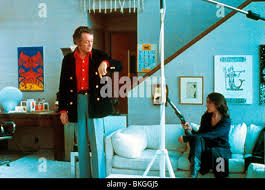
The film overall, really belongs to Patrick McGoohan as Kingsley, just a tour-de-force. Second to that is the chemistry between McGoohan, Alex Kanner and Antovicci. McGoohan is on screen quite often, he has a considerable amount of dialogue for a two hour movie and it is a remarkable effort. Every speech of his carries a certain amount of spark and impassioned dialogue, McGoohan and the screenwriting team of Alex Kanner (who also directed) and Edmund Ward have a pointed dialogue in mind that unfolds on screen between Kingsley and Miller, the schoolteacher. McGoohan as Kingsley carries his character with a certain amount of self-proclaimed dignity. Throughout the film, Kingsley is portrayed as a raging alcoholic, dawn til dusk and beyond. Kingsley’s speeches are delivered with a kind of machine gun precision, followed by lulls and pendulum swings to his timing, it’s a mesmerizing performance. His character empathizes and simultaneously toys with his adversaries in addition to his superiors. In another tense sequence, the conservative Kingsley grabs the barrel of the sawed off shotgun that Barbara is threatening him with and presses it against his chest, daring her to shoot him in a moment of drunken macho defiance. In addition to exposing his adversaries to his own suicidal tendencies, Kingsley has humiliated Barbara in a show of psychological power.
Once the plot begins to unfold during and after the affluent Christmas Party, there are quite a few organizational scenes of officials, radio station executives, legal experts, police, etc gathering to create and execute plans to confront the kidnapper/terrorists. These scenes, since the entire film has sort of a Documentary look to it, come off a majority of the time as appearing quite authentic and believable, very informal and off-the-cuff. The scenes are also quite dry; the low budget look and unproduced style almost gives one the feeling that we’re watching a news report, but that organic feeling I got from these scenes had an impact the longer the film went on.
In a dark basement, somewhere in Montreal, armed men keep Judge McManus captive in a dank, concrete emboldened isolated home. The men offer the elderly Judge a warm blanket and warm Coffee as he smokes his pipe and waxes on to the kidnappers about historically Canada had never been known for having impassioned anti-hero criminals of the people, such as the United States having beloved criminals like Billy the Kid, Jesse James and Bonnie and Clyde. The Judge is then interviewed through a scrambled telephone by Kingsley and Miller from the radio station studio. Elizabeth and the Kingsley’s child are held captive in their high-rise apartment, while the rest of Montreal listens to the debate between the conservative Kingsley and the angry radical liberal Miller on the radio, the broadcast is seemingly being played everywhere in Montreal.
Miller brings forth the facts that his friend, the man convicted of vehicular manslaughter, will be given a sentence of 15 years for killing a police officer with his car, while multiple previous vehicular manslaughter perpetrators (who had killed non-police officers) in the local jurisdiction had all received sentences of 2 years or less. (which sounds low to me for killing someone with your car, but I digress.) Miller’s point seems to be that Canadian justice is more linked to status than equity. Miller wants to have as many callers with relevant messages and facts to the case to call in to the radio station and then have citizens call in their verdict as to whether they believe the guilty driver should be still proclaimed guilty or given a new trial to protest his innocence.
Kingsley and Miller have an on-air debate which spans a wide array of civil, social and political subjects. Kingsley snaps at his establishment boss when the boss over the phone suggests that Kingsley keep the hypothetical on-air conversation toned down so as to not offend the station’s sponsors. Kingsley responds to his superior that all FCC rules are out the window in his mind due to the fact that the kidnappers have a shotgun pointed at his stomach and his wife and child are sitting next to a room that contains at least 20 pounds of dangerous explosives. It is a moment in which Kingsley displays that he believes in a moral atmosphere beyond conservative protocol. Kingsley performs his on-air work with a sense of philosophical whimsy as well as professional indignation. When Miller complains that Kingsley should not be cutting to commercials and taking calls from radio call-in guests who have nothing pertinent to add to the proceedings at hand, Kingsley attempts to explain to Miller that the latter simply doesn’t understand that since Miller chose this forum as his delivery service for his personal public manifesto, he has to follow the script and form of commercial talk radio. Each man has the other in a form of captivity, Kingsley is much more seasoned at this type of intrigue, however, he rarely breaks from his on-air personality, except in moments of personal outrage.

As all of Montreal listens, citizens call in to the program and either spout off an unsolicited opinion on the situation they are listening to or they recite social commentary, their personal beliefs or passages from the bible on air, as SWAT teams surround the radio station and the high-rise. People in the freezing streets of Christmas Day in Montreal listen to the goings-on on the radio as the local newspaper headlines scream out about an urgent hostage situation. Due to extenuating circumstances, Kingsley, in a moment of rage, loses his cool and attempts to strangle Miller while Barbara casually cocks and readies the sawed off shotgun to be fired directly at Kingsley’s head if he doesn’t come to his senses. Kingsley is human, the events and lack of alcohol in the radio station studio have brought him to the breaking point. Miller and Barbara are beginning to understand that they have potentially bitten off more than they could chew, that they had taken on not just the wealthy, but an entire social apparatus built by the wealthy for their own personal public enshrinement. The system that they are confronting is a mechanism that is not simple and does not feel the need to be coerced to change. This system’s mouthpiece is Kingsley, who’s veiled tauntings are perhaps bringing the frustrated and idealistic Miller and Barbara closer to pulling the trigger of the shotgun and killing him.
Where the more obvious and popular American film “Die Hard” took this Christmas thriller premise and filled it with non-stop action and body counts that in the end were not about anything beyond titillating the viewer in a momentary fashion, “Kings and Desperate Men” provides moments of human tension without action, but the specter of incessant potential unrealized violence with a tangible civic concern. Kingsley runs out of Vodka in his personalized studio at one point and now he is definitively askew. He takes to dancing around the studio in a scarf and hat like a Musical Theater showman, singing “McNamara’s Band” to Miller and Barbara as if to mock them as they keep the shotgun trained on him. Kingsley remarks that he has never felt so powerless in his life as an intellectual establishment conservative that he felt the need to take up arms and right the world’s wrongs at gunpoint out of sheer frustration. As the film cuts occasionally to scenes of bored SWAT teams checking the aforementioned buildings for hair-triggered bombs, it also shows civic leaders and conservative media types huddling together, as if to say that the authorities work in conjunction with the media at the behest of the ruling class.
”Kings and Desperate Men”, due to it’s clever device of delivering it’s grass-roots message on societal debate, along with the transcendental performance of Patrick McGoohan, is in my estimation, an accidental cinematic mini-masterpiece. One or two clumsy, amateurish sequences aside, the movie has a dry, infectious style. McGoohan had been one of the creators and innovators of a British TV show from the late 1960’s titled “The Prisoner”, a heady show which seemed to mask large-scale issues regarding history and society through an espionage and science fiction type setting. Reading some background on “Kings and Desperate Men”, it seems that it is retroactively acknowledged that McGoohan and Kanner were regularly highly intoxicated throughout filming. Some on set were reputed to refer to the film as “Kings and Desperate Crew”. However, each Man’s performance appears extremely sincere and focused, the alcohol fueled performances came across with conviction that was laser-sharp and direct. Kingsley and Miller seem to want to play out this philosophical confrontation to some sort of satisfactory conclusion, yet we the viewers know that this debate will have no tangible result, only a reshuffling of the public’s momentary value systems.
The film brings forth the idea that modern society needs meaningful and cathartic dialogue between it’s polarized sides. That one side, that of the status quo, uses Holidays such as Christmas to control the behavior and timbre of the masses, that in these times of social isolation, they are the optimum moments to discuss the meaning of society’s role in people’s lives. That the masses are encouraged to use times of reflection as moments of shared peace and kindness by an overclass that never stops monetizing, profiteering from and controlling every moment. Even as Kingsley offers his call-in guests to give their guilty/not guilty verdicts on the death of the policeman in regards to the driver, the idea that people’s opinions have been pre-shaped by media influence is decidedly inferred. The ending of the movie is jarring and thought-provoking, a fitting profound conclusion that left me with even more inspiration for dialogue on the myriad of social concerns that this film raises. This obscure film needs either a reboot or a resurrection, it shows that 1977 in Western society was a different time and place, one that maybe needs to be intellectually and spiritually revisited.
Leave a Reply