My dad had an amazing record collection of old 45-rpms that he kept in 3 or 4 hard cardboard or wooden boxes, the boxes were no bigger than a small tool box or bait case but they could house up to 50 small record discs a piece, the records were no wider in their circumference than a small salad or dessert plate. The records were all from the 1950s and early 60s, audial Americana, the birth period of American Rock and Roll. Dad collected songs by such performers as the Platters, Bill Haley and the Comets, The Coasters, Jerry Lee Lewis, Bobby Darin and Chuck Berry, just to name a few. One night, he was in a good mood and pulled out a record from one of the boxes that was in it’s own special sleeve, he put it on and it sounded like a military marching song. I was 7 or 8 years old at the time and I thought anything and everything that had to do with war was cool.
The song was by a 1950s singer named Johnny Horton and the song title was “The Battle of New Orleans”. Being a self-proclaimed war buff at this tender age, I was surprised to hear from my father that America had been engaged in two separate wars with England, not just the well-known American Revolution. He told me that the United States had kicked England’s ass at the battle of New Orleans so badly that the event was immortalized in song. I remember the refrain the first time I heard it: “We fired our guns and the British kept a comin’, there wasn’t as many as there was awhile ago….we fired once more and they began a runnin’, on down the Mississippi to the Gulf of Mexico”. As a White American child, it seemed like such a pro-American patriotic ditty, full of jingoistic enthusiasm and populist American bravado. Having always been intrigued by the events surrounding the Battle of New Orleans since I was a child, I recently learned that today, January 8th, is the 209th anniversary of the famous battle.
As with most seminal moments in American Military and Historical chronology, American Hollywood had made a couple of movies concerning the Battle of New Orleans, both films centering around a larger than life character who played a vital role in the surprising military upset by the Americans against a vastly more seasoned foe, the Army and Navy of Great Britain. This character in question, interestingly enough, was not Andrew Jackson, the controversial Historical figure who is credited with leading the American Army in the battle and later is hailed in subsequent years for being a stalwart US President and simultaneously vilified for being a slaveowner and his bleak genocidal treatment of Native Americans.
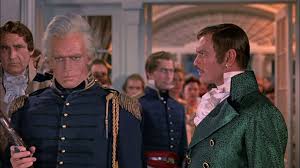
The focus of a 1938 film titled “The Buccaneer” was a French-born Privateer (Or Pirate and Smuggler, depending on one’s outlook) named Jean Lafitte, a real-life figure who lived between 1780 and 1823. The 1938 film starred Frederic march as Lafitte, the film was later remade in 1958, produced by Hollywood schlockmeister Cecil B DeMille, who was fresh off of making his iconic one-for-the-ages Bible mega-blockbuster “The Ten Commandments”. DeMille was well known for taking momentous Historical and literary events such as the tale of Samson and Delilah, the story of Moses and the origins of the Union Pacific Railroad and turning them into action filled melodramas, coupled with embellished romances and augmented plot twists. In “The Ten Commandments”, DeMille had pitted matinee idol Charlton Heston as Moses against another on-screen heartthrob Yul Brynner as Pharaoh Ramses. DeMille cast these same two actors in the 1958 “Buccaneer”, with Heston as the Country-dwelling Jackson and Brynner as the more cosmopolitan Lafitte.
As my son remarked when watching the first few minutes of this film, DeMille’s history movies are like watching a Walt Disney action movie, my son immediately cited similarities to the 1957 film “Johnny Tremain” or an episode of “The Swamp Fox” with Leslie Nielsen. To call this film, in it’s glorious Technicolor and Vista vision, campy is a vast understatement. By modern standards, compared to serious modern films representing that time period, such as “Twelve Years a Slave” or “The Revenant”, “The Buccaneer” is a howl, a costume drama with elements of tear-jerker romance and Disney Youth Adventure. Yet it is one of those films with ancient wisdom and effective symbolism, buoyed by a stellar cast that delivers even the hammiest of dialogue with true belief and austerity.
The film opens with a brief history lesson of the events that led up to the start of the War of 1812 between the United States and Great Britain. A didactic scholarly narrator with maps and charts gives the audience a preamble about the geopolitical conditions that led to the War and then he transitions to a brief explanation of the strategic location of Jean Lafitte’s seashore land haven located near the mouth of the Mississippi River, known as Barataria. Holding strategic significance, Barataria is pinpointed miles from New Orleans. In real life, Lafitte had carved out a position and territory for himself and possible as many as 1000 other Pirates, Smugglers and their respected entourages.
Until and beyond 1803, the area that Lafitte and his fellow Pirate matees inhabited had been under French Colonial “control”, so Lafitte in real life may have had as many as 100 ships sailing in and out of his Coastal position and into the Gulf of Mexico. In 1803, however, Napoleon I sold a tremendous amount of North American land to the United States in exchange for 15 million dollars, the land included Barataia, with it’s access to the Mississippi River and the Gulf of Mexico. With American expansion growing rapidly and Lafitte being engaged in a wildly successful criminal enterprise, it was only a matter of time before the two forces butted heads.

In the latter half of 1814, England was wrapping up it’s European land campaign land victories against Napoleon’s Grand Army, and now had more resources and focus to devote to this second war with the United States. This led to three large events: The initial invasion of Washington, DC by British forces that lead to the destruction of the White House in August of 1814, a stalemate battle in Baltimore in mid-September of the same year and an American victory in New York state by US forces over an invading British army from Canada in the first week of September. The third event was significant because it essentially ended the war, the British Army needing to retreat back in to Canada, and after a series of less impactful skirmishes, the war was halted by a treaty signed by the United States and England in Belgium in December of 1814.
The movie, however, depicts a society near New Orleans that gets news exceedingly slow and at the outset of 1815, as far as anyone in New Orleans in this celluloid quasi-history pic knew, the war rages on. The movie’s action opens with Andrew Jackson and the American military and civilian leaders knowing that the English had burned down the US capitol and that now the British were setting their sights on wealthy New Orleans, the English are bringing an invading army of 16,000 men. Charlton Heston as Andrew Jackson looks like a backwoods redneck Moses, remarking as he scatters chickens off of his battle plans table under a tent in the Louisiana forest that he’s got more chickens than he has soldiers. His advisers inform him that a key outpost needed to fortify the Mississippi River is held by a notorious French pirate, a holdover from the days of Napoleonic land ownership, one Jean Lafitte.
The next scene introduces us to Yul Brynner as Lafitte, a handsome sharp-dressed businessman/Pirate hybrid who seems to be holding daily flea market / yard sales for the wealthy in the swamps of Louisiana. Brynner looks chic, with his Pirate earing, Euro haircut and tight ass clothes, he looks more like Nureyev getting ready to perform in the Nutcracker. “The Buccaneer” was directed by screen acting legend Anthony Quinn. The ensemble scenes have all the earmarked looks of a Cecil B DeMille camp fest, full of actors taking turns delivering lines in large crowd scenes where everyone else is stone silent like a stage play and everyone has on dandy colorful Pirate apparel. When the Pirates are running their retail flea market, their fab colorful outfits had me wondering whether they were hawking stolen treasure or preparing to sing the shout chorus from “This was a Real Nice Clambake” from “Carousel”. Feisty young Claire Bloom plays Bonnie Brown, a girl Pirate who is both the daughter of the evil Pirate Captain Brown (who is Lafitte’s biggest local Pirate rival and is played by Robert Simon) and she is also secretly madly in love with Lafitte.
Ah, but Lafitte is so taken. Into this scene of flamboyant Pirate melodrama rides establishment chick Annette Claiborne (played by Beautiful Blonde Inger Stevens), who is not only the object of Lafitte’s desire, but is also absolutely in love with the big Pirate lug herself and she is the daughter of the new Governor of Louisiana, Governor Claiborne played by a staunchly pious conservative E.G. Marshall. The Governor rocks some real loud Purple gear in this, I don’t know what got into the wardrobe department for this picture. Claiborne wants to put Lafitte in jail for his disregard of the law. You know, robbin’ and stealin’, all that criminal Pirate stuff. Annette and Lafitte have to sneak off into the woods together to be alone, due to their relationship is the stuff of scandal; Annette wants our seafaring hero to go straight, that their taboo romance is putting a strain on her respectable over class image. Brynner and Stevens make a dazzling on screen couple, they quarrel and make out with equal zest, the viewer can’t help but get caught up in their eyes for each other.
”The Buccaneer” then proceeds to set off on a series of melodramatic events that eventually lead to the Battle of New Orleans and a surprising epilogue which changes the focus of the film back to Lafitte and his star-crossed romance with Annette. In real life, Annette Claiborne was only 2 years old at the time of the Battle of New Orleans, the screenwriting team of Bernice Mosk, Jesse L Lasky,Jr, Jeanie McPherson, Harold Lamb and C Gardner Sullivan concocted a totally fictitious romance for the movie. In real life, Lafitte had children with a free woman of Color named Catherine Villard. So none of the White Women characters in the movie actually hooked up with him in real life, least not as far as marriage goes. Although there are a couple of captivating outdoor sequences by cinemaphotographer Loyal Griggs, most of the film is shot on indoor sets, including the battle scenes. While this does give the film somewhat of a claustrophobic feel, since the majority of the action takes place in the late Fall and early Winter of Louisiana, the sets do provide an atmosphere of murky skies and closed-in and dank weather conditions.
The supporting cast is stupendous, there are some sharply written stand out role characters that provide authenticity and levity to the storytelling, extreme campiness be damned. Charles Boyer steals every scene he is in as a fraudulent yet knowledgeable French Officer named Dominique You. You is a bullshit artist and street smart rogue who provides a comic and confidence man-type presence as Lafitte’s right hand man and confidant. Boyer’s You is steeped in old-world morality, as well as liberty seeking enlightenment and rebellion. He flares up at the sight of anyone from the establishment, like an angry drunken artist. Whether they are Americans, British or representatives of the Louisiana government, it doesn’t matter to “General ” You. He has a soft spot for Women and the disenfranchised. He seems to be Sancho Panza to Brynner’s impossible dreamer, but when Lafitte can’t find immediate words to finish responses, You storms in like an unrepentant verbal dragon, he breaks into several impassioned fiery speeches in the movie to anyone who will listen, speeches about the camaraderie of those who voyage through life together on the open seas.
The film puts forth the notion that great men of yesteryear had a loyal assistant, squire or confidant that served as a kind of life caddy. In Andrew Jackson’s character’s instance, he has an old squirrel-hunting buddy/ assistant, played by bearded Henry Hull. Ezra Peavey is a crusty, backwoods- maxim-spewing Frontiersman, who nags after Jackson to drink his milk before bed and look after his ulcers. The role seems like a role patterned after several of Walter Brennan’s sidekick roles from other movies. Other side performers in the Buccaneer are Lorne Greene as an alarmist cowardly asshole French aristocrat. John Dierks plays a Bible reading philosopher Pirate who sails with the brutal Captain Brown. Woody Strode is a non-verbal Pirate who blasts British troops with what looks like a mini cannon and saves a little White Boy and his puppy from being killed by Captain Brown and Brown’s lust for stolen gold and penchant for being a shameless asshole.

While the tone of the “Buccaneer” is at times breezy about events that led to the loss of lives or wounding of over a couple thousand soldiers (the majority of those being British soldiers),the movie contains metaphors that have staying power. The real-life Lafitte and his band of merry Pirates, Choctaw Tribe Indians and free Black men of the region joined in the fight against the British, alongside US soldiers, White hunters and townspeople. it was a truly rainbow coalition fighting force, Lafitte’s Pirate haven contained men of many different countries. Lafitte in the movie (and supposedly in real-life) was strangely quite Pro-American. He wants to be a part of the American fabric, the main reason given in the film is Lafitte ‘s love of Annette. He eats under her portrait, he turns his head in anguish at the sound of her name, he wants her bad, and if being loyal to America gets her, he is willing to do what it takes. Annette wants Lafitte to use his Pirate power to help America, since that’s what her Daddy does. Lafitte’s love for Annette is both symbolic and synchronistic, with love for freedom, country and community being a metaphorical package deal.
In moments of confidence and sometimes excessive drinking, Dominique You speaks to Lafitte about liberty and belonging to no country or ideal or Woman, that all three bring a man to his knees. Lafitte yearns for all three, however, he wants acceptance. This acceptance starts with validation from his WASP frozen Blonde beauty. The film’s battle scenes provide an unorthodox, yet perfunctory bond of commonality of the different archetypes that came together as Americans to fight a foreign invader. When given a righteous cause, the unusual mix of different persons from a variety of backgrounds simultaneously jelled in sense of purpose and showed an ability to perform great feats beyond themselves as individuals, based on an unspoken and shared innate sense of wisdom, patience and survival instinct.
When the British Army in the film marches into battle , the band of bagpipers, drummers and Flag-Bearers march in the front, I assume this was symbolic and not meant to be realism, otherwise what a shitty gig. It must be noted that the battle scene visually is pretty cool, with the British firing off rockets at the Americans, which was a new weapon being used on battlefields in the early 19th century. The battlefield is covered in complete fog. DeMille uses a device from his “Ten Commandment” success as instead of the viewer seeing scores of Egyptian troops and horsemen being drowned by Moses, we get seemingly hundreds of British troops being gunned down in a giant turkey shoot by the US contingent. The British Army is portrayed as a lumbering antiquated unthinking machine with no sense of strategy like the front line of attacking aliens from a round of Space Invaders. In actual history, the Battle of New Orleans was a surprising beat down of the world’s most successful at the time first world army, beaten by a ragtag compilation of soldiers, civilians, pirates, hunters and mercenaries.
If a depiction of this historical landmark interests you, imagine it being meshed with a love story, a musical number or two ( Brynner sings one, so does Stevens), and several scenes with cute kids being mentored by famous Pirates and Military generals. “The Buccaneer” celebrates several angles of American and individualized cultural diversity. For all it’s hokeyness, it has memorable scenes, dialogue and imagery that improves upon repeated viewings. I grew up in an America that showed “The Ten Commandments” every Easter vigil on network television, a veiled gesture to foster communal spiritual solidarity. Watching “The Buccaneer” every January 8th could perhaps promote solidarity between Americans of all walks of life and different viewpoints in a similar fashion.
Leave a Reply