In the last 70 years, the 1950’s melodrama “Bad Day at Black Rock” has in the public opinion of cyberspace, morphed into a Left-leaning film about communal integrity. I was a fan of this movie when I saw it as a wee lad in the late 1970’s on Washington, D.C. Channel 5. While the pundits prefer to declare this film a Neo-Western concerned primarily with racism and xenophobia, I believe Director John Sturges’ 1955 film goes far beyond that. Some of it’s conversational scenes of confrontation are so sharp and isolated, the action almost has the feel of a stage play. If this film is not taking an overt political stance, it is certainly announcing which side it is not on.
Sure, the backdrop and setting to this film is like a Western, even though this film takes place after World War II, in some desert town in the Western States of America. As we enter another caustic election cycle in the modern United States, very familiar foes rally their electorates to their cause, and those opposing viewpoints are crystal clear in this film made almost seventy years ago as well. One side in the film philosophically likes to keep to themselves and their own, doesn’t trust strange visitors and doesn’t trust or like people from foreign countries. The other side has crippled War Veterans, Lawmen with self doubt who have lost their nerves, Old Country Doctors who are afraid for their lives and missing Asian immigrants.
Director John Sturges creates a picture that is at times a sweeping crime melodrama, a mystery, a martial arts film and a diatribe on social justice. The train speeding down the tracks at the film’s inception is metaphorically the speeding train of wokeness and social justice and Spencer Tracy’s character is the reluctant avenging angel who steps off of that train in Black Rock. Sturges’ direction and Millard Kauffman’s searingly pointed script give us a film akin to Welles’ “Touch of Evil” in which the filmmakers point to an ethical cancer in a fictitious society, and that cancer is in part embedded in the self-proclaimed stalwarts of the community themselves. That Men can only achieve what is just and find integrity by rooting out wrong, especially when it presents itself right in one’s face. The idea that we are all truly judged by a higher power is put to the test often and without impunity.
The film hints at something substantial from the moment the credits begin. A passenger train speeds across an open desert-looking area in what looks like a prairie or a desert, somewhere in the Western United States. The locale is actually territory in California near Lone Pine and the Sierra Nevada Mountain Range. The music score races along with the train during the credits, clear Blue skies and puffy clouds provide a beatific canvas for the start of the film. The music was scored by none other than Andre Previn and it is a dazzling, probing and confrontational score. Sometime I peruse that the biggest years of the greatest movie scores are found in the 1950’s and 1960’s before electronics and the orchestra beginning to take a backseat to technology. Previn’s work here is as prodigious as the contemporaries of this time, be it the Bernsteins, Alex North, Maurice Jarre, etc. The speeding train opening is reminiscent of the iconic speeding train sequence from Director Richard Donner’s “Superman” 23 years later.
The glorious technicolor and cinemascope look of the film is on full display in the opening sequence, the panorama of the opening credits is involving and breathtaking, The train pulls into a desolate stop in the middle of nowhere, the befuddled locals claim that nobody has stopped there in four years, the train usually just blows on by. The movie was based on a short story titled “Bad Day at Honda” from 1947 by Howard Breslin. The opening after the credits concerns a modest looking War veteran in a cheap Black suit played by Spencer Tracy, who received an Oscar nomination for his performance in this as a mysterious stranger named MacReady (Also, Kurt Russell’s character’s name in John Carpenter’s “The Thing”) who has arrived in the tiny outpost of Black Rock (State not identified) to deliver the War Hero medal earned by a dead Japanese-American soldier to the soldier’s father, who last time anybody knew had lived alone in the town of Black Rock. The elder Japanese Man was also the last person to arrive in Black Rock by train, four years ago.
The time that the film takes place is in either 1945 or 46. What MacReady finds when he gets to Black Rock is nobody is very friendly; several people want to know why he is there and there is no sign that Kokomo, the Japanese Man that MacReady is looking for, is anywhere to be found. Like a Western however, MacReady is approached by local tough guys in Cowboy Hats and Boots, played by a younger Lee Marvin and Ernest Borgnine. MacReady discovers that both of these henchmen work for the real local despot, played by Robert Ryan, who is a local landowner named Reno Smith. Once Smith and his toughs realize why MacReady is in town, a cat and mouse game begins between them. MacReady’s keen instincts alert him to the possibility early on that his benevolent mission of mercy might get him killed. As the confrontational tone of the locals ascends the longer MacReady is in town, MacReady realizes he has no choice but to outwit the locals and strike back if he wants to stay unharmed. Fortunately for him, although the Spencer Tracy’s character has only one arm, our protagonist is a Judo expert.
Tracy as MacReady is a ubiquitous, passive-aggressive action hero, a forerunner of righteous cinematic underdogs like Zatoichi the Blind Swordsman or Rutger Hauer’s character in Phillip Noyce’s “Blind Fury” from 1989. Macready is also flippantly verbose, he can speak plain or he can talk circles around his provincial opponents. MacReady brings a dose of integrity filled al-American pragmatism to this malevolent hayseed enclave. MacReady’s presence awakens the altruistic sides of two bitter old men in the town; the town doctor Velie(played by Walter Brennan) and the town sheriff Tim Horn (played by Dean Jagger). Both men realize through observing MacReady outmaneuver the local thugs, that they need to step up and stand with him, if for no other reason than to honor their sworn civic duties.

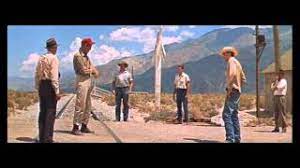
There is a gripping scene early on that serves like a symbolic and impromptu town council meeting. Several of the town’s key characters assemble, almost mystically around a railroad crossing with desert encompassing their position during the middle of a hot dusty day. Smith and two of his entourage members Coley Trimble and Hector David (Borgnine and Marvin), along with some other local toughs and Doc Velie begin a spontaneous discussion about the arrival of MacReady, what it may possibly mean and what to do going forward. We become privy to the sort of sado-masochistic control that these Men have exerted over the local atmosphere. As MacReady remarks later in the film: “It looks like the rule of law has left this place and the Gorillas have taken over.” Reno Smith even wears a Red Baseball cap in some scenes.
Though the film appears to be awash in Testosterone and “Art of War”-type maneuvering between the mostly Male cast, the beguiling Ann Francis is in this as a bright and perky Woman of cordiality and potential deception. She is friendly to MacReady at first, until the domineering Smith informs her that MacReady means the hive harm, Francis as Liz Werth with her status quo down home radiance does what she can do to impress her MAGA-like mates by becoming a source of disinformation to MacReady. MacReady discovers that everyone in the town is suspicious of his presence, that his mere being there and wanting to see the Japanese resident puts the town in a precarious situation and MacReady is quickly piecing together why, furthering his beliefs in his own expendability.
While I most certainly got caught up in the sequence of events in this picture and for a movie from 1955 the action is fairly accurate looking and exhilarating to some degree, the film feels immersed in symbolism and analogy portrayal. MacReady appears to be the standard bearer for the immerging progressive American psyche of the times, yet an allegiance to the super ego and a master of both the philosophical and martial arts make MacReady an All-American renaissance Man. Even the surly locals of Black Rock back off and give him some space to a degree once they discover his Military background and his ability to operate a Jeep with one arm under duress. The malicious locals appear to be emblematic of an incestual criminal underbelly that exists in America.
In essence, the locals of Black Rock who may not be of a violent or truculent nature are philosophically held hostage by those that are. That when people live and exist among hostile individuals all internalize the hostility when it activates. MacReady claims to be from a cosmopolitan Los Angeles, a place that will eventually become a location of blossoming social tolerance juxtaposed against the paranoid city-state’s mentality of Smith and his underlings. During a conversation scene between MacReady and Smith, Smith informs his opponent, “A Man is only as big as what makes him mad”. Smith goes on a rant about persons of Japanese origin and Pearl Harbor and Bataan, he is measurably not in tune with the oncoming accepted groupthink and world view, MacReady grasps the vein of provincial territorialism that is pervasive in Black Rock and soon comes to the realization that he cannot reason with them that don’t wish to be reasoned with.
Borgnine and Marvin bring the personification of the local civic bullies, Borgnine as Trimble being the more obvious and belligerent of the two, Marvin as David is the more calculating and sinister. The confrontations with MacReady are predictably increasingly provocative, MacRedy’s zen-like posturing and counter strategy is paramount to the movie’s message and formula. To the Western format and its archetypes of plattitudinal insecure bad guys and their churlish henchmen, we get a new kind of anti-hero, an obedient Military servant who must rely on his self-preservational instincts when the system is not there to protect him.
With his sunken in chest and depressed look, Dean Jagger is memorable as the local sheriff; he is a Man defeated by his mistakes, kept employed by Smith though he detests Smith for taking his manhood years ago metaphorically. Jagger and Walter Brennan as the local Doctor have great interplay as the local brains who have long ago been subjugated by the local brawn. Brennan as Doc Velie creates another fastidious depiction of an integral sidekick character in a long acting career of legendary screen cronies. Brennan, broods more in this, his character is somewhat duplicitous, placating Smith and his entourage while secretly encouraging Sheriff Horn and MacReady to counter punch, Brennan brings a presence that is comforting, alarming and sagacious.
Despite Smith’s discriminatory speech about people of Japanese descent in the film, racism is only a symptom in what I believe Screenwriter Kaufmann is issuing an edict concerning . Kauffman’s Screenplay received an Oscar nomination in 1955, in addition to Tracy as Best Actor and Sturges as best Director (all lost to “Marty” with Borgnine, Directed by Delbert Mann, written by Paddy Chayevsky), I agree with those who say that “Bad Day at Black Rock” was in part about McCarthyism and it’s influence on the willfully ignorant, it’s fear and intimidation spread like a prairie fire and soon the interests of the few became the coerced interests of the many. Come to think of it, wasn’t Roy Cohn special counsel to Joseph McCarthy in the 1950’s? I digress.

With “Bad Day at Black Rock”, Director John Sturges loaded salient viewpoints into his film about personal integrity in a free society and the fragility of democracy, that whether it’s the exterior control of an axis power or good ole boys, it’s still fascism if someone has to live in fear. Smith and his acolytes behave quite a bit like Jack Palance and his henchmen in “Shane”, the Western Beach bully kicking sand in sensitive guys’ faces to in part establish a unspoken chaste system of social dominance. As a side note, it is noteworthy that in addition to being a Marine at one point, screenwriter Kaufmann acted as a front for blacklisted legendary screenwriter Dalton Trumbo in the 1950’s, lending his name to then blacklisted Trumbo’s screenplay for the fabled 1952 film “Gun Crazy”. Facts such as this add a modicum of passion to Kaufmann’s script; it would stand to reason that aside from the vintage Western villain atmosphere that the film espouses on the surface, the rural flag-bearer characters are there to represent a specific American mind frame; a brand of separatism within it’s borders that is at once physical, religious, psychological and tribal.
Leave a Reply