Combining the subjects of racial stereotyping with the underground prostitution culture of the streets of America, while adding an angle of the juxtapositions of the lives of the varying classes of Urban America sounds like low hanging fruit or subjects we all feel like experts on now due to countless media exposure of a multitude of Cable TV shows that give us hard-hitting insight on such subjects . All of these aforementioned gritty Urban shows also display the power dynamic between people involved sexually, whether there is physical /emotional /psychological abuse or coercion involved. We watch these shows and the presumptuous behavior of the shows’ characters permeate into society, the conversation can definitely begin about some people’s behaviors and whether these behaviors are organic or shaped from watching modern representations of their presumed lives. Shows that fit this description are shows like HBO’s “The Wire”, the gritty urban series “Power” or “Snowfall” or “The Chi”. People watching Cable in the remotest corners of Alaska can claim themselves experts on the ways of salacious and innocuous Urban city dwellers thanks to these fictitious creations.
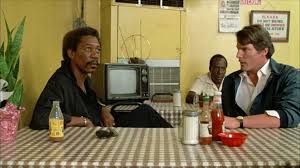
In 1987, A Hollywood film opened with a scene involving three erudite New Yorkers, sitting in an office, discussing what one of the characters, who is an ambitious and handsome young writer, is going to work on next. His editor is happy with the writer writing about local construction projects or fluff pieces about community involvement. The ambitious writer changes the course of the conversation and proclaims that he wants to write about something edgy and profound, suggesting that he write about the real life of a New York Street Pimp. His editor loves the idea and says have the article on is desk by the end of the week, class dismissed. This is the opening scene of a disregarded film with a cult following now titled “Street Smart” from 1987. The Movie was hailed by TV critic Roger Ebert when it was released, and in addition, actor Morgan Freeman received an Oscar nomination for Best Actor for his portrayal of Street Pimp character “Fast Eddie Black”.
“Street Smart” was directed by Jerry Schatzberg, who had a distinguished career that included such well-received movies as “Scarecrow”, “Panic in Needle Park” and “The Seduction of Joe Tynan”. His work here is uneven; at times the film’s tone and pace is like that of a TV movie, in it’s contrived predictability. At other times, the film’s darkest scenes almost have a Foreign Film quality to them, with long pauses during scenes of sexual abuse and violence. Then there is a profound party scene which draws parallels between those that have ambition and crave control; regardless of their background, gender, race or social position.
In order for the film’s Caucasian protagonist, played with an amazing sense of self-consciousness by Christopher Reeve, to get his editor’s assignment completed in time, he’s got to hit the streets. Reeve is Jonathan Fisher, a young ambitious up-and-coming figure in New York media. He decides to peruse the streets of Times Square looking for a Pimp to interview. Apparently, according to this movie, there is no shortage of furry-hat wearing Black guys in Times Square in the late 1980’s pimping hoes. Fisher approaches a man he believes to be a Times Square pimp and the fellow threatens to beat Fisher’s ass if Fisher doesn’t vacate immediately. Getting to know pimps is evidently more difficult than applying for a temp job at Vanity Fair as Fisher finds out. Although Fisher does interview a sexy White prostitute named Punchy (played by Kathy Baker), that’s as far as his investigative skills have gotten him by his editor’s deadline. So, like many experienced seasoned go-getters, instead of throwing in the towel , Fisher decides to cheat and fabricate a tale of pimps and hoes in the streets of Times Square out of his own stereotyped mind for an audience that he believes is certainly ignorant of the streets and what goes on there in fact.
Fisher concocts a tale of a vicious pimp with street and investment savvy, who uses his wits and violence to control his hookers while he is also making shrewd business moves and investments. Fisher’s piece is initially a smash success, the literary world can’t get enough of his stories of Urban ribaldry. Fisher’s morally corrupt and culturally liberal elite boss, Ted Avery (played by “My Dinner with Andre”‘s own, Andre Gregory)has a passion for theatrics and bullshit. Fisher’s passionless relationship with social equal Alison Parker (played by a Vanilla Mimi Rogers) seems to be getting a boost, as their social-climbing coupling seems more motivated by success than attraction and intimacy. Everything seems rosy and the movie could end right here, but there is a catch.
Unbeknownst to Fisher, there actually is a pimp in New York who fits Fisher’s concocted cliches’ of a savvy Times Square pimp. The character’s name is “Fast Eddie Black”, played with monumental intensity and heat by Morgan Freeman. What’s worse, Fast Eddie is being tried for murder of a rogue client of one of his prostitutes and Eddie’s lawyer has the brilliant idea of having the public identify Eddie as the subject of Fisher’s pimp article so that it could potentially exonerate Eddie of his crime; Fisher, at Eddie’s request, would errantly tell the police that Eddie could not have killed anyone due to the fact that he was with Fisher at the time of the killing of Eddie’s hooker’s client. If Fisher refuses to lie, Eddie’s lawyer and camp will expose Fisher’s fake pimp story to the press, potentially ruining his career. Suddenly, the movie becomes complicated.
The movie even goes further off the rails when it becomes apparent that Fast Eddie is as stereotypically volatile and controlling as Fisher had fantasized about his fictitious pimp to be and that Fast Eddie doesn’t have diplomatic patience to wait for Fisher to “play ball”, he will fix his issues with malevolent terror. “Street Smart” is a multi-dimensional film in that it plays on it’s intended educated audience’s presumed stereotyped perceptions of criminal street life and the world of the underground pimp and prostitute. Fisher’s sense of what the world of prostitutes entails is validated by his experiences with Punchy, who is cunning and theatrical. When Fisher hangs out with Fast Eddie, Fisher sees Eddie’s use of sado-masochistic menace and it freaks him out, but then the screenplay (by Screenwriter David Freeman) shows Fast Eddie to have a violent temper that he can’t and doesn’t control.

Fisher discovers Fast Eddie has an adversarial partnership with a dominating African-American Woman named Harriet (played by TV actress and Comedienne Anna-Maria Horsford). Harriet and Fast Eddie spend their time screaming, threatening and controlling each other, sometimes to the edge of violence, while they count money from their hookers and somehow maintain a business partnership. Fisher witnesses Fast Eddie smashing a bottle of YooHoo soda and pressing the broken glass against the face of one of his girls’ faces (Darlene, played by Shari Hilton) when he believes Darlene is skimming. Fisher begins to see the correlation between mental illness and criminality. The pimps, hookers and underlings are always overly animated and screaming at each other as a way of communication, these people live with the volume up on extra loud.
Reeve gives a surprisingly complex performance as Fisher, the self-righteous WASP champion. Fisher’s behavior comes off as insincere, pandering and self-absorbed. The film hardly redeems Fisher, Reeve does an admirable job as a fraud hiding behind Country Club fashion magazine threads and airs. He creates an editorial news brief on TV called “Street Smart” where he exposes various ways New Yorkers can get hustled, as if Fisher’s time on the street has granted him an unusual exalted position in educated circles of being cunning and street-wise, that he’s a WASP go-getter with a ghetto pass. Yet Fisher is not street wise, his time spent with Fast Eddie is a thorough crash course in Hood strategy and madness.
In a bizarre way, the tumultuousness of Fisher’s newfound lifestyle adds flame to a docile relationship between Fisher and his matching set other, Allison. Reeve and Mimi Rogers are distinctly beautiful looking together, their characters’ interactions with each other are clinical. This is exacerbated by Fisher’s immersion in to the world of pimps and prostitutes. In a manner, Fisher’s entrance into this world becomes a source of abusive behavior towards Allison and in a perverse sense, it endears Allison more to Fisher and their relationship. The more Allison is being potentially harmed, outright offended and physically and psychologically injured by the periphery of Fisher’s forays into street criminal life, the more she seems to be drawn to their relationship.
Whenever Kathy Baker is on screen as Punchy, the energetic and strategic prostitute, she dominates everyone except Freeman, there is a stand-out scene between the two of them, which is all I will say. Punchy seduces Fisher as part of Fisher’s indoctrination into the world of hookers. She flaunts her advances towards Fisher in Allison’s face at a party in the middle of the film which is a seminal sequence for a myriad of reasons. Allison is not dumb, but can’t let her trophy boyfriend go unchecked nor will she dismiss him simply for infidelity. Can’t let those tall guys go. Punchy is always prepared to be provocative sexually with potential Male clients and even with Women. Punchy uses her sexuality as a weapon and as a disarming tool, whether she is attempting to cool down an angry Fast Eddie, rev up Fisher, or even attempt to confuse the District Attorney assigned to Fast Eddie’s case, played in appropriate straight-laced fashion by Jay Patterson as D.A Pike. The script is raunchy at times, but that is emblematic of the world that Fisher has entered by choice. After threatening to slice up Darlene’s face with a broken YooHoo bottle, Fast Eddie passionately makes out with Darlene in front of everyone after Darlene just finished begging for her life inside a cramped Cadillac while Fisher watches.
For all it’s insight, screenwriter Freeman’s screenplay is much better at it’s portrayal of the White Middle Class responding to street culture then it is portraying the street culture responding to anything. Aside from Fast Eddie and maybe Harriet, many of Screenwriter Freeman’s street characters are one-dimensional and dim-witted. In an early scene, Fisher and Parker go in to a Times Square Bar like missionaries seeking out cannibals. They attempt to use Allison as bait to see what kind of action they can attract and she is immediately pounced upon and damn near assaulted by a street pimp played by comic actor Rick Aviles, the scene is forced and unimpressive. Some of the characters in “Street Smart” seem like the kind of roles for African-American actors that comedian Robert Townsend is lampooning in his skit “Black Acting School” from the film “Hollywood Shuffle”, released the same year as “Street Smart”. Pimps, hoes, junkies, all behaving like stereotypes. It is ironic to have such awkward material that itself is mocking and criticizing the mainstream’s knowledge and portrayal of street culture. Screenwriter Freeman seems to be basing his characters on the same mythology that White writer Fisher does in his fictitious Pimp piece.
Since I am a listening child of the Jazz-Fusion era, it was a pleasure throughout the film to hear the sounds of keyboardist Robert Irving III and his heavenly special guest on Trumpet on the soundtrack, the one and only Miles Davis. Irving III was a member of Davis’ Electric Band in the 1980s for a spell, Synth Pop and Funk as played by Jazz and Jazz-Fusion experts will always have my ear, it is an era of music dear to my heart. I believe when I heard Davis live in Richmond, Va in 1987, Irving III was in the band as one of the Keyboardists. The Electro-Pop Smooth Jazz sounding Music in “Street Smart” certainly adds to it’s time capsule persona.
Andre Gregory as the Chief Editor is duplicitous, relentless, academically arrogant and a constant showman. He personifies elitist successful bullshit artists, but at least Fisher begins to see through him, though he appears to need Avery’s validation, it’s part of what seems to drive him. Avery’s message to Fisher is that in order to be a success in the print industry, he has to live on a plane above the common folk. Avery hosts a party in the middle of the film and has Fisher bring Fast Eddie and Punchy as the main attraction, like Big Game they have caught. Avery and Fast Eddie seem to share some kind of corrupt kinship and fascination with their needs to be in control. At one juncture of the party, Fast Eddie is conversing with Avery’s upscale wife with Avery’s blessing as Avery carouses with others somewhere else in the room. Fast Eddie takes the opportunity to inform Avery’s wife that she has spectacular tits, to which Avery’s wife giggles, these people are apparently speaking a similar language of moral corruption.

The party scene is an excellent section of the film, it and the violent confrontation scenes are where the film really kicks it into high gear. Two scenes where the viewer isn’t sure or not whether we are going to witness brutal onscreen violence or not, these scenes are incredibly tense and masterfully done. In the end, however, the film is dominated by the performance of Morgan Freeman. Freeman’s physical look is just the icing on the cake, he is mesmerizing in this movie. Freeman’s delivery, his bellowing voice, his ability to command a scene is certainly in the same class as Burton, Brando, O’Toole, etc. Freeman brings a dimension of gravity to the character of Fast Eddie that lesser actors would have missed and just honed in on the psychosis of the character. The several scenes where Fast Eddie slowly terrorizes people are jaw dropping, the viewer is emotionally exhausted after these sequences. Freeman in this film has the clarity, presence and brilliance of a stage actor while giving his role (which at times deals in media-driven ghetto cliches) a sense of purpose which encompasses hostility and militancy. It is no wonder that chronologically, Freeman’s performance began his ascendancy towards super stardom.
Leave a Reply