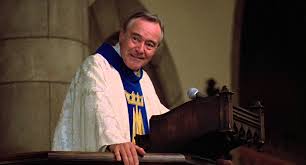
The opening scene of the 1984 Family Religious Drama “Mass Appeal” conveys a very familiar and comforting sight. Accompanied by fake prestigious Religious Music for the opening credits, the movie begins in a Middle-to-Upper Class Suburban Church in some major American city. The film was actually filmed in Claremont, California, but it is supposed to be a ritzy Connecticut suburb. I was thinking Burbank or Thousand Oaks. A poised and bemused Patriarchal Priest figure, played by Jack Lemmon, commands his large Congregal flock with his tone, his stare and his pace of speech, all in attendance are helpless in his gaze as he takes Mental and Spiritual dominion over the room with a Johnny Carson Late Night talk show host disarming charm and rhythm. I was thinking watching this, this is what the Conservative Middle Class wanted in 1984, I thought watching this that this is the sort of theater Main Street Middle Town America engaged in in those years of the mid-1980’s. As Father Farley, Lemmon opens up the floor of the Hall filled with parishioners there for a Catholic Mass, to a discussion concerning whether Women should be allowed to be Priests or not.
Father Farley takes a couple of Softball toss questions from Middle-Aged Women who are several stages short of activist on the subject before he receives an inquisitor with a more rebellious tone from the congregation, a young White guy in jogging clothes. The Young Man badgers Father Farley about the subject presented in front of the congregation, an awkward and abrasive moment which the gregarious Father diffuses, deflects and hustles the focus of the open floor to another speaker with a question, while dutiful Mothers in business suits shush their babies and little ones behind plexiglass surrounding the church Rectory in the corner. The disruptive verbal exchange serves as unintentional timely entertainment in an otherwise drab and self-affirming mundane service.
To set the background for the film, we see Father Farley’s day-to-day living arrangements and routine. He has a Housekeeper with a quasi-Irish, quasi- Reader’s Digest reading accent who appears to be more like his work wife, Margaret (played by Louise Latham). Father Farley likes to get loaded on Scotch in his study while he is prepping for his weekly sermons by pontificating into a Dictaphone while he paces around his study carrying a Golf club. Or he’s in his Audi, tooling around the embellished Suburbs. The Dictaphone was an essential 20th-century piece of office equipment, I recall my father in his lawyer days of the 1970s and 1980s, speaking into and using a Dictaphone often, of course nowadays, they have an app for that.
There would be no need to interrupt this solitude-filled insular existence for Father Farley, but hey, without some sort of conflict, there would be no movie. This is not an art film, by any means. In weaker hands, this could have been a tepid TV or cable film, or Hallmark movie. The conflict arrives in the form of now it’s Deacon week, and Father Farley, along with the local Monsignor (played aptly by Charles Durning, who definitely encompasses the size, shape and look of a Church higher-up.) have to choose young Seminarians to ascend to the Deacon-hood. One of the young Deacon candidates is the young Man in jogging clothes from the earlier discussion scene (played stiffly by Zeljko Ivanek). Two of the other candidates may be more than Brothers-in-prayer with each other and the Corporate-like Local Ministry ain’t having that shit out in the open in 1984.
The Monsignor makes it plain that he doesn’t wish to promote openly Gay guys as representatives of the local Ministry; Farley and others grasp that this is the Monsignor’s stance, whether they agree with it or not. Mark, the young idealist played by Ivanek, doesn’t abide by the Ministry’s shunning of the Gay Deacon candidates, he repudiates the Monsignor verbally directly because of it. The Young Man’s rebellion puts him on the radar of the Monsignor for potential expulsion. When Farley defends Mark’s passion when questioned by the Monsignor about whether Farley thought Mark had what it took to become a priest, the Monsignor voices his displeasure with Mark and tells Farley this: If you want to save this young candidate’s chance to be a priest, you have to mentor him for a month or he’s out. So the movie becomes like “Training Day” for Suburban Catholic Priests.
Once Father Farley begrudgingly takes the Deacon without a cause on as a Mentee, the movie shifts to a philosophical debate between the young man’s ideology of challenging the privileged class to behave in a more Christ-like manner going forward and the establishment’s tried and true position as serving as a spiritual cheerleader on Sundays to the status quo. I stopped to think what this movie would have been without Jack Lemmon as it’s rudder and center. The answer is the movie would have been nowhere but I couldn’t imagine anyone else in this movie, not in the mid-1980’s. The film’s ability to allow Lemmon to spread his wings and employ his range of emotions gives the movie impact and suddenly it’s not just a good old-fashioned social drama, it’s a fitting time piece from the heart of the group think sensibilities of the United States of the Reagan-era 1980s.

Instead of the film emphatically embracing the outlook of the restless youth, it gives his character air time, though Farley implores him to just look the other way and give his sacred audience what they want: To be validated every week without guilt or regret. While the young idealist can’t seem to accept the use of duplicity or half-truths by his Superiors in the Ministry, Farley has long ago accepted the unwritten rules and etiquettes of his trade, he sees his own rebellious and virtue-laden origins of his younger self in Mark, yet he has a difficult time selling the Young Mentee on the idea of just smiling, being cute, telling people what they want to hear and he, too, could be driving a nice Foreign Car to Church every Sunday.
Based on a play by Bill C. Davis from 1980, Davis wrote the script for this as well, while the movie has no true seminal events of conflict or closure, it’s revelatory dialogue gives the film it’s impact and scenes of Lemmon appearing to exhaust his emotional tank attempting to get young Mark to accept the tenets of conservative Middle-Class America and live a droll happy life or be shunned into a shadow existence of personal and social ambiguity. These are real issues in all of our lives and it’s where this film bears weight.
I once attended an Easter service in the early 1990’s (okay, attended is a strong word, I was hired to play Trumpet for the service, in order to get paid, attendance and performance were mandatory.)in a South Hills suburb of Pittsburgh. A fired up Minister at the time made a speech involving asking the congregation how did their assumed experimentations with free love and drug use in the 1960’s work out for them spiritually? It was a great sermon, in my opinion, but you could hear a pin drop after he breached the subject, especially on Easter. I believed that these people did not want the sermon equivalent of an Ingmar Bergman directed-type self-therapy journey of reawakening and self-discovery, they wanted the sermon equivalent of a Disney film directed by Robert Stevenson. When the same Priest finished his sermon with “Our God does not write tragedies for us, only light Comedy”, I knew he knew how to take his audience by the proverbial cliffs, dangle them over the edge and bring them back to unencumbered spiritual safety. “Mass Appeal” is addressing the same crowd with a film that asks more questions then gives answers, which is in part what caught my attention about the movie and separates it from fluffy TV and Cable channel movies with quirky symphonic music and tidy conclusions.
As much as I bemoan the pedestrian sounding film score, I am not sure what else Bill Conti could have done, the tone of the music had to be light and retro-sounding, like the theme to a Sunday Morning TV Talk Show about Bible Passages. I don’t believe that this movie’s intended audience were New York Urbanites out on a Saturday Night in Midtown Manhattan, I believe this to be a film meant for Main Street, Iowa. That it’s discussions of how the Church deals with LGBTQ issues without graphic detail is plenty salacious enough for a date night in Indiana in 1984. Lest we not forget that the typical American with a college degree in the United States in 1984 was a Republican-voting Reagan supporter. “Mass Appeal” is a curious and thought-provoking movie to me, it’s just intellectual and well-executed enough to draw the interest of serious movie-goers, yet it still has the packaging and pacing of a Network TV production with say, Dick Van Dyke, Dick Van Patten and Dick Cavett. It speaks plain like a visit to a Kansas barber shop where everyone gets a crewcut and a lollipop.
Donald Peterman’s Cinematography is shiny and attractive, most of the outdoor shots take place on Sunny days, the screen is awash in color during Sunday Service scenes. Since this film is based on a play, there are quite a few indoor conversation scenes involving clergy. One memorable scene that comes to mind is an outdoor scene at night where Father Farley is again attempting to bestow some keen insights on Mark as they stand outside in the moonlight. Director Glenn Jordan’s use of the depth and lighting to intimate shadows speaking to each other invigorates and adds punctuation to an already engaging Lemmon in his role as the oft-sauced Farley. The back-and-forth between Farley and Mark is compelling, even if I felt Ivanek to be too wooden at times. He’s got the look of the suffering young idealist, but his work to me here is almost amateurish at times. I’m convinced he wants to challenge authority, I’m convinced he wants attention and validation for his empathetic abilities, I’m not convinced of anything beyond that. It is an accurate touch that the film shows Mark using his criticism of Farley’s drinking and lying as deflective tactics when Farley is either criticizing Mark or attempting to give him direction on succeeding in the clergy game. He is trying to alert Mark to the concept that the righteous Suburbanite is his clientele, and that this particular archetype shuffles the right clergyman into their palette of necessary professionals to uphold a righteous Suburban lifestyle. The right Priest is up there with the Family-approved accountant, the attorney, the landscaper, the Home Inspector; the Priest is like a defacto therapist.
Charles During as the Monsignor appears to be there to show the Corporate, dismissive and reactionary side of the Church Industry, his stances and takes on issues throughout the movie are predictable and uptight. He’s a bureaucrat and a chain-of-command practitioner. He’s not in the business of challenging people’s beliefs, he’s here to confirm them. When Mark bursts into his office to chastise the Monsignor for expelling Seminarians who may or may not be Homosexuals, the Monsignor is taken aback when Mark labels him a “Homophobic Autocrat”. It’s a workmanlike performance for Durning, who is merely there as a straight man for Mark and Father Farley. As for Louse Latham as Molly, the MILF-aged Housekeeper, she and Farley seem to have this Burns-and-Allen-type repertoire where they know each other’s moves and finish each other’s sentences; it’s an unexplained bond that the movie doesn’t go into detail about.

The dominant force and what makes this movie is Jack Lemmon. Like his work in “The China Syndrome” or “Save The Tiger” or “Glen Garry Glen Ross”, once Lemmon seems to grasp the point and purpose of his role, he dominates like few others can. Akin to a Paul Newman, except more neurotic. Lemmon is so in control here, he gets the role and is blistering with his analysis of everyone involved, including himself. He was almost 60 years old when “Mass Appeal” was released and he appears to be at the height of his acting powers. Lemmon was a master of facial expressions that evoked thoughts without him saying a word. From the moment he hits the screen in this, he is in command. Bridging that gap and translating between neurotic self-doubters and rigid conservatism is a skill Lemmon was born with, his well of procedural appropriateness is only matched by his well of empathy for his fellow man.
Lemmon makes being a lonely miserable Priest look like enlightened fun; he strategizes and boozes it up in his doxological man cave, he’s always on call bullshitting Middle-aged Suburbanites who have just lost loved ones or hosting Church events for the local community. Like being the Head Honcho of a local institution that acts as both quasi-community school and sanctuary for those that seek spiritual guidance and comfort of all ages. As all great actors do, Lemmon makes his performance so believable, his character Father Farley, really seems like Lemmon. I had no problem believing that this imaginary Connecticut suburb would be beholden to this charismatic, caring (whether genuine or feigned) figure. As much as Lemmon is on screen in this film, and as much as we get of his range, if you are a Jack Lemmon fan and enjoy watching him tout his craft and have never seen “Mass Appeal”, you are in for a cinematic treat.
Leave a Reply