In the Spring of 1977, I was attending Venable Elementary School, which was located a robust Dog walk away from the University of Virginia Hospital. The end of Third Grade for me was on the horizon, a month or two away. It seemed as if our dusty and musty smelling School bus would always drop us off after School after 3 Pm, the meat of our scholastic day at school was spent between 8:30 and 2:30Pm. At one juncture during this year, our regular teacher took a hiatus and a substitute came in for a few weeks and let us watch morning cartoons on a classroom TV while we did our morning seatwork; someone eventually put a stop to that shit because we were digging it way too much. This was also the school year when Jimmy Carter had defeated Gerald Ford in a close election back in November, and in addition to our school grounds being a polling site, a verbal and slightly physical brouhaha erupted on the playground between the Democrat and Republican kids. My parents were in the Arts and had me watching Foreign films about citizens binding together to combat fascism, so you know what side of the playground dust up I was on.
As I was now Nine years old at the time, I gained more freedom of movement, my Father in those days did not return from the law office where he worked until well after 5 PM most days, and by that time of day Mom was moving back and forth from the House to the family Business. For many days after school during this stretch, until my parents began to understand the benefits of putting your child in after school sports, I had several hours to myself. Somehow, I soon came to realize that a walk to the University Theater, which was located on the grounds of the University of Virginia, was probably only 30 minutes away, totally doable for a kid with my precocious energy. Over the landline phone with the hard plastic coil I convinced Mom that I was safe to go view the newest animated film, “Wizards” at the University Theater after school for a 4 PM showing. As luck would have it, my newest edition of Sports Illustrated had shown up in the mail, I gripped my rolled up copy of the weekly sports mag as I gleefully trekked up the hill towards the University of Virginia grounds at 3:30 in the afternoon on a sunny Spring Friday .
I had seen the posters for “Wizards” and had very little idea what it was about, I just knew it looked cool and avant and animated characters were holding guns in the posters. It was listed as being developed and created by animator/filmmaker Ralph Bakshi, who by this point had made several controversial animated features, including “Fritz the Cat” and “Coonskin”. Bakshi’s style seemed to speak to an audience of a certain sensibility that was neither decidedly political in one direction or another, but his constant tone of tolerance may have been an indicator. My Father was oblivious to Fantasy/Horror/ Sci-Fi fare, I could have told him I was going to see South Korean Professional Bull Riding and gotten the same enthusiasm-deficient response. As for my Mother, she knew what I was going to see to a degree, but the movie was rated a solid PG, which in them days a PG ran a wide gamut of impropriety. Where as this particular entry was pretty harmless image-wise for a PG, I do recall going to see “The Outlaw Josey Wales” earlier that year and it was a PG with all kinds of graphic killings in it and some bare bums and boobies were on display as well.
It was a gorgeous day in the mid-afternoon of a Central Virginia Spring of 1977, my hike to the Grounds of the University of Virginia went unimpaired, in subsequent years I learned to take public transportation with a bus that picked up and dropped off riders in front of the Thomas Jefferson statue that stood yards away from the storied Rotunda building on the University of Virginia campus. A couple of months later, I would make this same pilgrimage to the University Theater to see “The Deep” with Robert Shaw and Jacqueline Bissett when school let out for the Summer in June. There was practically nobody in the theater for this Friday afternoon matinee showing of “Wizards”.
I learned years later that “Wizards” was sort of a variation on Tolkien’s “Lord of the Rings”, except this fantasy film only lasted one hour and twenty minutes, so it was more of a cliff’s notes variation on the Tolkien epic. “Wizards”, while being an animated movie, opens with a preamble about a future on Earth after a violent cataclysm has happened, such as a nuclear war between humans, brought about by technology and human greed. The film puts forth the idea that the Earth healed itself after the violent surface ruptures and began again, that an assortment of magical entities, such as elves, fairies and wizards returned to Earth, the ecosystem returned to some sort of mythological legacy.
A Queen of the new humanity gives birth to two sons, both born with the powers of wizardry. One is a benevolent peace-loving wizard named Avatar (voiced by Bob Holt, he was the voice of the original Grinch, by the way), the other a sullen dark-thinking man-child named Black Wolf (voiced by Steve Gravers). As the twins age, the preamble informs us, Avatar embraces the philosophies of magic and the ecosystem. Black Wolf, on the other hand, always feels slighted and wishes to resurrect the specter of industrialization and technology back on the world. The two wizards embark on a life-long struggle to share their contrasting manifestos with the planet. Black Wolf is a frustrated wanna-be dictator with carpeting in his lair that includes a giant swastika on it’s surface. Avatar is a more worldly and wisdom driven yogi. Imagine Yoda smoking a cigar, having a voluptuous vixen fairy queen for a companion and talking like George Burns.

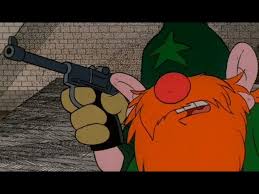
“Wizards” takes an astounding turn towards clairvoyance when Black Wolf, desperate for more power and influence, discovers old Black and White films of Adolf Hitler and the Nazi War Machine. He uses the found archival footage to recruit an army of low-IQ monsters from surrounding hill and dale. I am not making this up, this is the actual plot of an animated movie from 1977, not an animated documentary on rural Pennsylvania in the 2020’s. Once the Army is galvanized by the vintage Nazi war footage, it begins a blitzkrieg-like advance into the lands inhabited by peace-loving elves, fairies and magical dorks, etc. This leads Avatar, his hot Fairy Queen ingenue (Queen Elinore, voiced by Jesse Welles), a courageous elf-warrior(A character named Weehawk, voiced by Richard Romanus), and an electronically controlled turncoat assassin (intentionally and ironically named Peace, voiced by David Proval) on a Tolkien-like quest trip to slip behind enemy lines to stop Black Wolf and his beer-bellied automaton army from taking over the planet. Along the way, the group of heroes, feminine heroes and anti-heroes encounter fantastical friend and foe in creator Bakshi’s visualization of a future Earth that has returned to it’s primitive magical roots.
Watching this at age Nine, the movie seemed tapped into the vibes on the street of it’s era, an outlet of creativity and imagination from the collective thinking of the introverted and disaffected. An animated viewpoint from the counterculture and those that would toe the line between the constructs of the era’s social rebellion and traditional pragmatism. I recall as a child the presence of a kind of kinetic mythology that swirled in all things that related to cultural entertainment such as art, music, comic books, TV, etc. The imagery at times seemed to harken to primitive times before industrialization and modern society, to times that involved magic and legend making.
I would be at the playground in the mid to late 1970’s and there was inevitably that faction of young burnouts at the park or school grounds from time to time, smoking cigarettes and listening to X-rated comedians on cassette tape, partying and drinking out of the back of pleasure vans with wall-to-wall interior shag carpeting. The vans having art work on their side exteriors of conjured mythology, such as ancient sword-wielding warriors standing next to scantily clad tribal Female vixens, maybe there was a lightning bolt in their somewhere or big bulbous balls of flame. Music blasting out of these vans might be by Led Zeppelin or the Moody Blues, songs of times described of an ancient period long ago, of fantasy and timeless sorcery, there appeared to be a vibe in the late 1970’s that I witnessed of people attempting to get in touch with a purer and more authentic heroic version of themselves. Expressing these feelings and vibrations with an ever-changing style of clothing and accessories, partying while listening to and internalizing loud music, demonstrating attention-seeking behavior that was tinged with contrarian apathy.
The movie “Wizards” seemed aimed right at this crowd, as if Bakshi himself spent time getting bombed with surfers in a Malibu parking lot in the back of a VW bus. The music for the movie, by Andrew Belling, is a perfect fit, a mixture of Guitar-driven Rock music and traditional Orchestral film score sounds. The animation is a mixture of still backgrounds blended with colorful, yet sometimes primitive-looking at times compared to modern animated standards animated characters that resemble the Rankin/ Bass production studio of animation. Bakshi’s sensibilities seemed to be emanating from a different headspace. While “Wizards” is extremely violent on the surface, the carnage is not celebrated in any manner, it is portrayed as sad and unnecessary. Bakshi seems to be coming from the viewpoint that war and violence aren’t instinctual human needs, that they are coerced out of people in modern society for nefarious ends. The filmmakers appear to have taken footage from some older film (For my money, it looks like “Alexander Nevsky”) and used the footage as part of the animation, specifically scenes involving armies preparing for war.
Bakshi’s film seems far more interested in it’s eclectic protagonists and peace pursuant peripheral characters than the brain-dead army of fascist antagonists that have been activated to take over the Earth. Akin to the structure of Tolkien’s LOTR universe, the bad guys are a giant army of grotesque and cowardly goons that are armed to the teeth and have a collective IQ South of Stupid. The rest of Bakshi’s post-apocalyptic future Earth is a fractured collection of mythical people and beings from Earth’s past. In this realm they have returned due to the ecosystem’s non-reliance on Man-made technology. Bakshi amplifies Luddite mantras; there’s no grown Men, just elves, fairies, dwarves and the like. The fascist army members have no personality, just child-like cads who take and obey orders. The fairies, elves and dwarves have been coming together in solidarity due to a myriad of meticulousness, yet there is innate knowledge that they must unite to overcome a persistent and oppressional force.
Something about this minor animated film resonated with audiences in 1977, such as it speaks to people now. Made on a miniscule budget of 2 million dollars, “Wizards” outperformed it’s budget at the box office, making back almost 5 times it’s cost, with a estimated nine millions dollars brought in. Under current prices, even with the inflated production costs, this would have been a huge take for any studio considering what a minor film this had been allocated to be. A film with a niche audience in mind, “Wizards” was released at the same time as another film from that year supposedly made for a niche audience, “Cheech and Chong’s Up in Smoke”, the latter of which became a runaway box office smash, the film’s projected hipness drew audiences searching for a new identity, a new ideological trend or fad that had the young crowd’s mindset. While “Wizards” was not nearly a success on the level of the Cheech and Chong film, the headspace and audiences were limbs on the same tree. Both films spoke the new language that was on the streets of America and did not divide based on any individual characteristics, this was a new mentality that was a combination of America’s hippies, drug culture, punk and heavy metal and blues culture and mall culture converging.

To simplify “Wizards” and deduce that it was an animated fable based on a cliff’s notes version of LOTR, littered with gun violence, drug references, rock music, would suffice for the intellectually less engaged, some of Bakshi’s projections from this film are due their day in the sun. With the modern world’s seeming reembracing of fascism in first world countries, Bakshi’s idea that evil people in the future would look to proven Nazi techniques of manipulation and coercion were deemed potentially opportunistic and overblown when the wounds of the twentieth century were still relatively fresh, seems like a brilliant and haunting prediction now. One need not go too far in to the future and the ideas that the twentieth century espoused of despotism would be in vogue again. Bakshi’s concept that the projection of precise and devastating authoritarian violence would galvanize the cruel and mortify the meek was spot on. As clapback to all of this doom and gloom, however, is the courage that Bakshi instills in his heroes. His elves are fearless and non-deterred, in one scene a group of them are dug in like French soldiers on the Maginot line.
Bakshi’s primary powerful wizard character, Avatar, smokes a cigar while holding it in between his toes, his scantily-clad fairy queen companion looks like something from the cover of a 70’s Rock album and sounds like Fran Dreschler when she talks. Through the ingenuity and perseverance of this protagonist, Bakshi puts forth the concept that the identities of peaceful creatures are oblivious to the existence and veracity of violent and power hungry men. While the one dimensional Black Wolf seeks dominion over all to fulfill an unspecified ambition lust that he requires, the separate indigenous existence of all other creatures seems to happen as a form of eco-cohabitation, but the sides of the Earth that have survived have chosen to live a life pursuant of magic and rustic era harmony and have developed self-defining techniques and measures that are diagnosed and designed to assist in healing to defend and destroy against a known infinite enemy; the forces of the greedy, cruel, insensitive and unimaginative, morally bankrupt and the ethically short sighted.
Leave a Reply