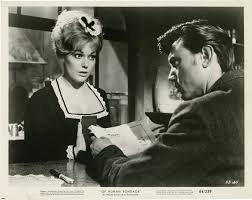
An introduction to Hollywood movies from the 1930’s came to me as a child in the form of a hard-covered book my parents owned which was essentially a pictoral list of well-known and iconic movies from that era. One of the first titles listed in the book was a sad looking drama from 1934 called “Of Human Bondage”. Stills in the Book from the movie showed Betty Davis looking all dour and shit, Leslie Howard looking like her character was stressing him the fuck out. I didn’t even want to read about it, whatever it was it looked adult and fucked up and potentially depressing, some heavy shit I wanted to know nothing about. When I ran across the second remake of it (there is a version from the mid-1940’s with Paul Henreid and Eleanor Parker) on cable a few years ago, I was hooked by it, the movie had that look of clarity that mid-1960’s films carried with them before most everything went color.
A screen adaptation of an early Twentieth Century novel by William Somerset Maugham, “Of Human Bondage” as a film by modern standards would best be categorized as a tearjerker, a plot that could be construed as manipulative, yet by older standards the supposed semi-autobiographical work was considered daring and provocative. All I can recollect is that when I viewed this the first time, I found myself extremely and abruptly emotionally invested in star-crossed lovers Lawrence Harvey and Kim Novak making it work like only a Hollywood fantasy can deliver. I found myself simultaneously bummed out by the story and also relieved that I could look at my own failed romantic love life and think “Well, shit, it wasn’t THAT bad.” The gravity of the failed romance in this movie had me shook.
As referenced earlier, this story was supposedly an autobiographical account of novelist Maugham’s experiences, the tale begins with it’s somewhat sympathetic protagonist, Phillip Carey(played by Lawrence Harvey) who we learn is initially in Paris attempting to be an artist as a young man in the late 19th century, some time between the late 1880’s and early twentieth century. Some of the revelation entailed here is that the uneducated don’t adhere to nor care for the rules of the educated, especially when it relates to matters of the heart. Carey appears to be of middle class stock, he returns to England (his country of origin) and attends Medical school in hopes of becoming a doctor. Here we get some levity from scenes which includes Carey’s instigatory Senior Medical Advisor, played with a typical British stiff upper lip by the priceless Robert Morley.
The character of Phillip is hampered both physically and emotionally by a club foot he has had since birth. His condition makes him somewhat self-conscious. After getting established in Medical School, Phillip meets Mildred, in part because a fellow Medical colleauge student saw her first and was smitten, probably the first red flag. I had a College Instructor who once told me never date a waitress ( as I was in the process at the time of falling helplessly in love with a 21-year old waitress, this is why I won’t watch the movie “Singles”) because everyone wants to get with them and you’ll be at her house spending the night and the phone will be ringing and guys will be pounding on her door in the middle of the night. Mildred is a waitress at a pub near the Medical School building in London, I am guessing this was before Jack the Ripper. Phillip and Mildred go out on a couple of dates and Phillip wants to immediately ramp up the courtship, whereas Mildred seems quite content being popular at her bar and having a selection of men to date. This annoys the smitten Phillip as he wants to initiate a confrontation with her that causes her to abruptly rebuke him.
What follows is a back and forth catch and release cycle between Mildred and Phillip for the remaining two thirds of the film that is romantic, inspirational, tragic and heartbreaking. It sounds easy to forget someone when they have dismissed you, but the sensitive Phillip is touched by the physical beauty of Mildred, the manner in which she dances around him and kisses him on the mouth like a little girl in love, Phillip can’t erase the thought of Mildred from his mind if he had a lobotomy. If one has ever experienced the pain of young love, or what a young person thinks is romantic love, real or imagined, if there is a difference, this film strikes directly at those inclinations. One could mistake the emotional hysterics of the film’s events as a tale of misogyny, yet as friendly as the narrative is to the Male protagonist, his sense of shared culpability is tangible, one gets a sense of remorse on his part in relation to his past words and actions.
There would be an instinct, I believe, to compare this story and film to George Bernard Shaw’s “Pygmalion” and in turn the musical adaptation that became “My Fair Lady”. The shaping of the uncultured, uneducated and headstrong Feminine diamond by the all-knowing WASP renaissance man. Where Phillip has an educated background and value system (In the book, a wealthy relative leaves him an inheritance which enables him to correct his club foot.), Mildred is from the Cockney streets, her knowledge is from life experience, she is harder from a life of fiscal duress. In the world of faux propriety that Phillip hails from, Women are expected to behave in a more demure fashion, show more reserve, this is Victorian/Edwardian England, after all.
Mildred does not give a fuck about aristocratic conventions, or rules made by Men in general, she is living in the moment. She is going to respond in kind to whatever energy Phillip brings her, he continues to expect her to honor him with some kind of fealty due to his use of standard relationship tropes as methods of influence; gifts such as rings that denote loyalty or expensive dates where Phillip assumes Mildred’s emotional faithfulness, these characters are in their twenties, no older than early thirties. The dynamic between Mildred and Phillip seems at times to be like two teenagers in High School or Summer Camp, Mildred finishing dates off with Phillip by giggling, leering at him and planting the sweetest surprise kisses on him before vanishing into the foggy London evening. Her Feminine mystique both beckons him and haunts him, we feel the tractor-beam like sway that she has over him, but it has more to do with Phillip’s unconscious desire than Mildred’s outward solicitations. She’s a wild thing to him, he can have more educated (and less exciting) Women, they don’t give him Butterflies every time he sees them like she does, other Women to Phillip are just there.

That same Professor I mentioned earlier also said people who obsessed over their greatest fears were bound to succumb to them at some point. In Phillip’s case, his fears were that Mildred was promiscuous and therefore unfaithful to Phillip under the definition that he wanted her. Phillip wants to believe Mildred to be his one true romantic love, since she will not adhere to any rules of possession by him she can therefore never give him the complete passionate relationship with his ideal dream Woman. It is, in a way, a challenge to his manhood. If he is to be an established and proper professional gentleman, the thinking of the time went, he must have an established and proper Woman as his wife and for all her flaws (and there are many) Mildred is the Woman Phillip has convinced himself he desperately wants, she makes him tick, she is as much a rescue fantasy to him as she is an object of desire.
Initially directed by Hollywood legend Henry Hathaway (He is given partial credit in the titles)the direction of this film was completed by Ken Hughes and the pointedness of each dramatic sequence in the stretch drive of the movie is jolting and cascades to an engaging finish. I could see this being shrugged off as fluffy melodrama but the painful exchanges between Phillip and Mildred stick in the viewer’s head like a bad dream of regret. We are so on edge when it feels as if Mildred and Phillip are getting along, like maybe something is going to turn the corner here, even though we know as we are older deep down that their characters are too young to shut off their pride for long range pragmatism, that is too much to hope for. Usually around the corner for them is bitterness and rejection. As frustrated as their moments together make we the viewers, it’s as much Mildred’s callousness and short-tempered insensitivity as it is Phillip’s over-sensitivity and his need for Masculine control. Philip has a sense of romantic entitlement, although he struggles with the idea that Women are interchangeable, that he is defined by his need for something unique and special.
The screenplay, by Bryan Forbes, straddles the fence between attempts at tawdry melodrama for it’s day, with themes of promiscuity, infidelity, drug and alcohol use, prostitution and sexually transmitted diseases and insightful dialogue concerning adults wants, desires, self-doubts and vulnerabilities. Phillip gets considerable input about his life from an assortment of peripheral characters. In the mid-1960’s, this kind of Drama may have been run of the mill for it’s time, a costume drama akin to the situational writing of daytime soap operas, yet it feels fresh and probing now, the quiet moments are where a few pearls of age old wisdom are dispersed through dialogue exchanges. Outside of Mildred, Phillip’s most impactful interactions occurs with his sometimes deceitful colleague Griffiths (played by a cynical Jack Hedley), who is simultaneously telling Phillip to avoid Mildred while he is attempting to get under Mildred’s frock as well. Griffiths, for all his two-faced lechery, is at least trying to help Phillip understand the world for the way it really is. Phillip, however, to paraphrase from the Spike Lee film “Summer of Sam”, may have metaphorically bought the cow that gives everyone else the steak and Milk for free, but Phillip happens to like the cow.
Then there is Mr. Athelny (played by Roger Livesey), an older patient of Phillip’s, who takes to Phillip’s sincerity, hard work and virtue. The older Man becomes sort of a father figure and consultant to Phillip and offers him sage advice to pull himself out of his romantic stupor. This includes offering a more saner and reasonable romantic option for Phillip’s future in the form of the older Man’s own daughter. Athelny listens to Phillip’s tales of romantic woe and is at once understanding and sympathetic while attempting to offer him a future romantic option as if he is offering him a job, but the shared understanding is that Mildred was Phillip ‘s first real love and it fucking hurts.
Even the other Women who vy for Phillip’s attention here acknowledge his panderings for Mildred, and in a perverse way, find it charming and sexy, if not frustrating and emitting a feeling of being isolated and distant. In an attempt to forget Mildred, Phillip attempts a relationship with a woman who writes books under a Male pseudonym, perhaps an unintentional hint that because of this that there is some correlation between Phillip and the author on an empathy level, but she is no Mildred, Phillip’s dalliance into the headspace of an unbridled Woman is too powerful for him, he has seen and experienced too much to be satisfied with total subjugation.
The cinematography, by Oswald Morris and Denys Coop, is crisp, certain scenes, such as the night Phillip, Griffiths and Mildred go out dancing are filled with beautiful and anticipatory dread. We love to see Harvey and Novak in the same shot together, staring at each other under the lights of London in a more innocent time, but was there ever such a time, only in the minds of innocent-thinking youth? Maybe this time, Mildred and Phillip will understand each other, we keep rooting for them to end the audience’s torment. We know this pain, we are hoping Hollywood will give us a fantastical way out of the angst and failure that is inevitable, we know this feeling from our own lives. We come to realize that these characters on screen are young and pride takes so long to get ahold of, these characters don’t have that much time to make things right, their rejections of each other as the film goes on stay in our minds as the end credits roll. Watching this film made me play back moments of personal romantic regret, a feeling came over me of wanting to find people from my past and reconcile with them and apologize to them before those people and those momentary feelings are gone, lost to time. Not to get laid again, to restore dignity and a shared sense of human warmth and compassion.
While the cerebral super ego center of the film is Phillip and his experiences, he is shown time and again as a dutiful Doctor, concerned with the highest urgency and sincerity for the welfare of his patients, Lawrence Harvey plays a Man both disciplined and adrift, chaos with Mildred is teaching him the part about life that his studies and professionalism do not. In a way, his experiences with Mildred are making a Man out of him in his eyes and those of everyone else who is educated and meekly passive/aggressive in their own lives. Loving Mildred means Philip stands for something, regardless of how flawed it is. Harvey is always good as the giving and self-loathing nice guy, just waiting to be victimized or feel betrayed. Here he is a prisoner of his own design, he’s got options, they are just not as compelling as Kim Novak, and Nannette Newman as one of Phillip’s love interests is certainly no slouch in any department on any man’s visceral checklist. A maudlin strings-infused film score by Ron Goodwin at times seems unjust, rolling out the love theme as a cruel reminder of the love that we had hope for early on that is getting abused and taunted, the passion that the star-crossed lovers could have for each other manifests into their bitter rejections of each other, tinged with longing and resentment.

To me, this film wouldn’t work on the level that it does without Kim Novak. Her commitment to the role is overwhelming; we see what Phillip sees. Her performance in this is intense and profoundly sad, she uses the seductiveness of an old stripper to get Men’s attention but the jaded hopes of a little girl peeks through her cracks. Maybe for Victorian/Edwardian England Mildred is a scandalous portrayal of a working-class Woman, by modern standards she would just be another Woman in need of a Sugar Daddy and the Woman would have her own Only Fans Account. Mildred might be a drunk floozie, but what hot 25-year old isn’t these days? By 19th century standards? Novak as Mildred is an empowered character in that she is unfiltered and a Woman, she chooses who she sleeps with and she will not have a man fill out her dance card for her. Novak’s Mildred is not here for your entertainment, she’s here as long as you keep her entertained. If William Somerset Maugham took this character from his own life experience, regardless of how one feels the character of Mildred related to modern Feminism, she is a powerful character.
Mildred’s lack of virtues are irrelevant when it concerns matters of the heart. In one scene, after Phillip has taken Mildred in and is paying for her apartment and clothes while she has a child by someone else to raise, Mildred models a dress she has purchased with Phillip’s money in front of the mirror and wants Phillip to look. Novak in moments such as this in the film exhibits her understanding of her character’s Feminine power, that her ability to exude Sexual vulnerability in a controlled fashion is what Men want, damn the educated torpedoes. Novak’s various breakdowns in the movie reminded me of arguments with Women from my past and partners and those awful feelings of saying things to protect your sense of self-esteem when it feels your soul is under assault. That pain is there in Novak’s performance, that look of desperation and self-rejection, a sort of personal nihilism when you have lost all faith in redemption and you are running on some kind of jaded animal energy.
At it’s worst, Novak’s performance could be misconstrued as a study of a selfish Woman who only uses Men and reaps dire consequences for not worshipping at the temple of educated well-meaning nice guys. That she is punished for being attractive and uncontrollable, that she does not lead a life of social propriety, that she is wicked somehow. That by not compromising to be by Phillip’s side, she ensures for herself a dubious fate by not being compliant to the wishes and demands of the righteous and sensitive White guy. It is a role for Novak that invokes extraordinary pathos, she embraces the desperation of a hopeless Woman in her twenties, the anger and the defiant resilience of a beautiful comet in the form of a gorgeous and self-destructive Blonde. Novak’s timeless beauty is a perfect paradox to her character’s surging depression filled downward spiral.
I was under the impression that novelist Maugham’s title refers to the existential ties that people feel towards each other after they have engaged in relationships that are both physical and emotional. That they feel, for lack of a better word, bound to each other. That Phillip and Mildred have established and experienced a strange life bond through their demonstrative interactions with each other. In part, a great deal due to Novak’s range as an actress, the real impactful scenes of dramatic contention between her and Harvey explode with emotion when they occur. Novak brings an out of control self contempt that is as memorable as it is heart breaking. Maybe in 1964 it was not considered at the top of anyone’s lists, I would contend 60 years later it is a monumentally and devastating and draining performance by Novak, who by this point certainly knew the rigors of what it meant to be portrayed as an object, she reinvents here the look and timbre of the local turn of the century bar maid beauty and it is one of those dramatic portrayals that will haunt the shit out of you once you have seen it.
Leave a Reply