In the Summer of 1992, my Mother took me on a trip to see Colorado and enjoy several days and nights of the World famous Telluride Film Festival. I was 24 at the time, bouncing around after graduating College as many were want to do, Mom had been to the Festival before in years past and had a network of friends she knew there. All good people from the small business owners peer group of repertory movie houses, theaters that mostly ran older American and English films, Foreign films, Independent films, almost anything that wasn’t a Corporate Hollywood movie. The Telluride Film Festival had a myriad of options of things to watch every day over the 4 to 5 day period, it was an avalanche of thought-provoking entertainment, highlights included the premiere of two little know films (at the time) by little-known directors Robert Rodriguez and Quentin Tarantino, those movies being “El Mariachi” and “Reservoir Dogs”. Abel Ferrara almost started a riot at one theater that showed his newest work, the controversial “Bad Lieutenant” with Harvey Keitel.
One morning at the Festival, there was a film tribute and presentation involving the British filmmaker Cy Endfield, who in his past had seemingly made one of the most Nationalistic right-wing war movies ever with the enigmatic “Zulu” from 1964. A movie as an 8-year old that I had been infatuated with, until I saw it years later as potentially a film that was in ideological bad taste, a film meant to accent the heroism of British soldiers in the face of extreme adversity, but became notoriously known in later years for being a film displaying “heroic” British White Men gunning down hundreds and hundreds of Africans as if we the audience should be cheering. Honestly, I feel even now that “Zulu” is a heart-pounding astounding-looking action movie with a great soundtrack by John Barry, that it’s intent was not meant to be racist, that it meant to show the Zulus as formidable, tactical and potentially righteous assailants defending their homeland from British invaders.
During the presentation about Endfield at the Festival, it was mentioned that Director Endfield’s politics were perceived to be so left-wing and radical that he was blacklisted along with other primarily Jewish and Communist sympathizers during the Red Scare in the United States during the 1950’s. ( A trial which as many of you know involved one of Donald Trump’s most influential mentors, young confrontational attorney Roy Cohn) My uncomfortable thought was why did a supposed radical who had inclinations towards empowering the working class and left-wing ideology make a movie so beloved incidentally by the Right-wing and American racists?
I had to dig deeper. I read an article of an interview with Endfield years after “Zulu”‘s release where he stated he had remorse about the way the film had been received. Though he was proud of the film technically (and should have been, it is a gorgeous looking movie from start to finish), the message of the film as it’s legacy came out wrong, he had intended to make something more than a British version of an American Cowboys and Indians film, with African Zulus substituting for Native Americans.
Enfield relayed in the same interview that he had wanted to make a second Zulu war film that would show more respect and honor to the Zulus. History buffs could tell you that the Zulu-Anglo war lasted at least six months, it was not a slam dunk for the British Military and the Brits I found out lost another battle in this war before they started hauling out gatling guns to finish the matter. When Endfield had heard that Southern American White audiences had loved “Zulu” because it showed so many Africans being shot to death, he was depressed, saddened and partly ashamed, he felt he owed the Zulu culture a more fitting cinematic tribute. Fifteen years later, Endfield’s second Zulu War film was released, where Endfield produced and Director Douglas Hickox directed. The move, titled “Zulu Dawn”, tells the story of the first battle of the Anglo-Zulu war, the battle on the plains of Isandiwana, a battle that along with Custer’s Last Stand is considered to be one of the greatest upsets in recorded Military history.
While this film is still told from the English perspective, the Zulus are shown as totally righteous in their vehement defense of their homeland. In reality, the British and Dutch had set up shop near the Cape of Good Hope in the mid-17th century because it was an important stop on the way for ships traveling from Europe to Asia and India. Over time, the Dutch and English would push further inland, searching for rich farmland and eventually Gold, diamonds, minerals, you name it, African soil had it. Eventually the push of the European colonizers led to violent entanglements with African tribes, who, surprise, surprise, already lived there.
“Zulu Dawn” is a handsome looking film, cinematography by Ousama Rawi, it was filmed mostly on location in South Africa near the Natal province and near the actual battle site. Beautiful expansive open ranges, filmed on perfect sunny days with breathtaking shots of the African dawn in both the beginning and ending credits. The Battle of Isandiwana occurred on January 22nd, 1879 the attack on the British outpost at Roarke’s drift (the subject of the film “Zulu”) occurred later on the same day and on the following day, January 23rd. The look of the locales and sets in this film are spectacular, a film obviously made years before rampant CGI and special effects, I did not count the number of people on screen, but it wouldn’t be a stretch to think that I was watching an actual recreation of this particular battle, which pitted a British contingent of 1500-1800 soldiers and civilians, armed with modern rifles, rockets and cannons against 10,000 Zulu warriors armed with spears, shields made of cowhide and a few muskets and older model rifles.
While more than half of the film seems to be the prelude and set-up for the climactic and definitive battle, the anticipation is worth it. The screenplay was written by Endfield and Anthony Storey and it is quite dry and clinical, there is not an abundance of character development here. The aim of the film seems to propagate a sense of general malaise, boredom and over confidence on the part of the British Generals and soldiers, beginning with Peter O’Toole’s passionless but arguably damn effective portrayal of Lord Chelmsford, the commanding officer for the British army stationed in nearby Natal province. A huge difference in this film in comparison to the previous 1960’s film “Zulu” is that the original shows British troops nervous and dreading an attack by 4,000 Zulus on their relatively tiny garrison compound. In the first film, however, the soldiers being portrayed know now the might of the Zulu army and were mortified by it, in real life especially, since the Zulus had disemboweled many of the British soldiers killed on the plains of Isandiwana.
In “Zulu Dawn”, by contrast, the British army almost seemed bored and more engaged in saving ammunition, there is potentially a substantial reason for this which is described in the dialogue of this film as well. Flashback in time to December of 1838. A Dutch colony of settlers, living in what became Natal province, numbering 500 men took on what was estimated to be 25,000 to 30,000 Zulu Warriors at an encampment along the banks of the Ncome River. Armed with rifles of the 1830s, the Dutch easily held off the attacking Zulus, suffering only 3 Men getting wounded while shooting an estimated 3,000 Zulu Warriors dead. The Dutch were firing from a fortified position which the Zulu attackers could not penetrate due to the marksmanship of the Dutch. It was at that point historically that the Europeans assumed they held a predominate upper hand if things got rough with the Zulus or any other African tribe of the day. The Battle of Blood River, as it is called, is referred to in “Zulu Dawn” when English officers are discussing a potential Battle situation with the Zulus.

When the British do conjure up a phony reason to invade Zululand, the endgame of their invasion seems to be to march on the Capital of Zululand at Ulundi, which they did get to eventually on the Fourth of July of that year. The British knew that they had an advantage if they were in a fortified position, their intention was to lay siege to Ulundi but one circumstance seemed less encouraging to them; what if they had to engage a Zulu army in the open field? The question is bandied about in some capacity throughout the movie, the open field is the last place the British want to get trapped with the Zulus, it was a place where the advantage, until the Brits hauled out the gatling guns, was thought to be held by the Zulu Warriors.
Besides O’Toole as Lord Chelmsford, much of the cast are big British acting names who don’t do much beyond portray different characters of the doomed British force caught out in the open that day, similar to Custer’s Last Stand, but potentially many times larger in scale. Burt Lancaster plays an injured yet active Calvary officer, he has a weird accent and not much to do besides appear dashing with his trendy 19th century facial hair. Most of the ancillary characters could have been played by no-names and been just as effective, but we get an overkill of wealth of talent; Denholm Elliot as the unfortunate Colonel Pulleine, Bob Hoskins as a proper Sergeant, Peter Vaughan as a stingy wagon ammo boss, familiar faces such as John Mills, Freddie Jones and Nigel Davenport are part of the British army, as is Simon Ward as an aristocrat turned soldier who gets a couple of scenes to himself of personal background because apparently his character in the legend of the battle symbolically prevents the victorious Zulus from making off with the British Army’s Union Jack Battle flag.
What begins as a back and forth for multitudinous exchanges of scenes between the British at their numerous respected compounds in Natal, and the Zululand city of Ulundi, where King Cetshwayo holds court and rules, morphs into an hour-by-hour description of the events leading up to the battle. “Zulu Dawn”‘s strength as a film is in it’s authentic looking depiction of the Battle of Isandiwana, like one of the most accurate battle reenactments ever shown on film, something you could never replicate with the same sort of realism with CGI. Early in the film, a British soldier relates to another that watching the Zulu army in action is like viewing a “Black wave of death”, and while this statement sounds cryptic and potentially offensive, when the battle gets rolling, the Zulu Army indeed appears to materialize into a Black wave of death that engulfs it’s redcoat adversaries.
Aside from a few English Military wives frolicking at Natal mansions for social gatherings and scenes of naked Zulu Women getting married in a massive ceremony, there are no Women in this, this is mostly a Man-dominated film. I never understood why showing a bunch of African Women with their tits hanging out wasn’t cause for at least an R-Rating for either Zulu war film, I still need that one explained to me without assuming a very racially demeaning conclusion on the part of the British film industry. With a competent score by Elmer Bernstein, the music is at times hokey and melodramatic, but use of African music is prescient, the score overall is complimentary, you won’t come away humming the theme song as my Dad used to say. Aside from the visual majesty of this film, the attention to detail of sets, costumes and accessories of the day, the accuracy of the unfolding of events leading up to and including the battle, there are optics and messages from this film that really stood out to me. That in part separates this film for me from other War films, certainly from other History/War films told from the perspective of colonizing Europeans.
Beginning with the dry representation of the Zulus and their King (the King is played by Simon Sabela). In an earlier scene in the film, a messenger who happens to be African but works with the British, is sent by the British to tell the King that the British no longer approve of Zulu customs like those of Zulu citizens being allowed to legally fight to the death over personal disputes like infidelity. After hearing this edict and ultimatum from the messenger, the King responds something to the tone of “I don’t tell Queen Victoria how to run her fucking country, I don’t want her telling me how to run mine.” But the British had no intentions of changing Zulu customs, they were more interested in converting the Zulus to Christianity and then they themselves could push further into South Africa to find more riches as their rivals the Dutch had done. The British were just looking for a phony excuse to invade.
The second thing I came away with from this film was the understated and cold-blooded performance of Peter O’Toole. To most, this would not stand as one of his most memorable performances, but to me O’Toole as Lord Chelmsford combines his “Lawrence of Arabia’ and “Ruling Class” pensive gaze mixed with an arrogant, short-tempered and low-key manner that includes an abrupt response to any underling who dares speak to him, he is a Military control freak of sorts. O’Toole creates a dour aristocratic persona that is consistent and keeps his subordinates on eggshells throughout the movie. His Lord Chelmsford is disdainful of any advice, yet knows better to be miles away from the Battle site, eating a fabulous lunch under a tent with his fellow officers. While all Hell is breaking loose on the battlefield, Chelmsford rides back to Natal with his Officer entourage. In essence, Lord Chelmsford gave up on 1300-1500 of his best troops to see if the Zulus had the balls to swarm the redcoats in the open field and the Zulus sure did. Whenever O’Toole is on screen, he exudes a larger than life presence, History and Film buffs should enjoy O’Toole’s portrayal of this somewhat disgraced historical figure.
Finally, there is the visage and message of this film on a grand scale of African peoples annihilating First World European troops on the battlefield. Though it can be pointed out that Endfield’s first film begins with the aftermath of the battle of Isandiwana, we don’t really view the Zulu Warriors successful in battle in the first film, we don’t get anything more sophisticated than the Zulu Warriors in the first film (The Roarke’s Drift Zulus were supposedly the B team according to Historians, not as accomplished as soldiers as the victorious Zulu Warriors at Isandiwana) running directly at British rifle fire.
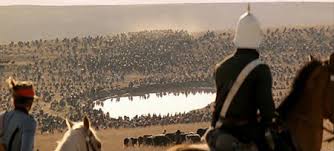
“Zulu Dawn” is different from most English and American war movies involving a non-White enemy with a few notable exceptions. “Burn!” from 1970 comes to mind, as does “Guns at Batasi”, “Battle for Algiers”, “Little Big Man” or “Something of Value”, movies that displayed non-Whites fighting Europeans in defense of their respective homelands righteously. “Zulu Dawn”‘s knowledge is in part lifted from eyewitness accounts of Men who actually participated in the battle. When Simon Ward’s character and his scout team ride over a ridge and come upon 10,000 Zulu Warriors steady mobbin by a watering hole, no CGI, just a spectacular eye-popping scene, the Zulus begin to move in formation and begin their battle cries. It feels like the Army of God’s super ego unleashed at that moment.
What is remarkable in retrospect is that even though the British may have felled as many as 1500 Zulu Warriors that day, they were firing rifles, cannons and rockets at the Zulus as fast as they could once the Zulu Warriors were in range. The Zulu Warriors were taking on intense fire from the British and yet they were so quick on the Battlefield and relentless as well as courageous that they simply ingested the British onslaught and then overwhelmed them once they had ran over their fallen comrades. In “Zulu Dawn”, the British soldiers eventually come off as unfocused and unsure, the Zulus are like an unstoppable force.

While the movie portrays the Zulu Army to be meticulate and well-trained, there is a focus to the depiction of the Zulu Military offensive that comes off as radical and revolutionary. Akin to the aforementioned Custer’s Last Stand, where a technological juggernaut got caught in the open field and wiped out by an army steeped in the ideals, values and courageous energy of the armies of the World’s past. The British and Americans became self-propelled into a portal where there Colonial ambitions were met by a sort of zeitgeist karmic super ego, the will of the people who lived there to defend their land and their way of life to the last drop of blood. It is my opinion that Producer Endfield wanted to get this message out through this film of the portrayal of the British Military and hierarchy as geo-political villains who for one day in January of 1879 met their match and reaped the whirlwind of God’s judgement on another Country and Culture’s home turf and the results have probably terrified the overlords of this planet since the day it occurred. The power of a focused united people is a commanding phenomenon.
Leave a Reply