During the early 1980’s, I was attending a public High School in Central Virginia, we students had to attend a Health and Wellness class, it alternated half the year with Gym. The pleasant and supportive Mrs. Saunders was not only my Homeroom Teacher, she taught the Health Class as well. She showed us a Health Class movie or filmstrip one day on Human Males and Masculine behavior traits. I recall one image was that of a group of sullen Males, sitting in a Bar getting loaded. The narrator said something to the effect of “Most Men do not verbalize their feelings, it is deemed Manly to repress sensitive inner thought, repression of thoughts and feelings have been shown in scientific studies to lead Men to health risks and issues such as premature Heart attacks and other mortality-inducing health problems.”
I was raised by one side of my family that was Italian and had no problem expressing themselves. My Father on the other side of my family had sought to be a Stage Actor and also had no issues about saying what was on his mind. I grew up around Academics, Artists and Men and Women of other professions that had zero problems divulging their innermost takes and predicaments. So what Men, I thought watching this film in class, was the narrator referring to? The film spoke of most Men spending as many hours as possible drinking, gambling at the local Casino or Racetrack, being tight-lipped or reserved about what was going on inside their minds.
The Health Class film appeared to present quintessential Men’s existence as stereotypically being a joyless, Spartan extent, as if all Men were ex-Military stoic Gambling alcoholics who hunt and work on machines in their leisure time. The Men in my life sphere during my youth mostly seemed concerned with ideas, their careers and what Woman or Women they were involved with. My Grandfather on my Father’s side did indeed drink excessively, gambled in his spare time and seemed untouched by concern unless he was adamantly and frequently verbally squabbling with his wife, my Grandmother. His incessant smoking and drinking led to his own premature demise in his early 60s. My Father, who is still alive today at the ripe old age of 80, informed me that all the Men in the Gordon family died before reaching the age of 65.
While I was on the internet not long ago, I became aware of the recent passing of Canadian-born filmmaker Ted Kotcheff at the age of 94, and I saw an inordinate amount of discussion concerning a forgotten ( and damn near literally physically lost) film of his from 1971, made Eight years before his fantastic American movie about Pro Football titled “North Dallas Forty” and Eleven years before his biggest commercial success was released, “First Blood”, starring Sylvester Stallone as hardened Vietnam Vet, John Rambo. The forgotten film in question was titled “Wake in Fright”; described by many as a psychological Horror film, the film’s biggest name for modern audiences would be career character actor Donald Pleasance, star of such movies as “The Great Escape”, “You Only Live Twice” and his biggest legacy role, that of vigilant Dr. Loomis from Director John Carpenter’s “Halloween” and it’s subsequent myriad of sequels.
“Wake in Fright” has an alternate title, “Outback”, and was presented in trailers as a film about a Man who descends into madness due to his engagement and life experiences concerning the nature of the people who lived in Australia’s wild and rugged Outback environment. The film has been compared and contrasted with two movies also released in 1971 (My personal favorite year of American and English-speaking films), those being Director Nicholas Roeg’s daring and insightful “Walkabout” and Sam Peckinpah’s searing and controversial “Straw Dogs”. Irish-born Film Director John Boorman’s super edgy outdoor thriller “Deliverance” has also been compared to “Wake in Fright”. The surface claim by some was that these three ancillary films contained negative messaging about the locals and culture of the Australian Outback, rural England and the forest-laden hills of Georgia, that these isolated places were being singled out for fostering a climate of malevolence.
I viewed “Wake in Fright” not long ago on an Internet site called Internet Archive and I was not only riveted and invested in what I was watching on the tiny screen on my phone, I was blown away, my mind felt expanded by this film. This movie has universal themes that go beyond it’s locale, which is just happenstance, this film could take place anywhere, the Australian Outback just gives it a surreal and thought-provoking backdrop. It has been quite awhile since a film rattled my internal cage like this one. While I don’t consider calling this film psychologically horrific as way off, if there is a sinister force being exposed here, it’s not an external one, not a specter that none of us have not seen before. The film’s most relentless savage doctrine is embodied by not an animal or force of nature, it is that of Alpha Males and the social climate they encourage and exist in. The film shook me, I was taken back to times in my life when I was unnerved by none other than type-A Men who seek to dominate all around them, physically and psychologically.
An absolutely beautiful-looking movie, “Wake in Fright” begins in earnest. Cinematographer Brian West has spectacular natural scenery to work with, his lens work here is memorable. The same goes for Film Editor editor Tony Buckley, who has opportunities to show his skills later in the film to devastating effect, with montages that echo the inner thoughts of it’s main protagonist. The film’s main character is played by Gary Bond, he plays the role of John Grant. Grant is made out to look prettier than all of the locals, probably by design. Grant is a school teacher, new to the Australian Outback, he has just finished his first year of teaching in a remote area.
The film begins at Christmas time in a tiny community in what looks like the desert, a town called Tiboonda.” “Tiboondocks” is more like it. Grant teaches a school room full of White kids, kids of varying ages, they all look frightfully bored and restless to be released for the Holiday, which due to the difference in weather South of the Equator, it is now Summertime and subsequently the last day of school before Summer vacation. Early on, the viewer senses that locals view Grant as less of a real Man for engaging in the pursuit of educating Children, his beatific exterior enhances this sentiment. As someone who taught Children for years, starting in my Twenties, I totally grasp this feeling, that feeling that life-hardened tough guys see the pursuit of educating youths as being Women’s work, that there is something inherently Feminine about a good-looking or youthful-looking Man teaching School. This sensation appears to be eating at John Grant as well.

Grant takes a train from Tiboonda to a mining town called Bundenyabba, where he would then catch a flight to Sydney and spend time with his almost mystical and mythical girlfriend Robin, a Woman we never get to meet, we only see visions of her in a bathing suit in Grant’s occasional daydreams. In one of his daydreams about Robin, Grant imagines pressing a cold bottle of Beer between Robin’s breasts, signifying a confluence of Macho leisure and sexual objectification culture, Robin looks like a fitting romantic escape object from all of this Masculine posturing Grant is surrounded by.
When Grant gets to Bundanyabba (these town names I believe are fictitious), he frequents a Pub where he is befriended by a local Policeman, Jock Crawford(Played by Australian Actor Chips Rafferty). Crawford relates to Grant that he has a keen eye for strangers, notices that Grant is new in town and engages him in a round of drinks, aggressively and seemingly repetitively. The Men in this part of the world drink like it’s a non-stop chugging contest and an affront to their Masculinity if they don’t drink with such fervor. Starting with Crawford, Grant’s good looks appear to make him stand out, he looks like a Magazine model in contrast to everyone else’s rough and rugged exterior.
Grant and Crawford’s drinking leads to Grant needing food after he gets himself a room for the night at a local Hotel. The weather is so hot that the Female desk clerk seems to be attempting to keep herself cool at her post to the point that she appears to be pleasuring herself out of loneliness. Grant happens upon a gambling enclave where he is eating, not only are there countless Men playing slot machines (While all the Women in town appear to be in groups at separate tables), Grant discovers an underground gambling scene where sweaty multitudes of locals bet hundreds of dollars at a time on an individual flipping two quarters in the middle of a circle. John Grant, hopped up on Beer, boredom and the anticipation of leaving in the morning to see his gorgeous girlfriend, wins at this gambling game as a novice to the point that if he wins one more time he surmises, he can quit teaching and escape to Sydney and begin a new life with Robin full-time.
Of course, he loses it all and now is trapped/stuck in Bundanyabba, at the mercy of the locals. With no place to stay now and nowhere to go, Grant lands at another Pub, contemplating his next move and the film really takes off. He catches the eye of a local named Tim Hynes (Played by Al Thomas), who appears to want to drink with Grant due to Grant appearing to be a fresh interesting face in town. After Grant relates his predicament to Hynes, Hynes offers Grant a place to stay with he and his attractive daughter Janet, played by Sylvia Kay. When Tim’s mates show up, a surly lot, Grant attempts to leave, sensing oncoming dread, but Hynes won’t hear of it. Stick around and have some drinks with the fellas, the inference being it would be ungracious and unmanly not to. Grant’s lithe and handsome presentation almost makes him a curiosity to these rogue-like tough guys.
Tim has invited over Dick (played by Jack Thompson), Joe (played by Peter Whittle), Doc (Pleasance) and others for a day and night of loud drinking and gambling, Tim wants Grant to join in, Grant is now yearning to find a way to get on a flight to Sydney somehow. Janet seems attracted to Grant’s good looks and sensitive energy and appears to wish he would take her away; mentally, romantically, physically and sexually. When Grant realizes that Janet is probably alone there all the time and doing the cooking, cleaning and pleasuring of these Type A Males at their whim, it disturbs him, he’s got to get of there, but he’s trapped. Making rash decisions would out him as hysterical and un-Masculine in this stiff upper lip land of non-comital ruggedness. Grant resigns himself to live off the land with these desert pirate types for the time being. The real Horror and squirm-inducing idea here is Grant’s own personal pursuit of Alpha Male Masculinity is what keeps him trapped. As long as he is concerned with upkeeping an appearance of being a macho tough guy with no feelings like the rest of them in front of them, he is fucked…….in more ways than one.
Bond is fantastic as the self-cornered Grant, his physicality is as impressive as his acting chops, we really get a feeling for a Man waffling between Beta and Alpha characteristics. In one scene where Grant is walking through the Outback with his belongings and his rifle, he tosses away the books in his suitcase to lighten his load. This is obviously metaphorical; keep the rifle, get rid of the pursuit of “pansy” knowledge, it ain’t gonna do you no good here. Pleasance plays an unnerving character, a former Doctor who gives up his profession to pursue a lifestyle of debauchery and Testosterone-fueled aggression and perversion. He holds no job, he gets paid in Beer, food and lodging for divulging occasional Physician information to belligerent and truculent roughnecks.
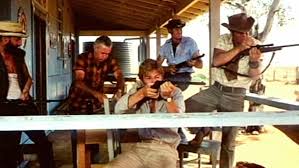
There is a controversial angle to this film beyond the psychological baleful content. A scene involving Grant, Dick, Joe and Doc hunting Kangaroos, which was imitated in Russell Mulcahy’s visually stunning Horror movie “Razorback” from 1984, involved some very disturbing footage, especially to Animal Rights Activists. Director Kotcheff did not want his name associated with the purposeful harming or killing of animals in the making of his movie, so to skirt the issue and provide the film with it’s most (depending on your outlook, there is a scene of potentially equal shock) polarizing and disquieting scenes, a film crew went along on a Kangaroo hunt with professional Kangaroo hunters. Even though the crew of the making of “Wake in Fright” was not involved with harming Kangaroos, real footage of Kangaroos being killed is on display here. If you happen upon this movie and watching real animals getting killed screws with your sensibilities , don’t give me shit for suggesting you watch it, this is your disclaimer.
The violence against the Kangaroos, the treatment of Women, the need to drunken fistfight each other as a substitute for sexual interaction, the juxtaposition of sado-masochism and homo-eroticism, the wanton drinking, this is a Man’s world where self-identifying real Men do whatever the fuck they want, guilt free. The tinge of malice associated with all the activity is part of the purpose of it all. The need to be violently demonstrative is a declaration of unbridled Macho Masculinity, we’ve all met and known Men like this in our real lives, one must simply out-maneuver them mentally, actually a simpler task than one might surmise.
Composer John Scott’s orchestrated score includes modern sounds as well, like electronics and synthesizers. The music is haunting as well as cyclical at times, we feel trapped in the same patterns with Grant through these melodies. Evan Jones wrote the explosive script, adapted from a novel written by Kenneth Cook. The Horror is embodied in that we the viewer are privy to a Man slipping into Madness, one could argue that it is a Hell of his own making. That Grant’s inability to accept himself in a setting run by predatory malevolence is exacerbated by his need for validation by other Men. The presentation of Women as trapped objects who give in out of perceived virtual necessity is perceptive and alarming.

What’s most discomforting about “Wake in Fright” and why I was so taken by it was it’s depiction of this society of Men in these fictional towns. The Men leer, and we contemplate whether it’s because they are dim bulbs, or whether they believe themselves to be superior or they think like drunken rapists, it’s all in play. The social angle seems to be perpetrated by Men who when they seek you out, they want something from you, it’s never without an exchange of some sort. The madness that John Grant experiences is that of a Man skeptical and contemptuous of his own Masculinity, he seeks praise from a society of Men who value excess and a primitive caste system based on size, temperament and surly attitude. Oh, and a willingness to drink yourself blind drunk on a daily basis. The Macho template exhibited in this film is bore out in today’s American society at this moment in time, I believe. Persons who identify with this type of Alpha Male behavior and Male toxicity are really feeling themselves in today’s social climate, which should alarm and be a call to vigilance for anyone with a conscience.
Leave a Reply