From my earliest moments of childhood literacy, I was gaga about anything relevant to Dinosaurs, Toy Soldiers and The American Civil War. I had books about the Civil War, adults would take me on day trips to Civil War battlefields, where there were program guides, complete with locations of battles with Civil War memorabilia and merchandise. Hell, I still frequent the small gift shop in New Market, Va every time I pass there on the way to visit my Mother in Charlottesville. There’s a battle site there, right off of Interstate 81, where the teenage members of Virginia Military Institute actually staved off a unit of hardened Union regulars during the war, this event is known by Civil War historians as the Battle of New Market. For years, my Father used to tell a story of Six-year old me correcting tourists to the Smithsonian who were simultaneously viewing a diorama with us of a Civil War battle that they believed to be Gettysburg. “Antietam” I allegedly said to them, almost arrogantly.
“The Red Badge of Courage” was one of the first books I ever read, a novel written by Author Stephen Crane, written in 1895. Even as a child growing up in the South, I never understood people identifying with the Confederacy, Southern Heritage, Antebellum culture and outlook. My Father worked in Charlottesville as an attorney in the 1970’s and whenever I would go downtown and see statues of Confederate Generals Robert E. Lee and Stonewall Jackson, I would be mildly confused. The American Flag was always a symbol of righteousness to me as a child.
The Stephen Crane-written book was brief and easy to understand, a first-hand account of a Civil War battle, told from the point of view of a fresh-faced Private in the Union Army. It wasn’t until recently that I came to understand that the battle Crane was describing was the battle of Chancellorsville, a series of battles that went on for a week between late April of 1863 and early May. Ironically, even though historians cite the battle as a victory for General Robert E. Lee and his Southern troops, the battle included an occurrence that was most likely one of the pivotal moments that hastened the end of the war; the unintended death of General Stonewall Jackson, arguably the South’s most feared commander by the Union Army, gunned down by his own Men while riding through the woods at night.
The only poetic touch Director John Huston uses in his filmed version of “The Red Badge of Courage” from 1951 is that besides some of the battle staging and a couple of symbolic shots is that he has a narrator (Actor James Whitmore) read key lines from Crane’s book throughout the film, lines that carry weight in relation to the battle drama unfolding on screen. Huston uses quite a few close-ups of characters as they remark on their thoughts and feelings, he uses long tracking shots to set moods, the aim appears to be putting the audience in the mind of the anxious soldiers, steeling themselves for what is about to transpire. We feel as though we are in the platoon, we’re almost as full of trepidation and nervousness as the characters themselves. Huston doesn’t use a lot of music here, the majority of the music are just the sounds and riffs of the fife, drum and bugle corps summoning or discharging the troops on and off the battlefield. Composer Bronislaw Kaper does however, supply an excellent orchestrated score for this as well.
When we hear “The Battle Cry of Freedom”, we know it’s the Union troops on the move, if we hear “Dixie”, it’s the Confederates. There’s more action happening off-screen than on, but the battle scenes are harrowing and unforgettable. Director Huston stages the charges of each side in smoke, gunfire and cannon explosions in open fields, since the film is told from the viewpoint of the Union’s side, we don’t see the faces of the Southern troops until almost the end of the film. When we do, Huston displays a commonality among the opposing forces who share the same mainland and language. A captured Southerner tells his Northern captors he is from Tennessee, to which a Union soldier responds that he has never met a Man from Tennessee before and that he himself is from Ohio. The Tennessean retorts that until this moment he had never met a Man from Ohio. Their respective provincial drawls almost sound identical.
There are a couple of filmed renditions of “The Red Badge of Courage”, one of which was a version made for TV starring Richard (“John Boy” from “The Waltons” television show) Thomas as Private Fleming, the book’s protagonist. Another version was theatrical, made in 1951 and filmed in Black-and-White by legendary filmmaker John Huston. I viewed this particular one recently, it is akin to a master class in simplistic filmmaking. With the exception of all the filmed timed explosions, this could not have been an expensive film to make. The setting is the woods, with open fields for battle scenes. No special effects, just hundreds of acting extras playing out a famous Civil War battle reenactment. It almost looks like a Documentary. I was mildly surprised to see that it cost 1.7 Million dollars to make and only retrieved barely over a Million of that at the box office.
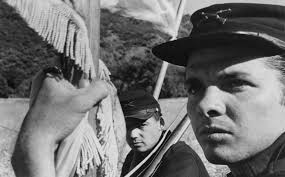
The film adds a dash of realism by casting two actual veterans of World War II, Audie Murphy and Bill Mauldin as it’s two main protagonists. What’s striking is how both are so youthful-looking given that World War II had now been over for Six years and that they had survived and lived to tell the tale, as it were. Both Men are quite convincing as soldiers and wide-eyed youths. There is a picture of innocence portrayed by the two that adds to the authentic feel of what we are watching on screen. They look and sound like young Men, growing up quickly in front of our eyes. The film shows the chaos of battle and how youth would come undone psychologically in an expedient fashion under such conditions. The anticipation of battle by all of those that have never experienced it before plays in part like a metaphor in ways, as battle is represented as a type of performance, which can translate to many aspects of life in general.
This slant that the film delves into made me think about coaching my own children through the rigors and anxieties of performing; the anticipation, the nerves, the worry of letting people around you and yourself down. I was taken to when I was helping my son through playing Baseball and performing on Trumpet in concerts and parades. Recently, assisting my Daughter through her first shifts as a Restaurant employee and Sushi chef. Just as the officers in this movie appeared to have the foreknowledge that young troops might flee their first time facing an oncoming enemy, the employer of my Daughter and other employers of young workers know that the workers may balk or shy at the first signs of contentious engagement. That fleeing the battlefield or the work station when things get hot is to be expected of youths put in a potentially stressful situation, not necessarily looked at as a blight on one’s character or a sign of eternal cowardice.

So it is here, in “The Red Badge of Courage”, our sympathetic leads turn tail the first time the Rebel attacks appear to break the line. The chaos of battle creates conditions so that nobody truly notices, those older and more experienced soldiers either stay and fight or die and/or get wounded, nobody has time to notice whether troops have fled. Those that remain and stand their ground assume that more Men have died or disappeared. When Private Fleming retreats to the woods and realizes that all is not lost due to his absence on the battlefield, he feels relieved, remorseful and ashamed. He wants to redeem himself, but he keeps these thoughts initially to himself, because nobody noticed or remembered that he wasn’t there. The heat of the moment swallowed the short memory of those that stood their ground, they didn’t have time to count who was there to stick it out with them, they were only consumed with surviving and repelling the enemy.
Huston’s depiction of War is akin to an assembly line; the soldiers perform like factory laborers, they are trained to dig a spot in front of them with their bayonets for rifle firing stability or they lay down well-tailored logs to shoot from and take cover behind. The most visible General, played Tim Durant, is like an encouraging boss, he rides around, talking to himself at times, or he’s riding through the regiments giving them pep talks, always spinning the results to make the troops believe they are winning. In one sequence before the climactic battle of the film, he rides to several groups of soldiers who seem anxious about the next detail, informing them he will eat dinner with them that night after they have performed their duties on the battlefield. The Men whoop and holler in approval, thinking that the General approves of their efforts, it makes them want to fight harder for him.
While the screenplay is dry and not opaque in any way, the simplicity of the soldiers’ dialogue and interactions with each other gives the viewer everything we need to get inside the soldiers’ heads. We don’t get too much gristle about sweethearts back home or tales of ordinary or the mundane, the troops are too dialed into the task at hand, typically either questioning each other’s commitment or praising each other’s fortitude. When Private Fleming yaps on while troops are in formation about all the details of soldiering that annoy him, other troops counter his complaints with stoic rebuttals. When the momentum of War overtakes him and he embraces a sort of suicidal gung-ho spirit, he gets nothing but praise from his fellow soldiers, like he’s part cheerleader, part galvanizing spirit animal. In reality, it is the only way he can cope with the moment. He creates a kind of self-kamikaze-type embracing of his potential fate. Like a Football coach might tell his players, you stand a better chance of getting injured bracing for the contact versus initiating and welcoming the contact. Each side in the conflict has two procedural strategies; lay down in formation and shoot at the oncoming charge of the opposition, or be the oncoming charge and hope that the fury of your offensive will traumatize the enemy and cause them to retreat. Private Fleming appears to be paralyzed with fear at the thought of laying down and shooting at the charging enemy, yet stimulated with a kind of hellbent energy when commanded to rush at the enemy.
More modern films depicting Civil War battles from the 1990’s such as “Glory” or “Gettysburg” make the fighting look totally terrifying, groups of Men firing rifles directly at each other, yards apart, then attacking each other with fixed bayonets. Here, this film was made in 1951, so the violence is a little more vague. We see a dead body here and there (the sight of which is given extreme gravity in it’s depiction), but we don’t see Men’s heads blown off as is seen in “Glory”.
The cinematography by Harold Rosson almost appears modern, there isn’t much difference at times between the sharpness in detail in the look of this film and movies from the 1970’s that used Black-and-White, such as “Tomorrow”, “The Last Picture Show” or “Paper Moon”. Huston sets up magnificent shots in this; a shot where Private Fleming looks up into the trees after a battle with the Sun shining through the trees causing a look of sheer grandeur stands out, as if God is looking in on the battle. There are countless images of smoke from explosives covering the expansive battlefields, these are the images that remained engrained in my mind from this movie. Shots like this are probably drawn out in storyboards for movies now, that kind of visual spectacle must be planned out with millions on the line. Back then, you wonder if Huston had a bunch of explosions staged and hoped for the best, it seems to me that fog was probably pumped onto the fields to create the ghostly quality that we see in battle scenes. It causes the charging Rebels to have a faceless, anonymous appearance. From a distance, they sound similar to attacking Native Americans from Cowboy movies, they manifest out of the mist like spectral blurs with bayonet-fixed rifles extending from their shadowy silhouettes.
The term “The Red Badge of Courage” in this story originates from a conversation across a divide that Northern and Southern troops have with each other at night, when they are taking a break from killing each other on command. The Red badge being a wound, most likely garnered from being shot, but any stain or wound on one’s personage of blood identifies you as someone who is giving his all for the cause. You have displayed enough courage to gain the respect of other Men being now that you have sacrificed for the War movement, you are literally giving up your own blood for this cause. Quenching a sort of self-hypochondria, the pain of wounds and injury is satisfying in that it proves to other people that you are trying, you are not a coward, the worst thing to be identified as. The Red Badge is a psychological pass, better than a medal on your uniform, your fellow soldiers can see your bravery right there, out in the open.
The other soldier characters that we hear from the most often in this film are performers/character actors from 1950’s films such as John Dierkes, Royal Dano and Arthur Hunnicutt. The platoon interaction is familiar and welcomed, the dynamic is most like farmers or factory workers working together; there is a sense of camaraderie while a portion of it is ball-busting and the rest is candid disclosure. These aren’t complex people, but they are simple folks given a complex task; kill these Men that walk and talk just like you do, kill as many of them as you can, we’ll show you how and give you the tools to do it. Huston’s movie is only sympathetic to the soldiers as people, not to any army as heroic.
While the film sways your personal want to see these Union soldiers survive, the movie doesn’t denigrate the Confederates, it doesn’t take a political side. We don’t get any dogma about the Civil War, this could be any war. Huston does a masterful job of staging the look and feel of the Civil War, without delving into it as a social issue. This movie stages a great dissertation on war and uses the costume period of the American Civil War to enact it’s model. Future generations of American school students should be made to watch this as a fantastic and dramatic representation of the American Civil War and what it looked like, felt like.

The words dispersed throughout the movie in snippets from the prose of Stephen Crane puts the viewer in the headspace of another era that feels directly from the soul of a Man who was on the battlefield and was relieved to have survived it. This film review was written in part to salute all those who donned a uniform in defense of their Country and perished, their deaths were not in vain. They gave the most important gift in the world they could give and the world will always consider them having given it in support of their comrades-in-arms, they gave the gift of their life.
Leave a Reply