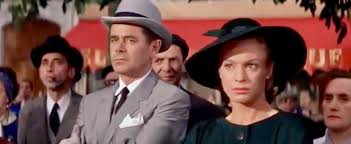
There are times as modern consumers of Arts and Entertainment, where we come across old works that have too many big names, too many accomplished voices in them for us not to take at least a Pandora-like peek at them. (The character in mythology, not the streaming service.) I found myself in this conundrum concerning a forgotten and discarded film, made in 1962 by the one and only Vincent Minelli. Yes, the Director of iconic Movie Musicals and savagely candid 1950’s dramas like “The Bad and the Beautiful” and “Lust for Life”, as well as Father to his arguably equally famous Daughter, Liza. Vincent helmed a melodramatic soap opera World War II yarn titled provocatively “The Four Horsemen of the Apocalypse”, a remake of a 1921 movie that contained a World War I backdrop and starred 20’s mega-star Rudolph Valentino. Like a cheap dime store novel that you wolf down in one night, I found myself engaged with this shlock, full of famous people, there was too much hard-selling of this material by it’s makers and performers for me to not get all caught up in it.
By comparison, Two superior films to this, one being the 1958 Black and White work “The Young Lions” with Brando and Dean Martin and the other being Visconti’s masterpiece “The Damned” from 1969, reminded me of this movie. Minelli’s film seems like the Disneyfied version of Visconti’s dark vision of pre-World War II Europe, and it also appeared that Minelli was attempting to make his own many splendored version of Director Edward Dmytryk’s brooding wartime soliloquy. But while “The Four Horsemen of the Apocalypse” is sloppy filmmaking at times, and not Minelli’s best, the film still sports a tremendous cast of characters who lug this psychodramatic material over the goal line and the look of this attempted epic is magnificent.
It is evident, not even arguable, that modern Fascism’s return is old wine in a new bottle. Pre-20th Century writers and thinkers such as Nietzsche, Georges Sorel and Thomas Carlyle wrote of using myth to rally and control the masses, the 21st-century return and public fascination with the underpinnings of fascist control make post World War II film and literature fresh again, maybe there are answers there on how and what to do when denizens and preachers of the F-word come a knocking on your door. In Minelli’s movie, based not only on the original film, but both are based on a novel by Vicente Ibanez, the title refers to the imaginary characters from the Bible in Revelations; symbolic riders of destruction who represent War, Famine, Pestilence and Death.
The movie opens in 1930’s Argentina, of all places, where a wealthy and successful European Family that has migrated to Argentina decades before is having a reunion dinner of sorts. The makeup of the Family appears to be analogical, as some of the Family originates from France, some from Germany. I guess you can already see where this is going. The Patriarch of the Family, an elderly wild-eyed Man who has embraced the culture and identity of his South American digs is played with intensity and brevity by Lee J Cobb. As the dinner commences, Grandpa seems ecstatic to see everyone at the dinner table in his South of the Equator mansion. When he initiates dinnertime conversation regarding the rise in Germany at this moment in time of Nazi-ism and Adolph Hitler, he is stunned to ascertain that at least Two people at the dinner table, his son and Grandson (played by Paul Dukas and Karlheinz Bohm) are full-fledged card-carrying Nazis now, to the point that the Grandson gives Grandpa an Elon Musk-like full Nazi salute. Grandpa is not digging this and responds by slapping the young Man flush in his Puss and screaming out “Assassins!” Gramps then goes on a rant about how the Four Horsemen of the Apocalypse have returned to Earth (by his calculations, they were last here during the First World War), he throws open the doors to the patio during a violent storm, keels over from a stroke due to all the excitement and passes away in the arms of another grandson, a non-committal Playboy named Julio, played by Glenn Ford. Needless to say, everyone has lost their appetite by this point and the scene fades.
The film resumes in Paris in 1938, where some of the Family is now residing (others are back in Germany)and going on with their lives. Julio is a jet setting Playboy, he pursues the gorgeous, yet extremely married Marguerite (played by Ingrid Thulin). Marguerite is married to Etienne, a radical Leftist Newspaperman played by surprise, surprise, Paul Henreid. Meanwhile, Family member Chi-Chi, another ravishing Blonde with short hair, played by Yvette Mimieux, has joined the French Resistance as the film moves forward to 1940. The Father of Julio and Chi-Chi is Marcelo, played with passion and eloquence by one of my favorite older film actors, Charles Boyer. The Germans arrive in Paris in 1940 and there is a Family reunion of sorts, as the German Son and Grandson are high-ranking officers in the Nazi Army. Dukas and Boyer are reunited and Dukas informs Boyer to get Chi-Chi in line or he won’t be able to stop the Gestapo from shipping her off to El Salvador, er, German Concentration Camps. Julio makes a plea to Chi-Chi to knock off her activism to which Chi Chi accuses Julio of being more concerned with banging high-class divorcees than standing up for Human decency.
This is strike one for Julio, who then attempts to take Marguerite out on the town like they used to in say, 1939, except now there are Nazis everywhere running around Paris and you know, Nazis like to party. One of the German Generals in attendance at the night club where Julio and Marguerite are cutting a rug in dazzling evening formalwear develops the instant hots for Marguerite, which really pisses the aristocratic Julio off. Strike Two. When Marguerite won’t commit to leaving the country with Julio so they can live a life together of tranquility in Argentina, due in part to the fact that she can’t turn her back on her heroic, and now physically and mentally scarred and crippled Husband, this is Strike Three for Julio, he decides to join the French Resistance. Partly because he hates Nazis now and in part because he wants to prove his worth to Marguerite that he is a Man of character, even though he has sworn to secrecy that he can’t tell her what he is really up to.
Aside from the beautiful views of Paris and the French Countryside, the film has three noticeable strengths. One is the performance of the cast and the moments of dialogue-infused intimacy between them. Second is the visage of the movie and it’s staging of scenes and look of the costumes and sets. Third is the pulsing and extremely harrowing film score by Andre Previn, simply a jolting and riveting selection of film music. The screenplay, written by Robert Ardrey and John Gay, is hokey at times, in other moments, invigorating. One odd aspect of the movie I noticed was, after an extremely lengthy and wordy opening, which seems to go for 15-20 minutes, we get a truckload of brief scenes and many, many, quick character interactions and whoosh, it’s on to the next scene. With a running time of over 150 minutes. This film felt like it had 75 separate scenes.

Glenn Ford as Julio is sturdy, some background reading I did on this film proposed that there were those who were advocating for the lead to be played by a young Alain Delon, the young French star, which would have been out of place, in my opinion, more on that briefly and why. Due to Julio’s relationship with German Aristocratic figures, he is allowed to move freely about Paris as he pleases, even though it seems after awhile, the Nazis are onto him and his ties to a Woman that is both coveted by a German General and is still married to an active French Resistance figure seemed odd, but hey, this is part of why this film was not embraced by audiences and critics upon it’s release.
Paul Henreid as Etienne is like a Victor Laszlo reunion tour, talk about typecast. Charles Boyer is an absolute treasure, every scene he’s in, the entire film is better for it. His passion, his sincerity, we believe this is a Man who wants to believe in the indefatiguibility of his Family’s ability to persevere, but also the fragility of that same Family’s existence. He and Dukas play Men with opposing viewpoints from the same Family who are beginning to realize that the terror felt by their Patriarch in the movie’s opening had a far reaching meaning and grave results for both of their Countries, but more importantly, their own Flesh and Blood Family.
Director Minelli’s vision for staging the look of scenes, whether it be French Nightclubs, Parisian street scenes or Nazi Compounds is encompassing, the Man really knew how to give large visual moments a chance to promote awe in the viewer, it is no wonder he was a master of being the architect behind iconic Movie Musicals. Crowd scenes are bustling, we get several scenes with Julio and Marguerite out dancing and every detail, including Bands, dancers, Nazis, Cigarette girls, Waitstaff, all contribute to a beautiful visual moving painting. This film was made only twenty years after the occupation of Paris, so first-hand accounts of how everything would have actually looked were most likely well in hand and fresh in people’s minds. Though critics at the time may have knocked dramatic aspects of this film, the look, costumes and art direction were hailed for their accuracy.
Andre Previn’s Musical work is nothing short of stellar here. From the opening moments of this film, Previn’s intense score ratchets up the drama and grandiosity, he was an Orchestral master. Having praised his work in my previous review of “Bad Day at Black Rock” (1956), his work here is of the same caliber, maybe even better. Minelli attempts some narrative liberties in this film by several moments showing an imaginary Four menacing Horsemen of the Apocalypse riding in the clouds of above humanity. They represent the thoughts of chaos going on in the minds inceptually of Patriarch Cobb and later in the mind of Julio, who has most embodied the legacy of paranoid and grave thoughts of his Grandfather. Previn’s music makes these moments tangible and not out of place. Previn’s stretching of String techniques are something to behold, this is not atonal or experimental, Previn’s score is accessible, but it carries an extreme energy with it. For all of the sections of the Orchestra, especially his First Violins, this does not sound like an easy score to play. It is a reminder to me at least as a consumer of films from all eras, no music sounds as fulfilling and compelling as the full Orchestral work that was so commonplace between the 1940’s and the 1990’s, that there is a dramatic profundity that is lost in the experience of film viewing without this dynamic supporting the action on screen.
While there are cliches here that weigh the movie down, I did like the character of Julio, Ford I felt was a good choice to embody this role, due in part that the non-committal nature of the character at first is believeable, Julio only becomes engaged when what he covets most, the companionship and affection of a beautiful and engaging woman, is being taken from him. This is what sets him off and persuades him to tap into the legacy of passionate decision making from his Grandfather who dies in his arms in the early scenes. By being the one in the family who goes to his Grandfather in his last moments, that Family energy is subsequently passed onto Julio, whether it was by intention or fate, or both. While others around him, including Marguerite inceptually, see him as somewhat aloof and not serious enough to believe in, Julio is stealthily aiding the French in blowing up German Generals’ cars, and he himself is shoving Nazi officers under moving Parisian Subway trains. Julio’s journey is a slow-burn transformation, but it is dramatically satisfying in it’s payoff.
Filmed in gorgeous Technicolor, the crux of “the Four Horsemen of the Apocalypse” is really the romance between Julio and Marguerite. While Julio enjoys playing the field, he is really in search of that one Woman. Ingrid Thulin as Marguerite is believable as the object of Julio’s desire, but she appears more interested in him as a material object she can rely on, since she can’t rely on Etienne, his love is more committed to his causes, then it is to her. Meanwhile, Julio can drop a quarter of a million francs on a Renoir just to hit on her. A modern girl can’t live on the tenets of activism alone.
I enjoyed the interaction between Julio and Marguerite in part because here was a love story about convenience and circumstance as much as it was about conviction. Julio bears no grudges against Marguerite when she rebuffs him a couple of times throughout the course of the film. He is enraptured by her, she is the embodiment of what he wants, he doesn’t play games with her or try to manipulate her, he doesn’t need to. Early on, to flirt with her, he outbids her at an auction on a painting by Renoir and then gives it to her as a token of his affection. I heard a quote on the Internet not long ago about there are no Gold diggers when it comes to Women, just Women that you can’t afford. Here, Julio shows that there are no monetary barriers that he’s not willing to break to exhibit his desire for Marguerite and she appreciates it, even if she’s not sold on the idea of Julio as a soulmate.

While Marguerite cannot turn her back on her earnest husband, she isn’t a tramp, she does not want the attention of the corrupt German Generals who want to strong arm her. Julio wants to take her dancing, take her on vacations, lavish her with gifts of affection that he doesn’t want to just give away to good-time girls who don’t fully appreciate it. We want Julio to admit to Marguerite so badly about his real heroism because it will cement their romantic bonds, but he can’t, he is sworn to tactical secrecy by the Resistance, of which he later discovers Etienne is one of his superiors in the Resistance. It is the complications of Julio and Marguerite’s romance that gives this film it’s most dramatic impact. If you are in search of an old-time feeling epic with lavish sets, spectacular dramatic music and a couple of emotional and cathartic pay-off moments near it’s completion, “The Four Horsemen of the Apocalypse” is worth a look.
Leave a Reply