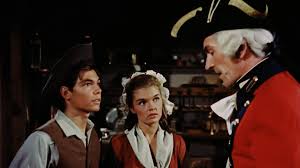
When youngins in the 1970’s turned on their parents’ TVs, there wasn’t a wide selection of fare to view after say, 7 Pm. “The Six Million Dollar Man” comes to mind, maybe “The Brady Bunch” and “Family Affair”. Of course, Holidays brought out the Claymation Christmas Specials and Charlie Brown Cartoons. Then there was a mainstay for Children, at 7Pm on NBC on Sunday Nights, the Wonderful World of Disney. I am specifically honed in on 1975, 1976, somewhere in there. I was Seven in 1975, I tried never to miss the hour-long show. Usually it was Cartoons or other Family-oriented shit like that. My Father used to grouse about the infamous “Heidi” game from 1968, when the Oakland Raiders and the New York Jets were engaged in a huge AFL Football Game on NBC that started at 4 PM in December and was destined for Overtime, only to be cut off right at 7PM by the Broadcasting Network to show the Disney movie about the little Swiss girl who liked to Yodel and I guess make bomb Hot Chocolate.
One night in 1975, I forgot about watching the Disney show until almost the very end. It must have been 7:55 PM and adult shows in Prime Time were about to come on. I turned on the TV and there was the end of a Revolutionary War Movie called “Johnny Tremain” on, how the fuck did I miss this? The battles were over, the credits were rolling and I was deflated. All these weeks of watching Mickey Mouse and Donald Duck and bullshit like that and I totally missed on a fucking War movie, meant for kids. I watched week after week, after that night, hoping they would show it again, and of course they never did. Then by the time I turned Eleven or Twelve and I was attending a Middle School where kids were getting assaulted and Gambling and Breakdancing and Boys would pluck Girl’s Bra straps for arousal, I forgot all about the Wonderful World of Disney, that was for softies.
I came across “Johhny Tremain” again on Youtube decades later, I was attempting to get my Ten-year old son at the time interested in History, he fucking loved it, couldn’t get enough of it. A Disney film from 1957, I finally watched the whole thing myself, it was chopped up in to Ten-minute downloads, back then you had to type in “Johhny Tremain, Part Four” or whatever. I found it to be an amazing movie to discuss, there is so much to tackle here, especially since it was aimed at “Family” viewers. There’s Patriotism, Religion, Racism, romance, violence, gun control, morality, Revolution, civics, etc. For a movie meant for kids and their parents to watch as a young reader’s guide to the American Revolution, “Johnny Tremain” is packed with compelling shit to talk about. If I had come to America from a foreign land, this movie would be a fascinating introduction to United States culture. I recall mentioning to my Mother that I had introduced this movie to my son and she must have recalled it from her All-American Massachusetts childhood because the first thing she blurted out was “Oh My God, I remember reading the book when I was a little girl, that was so sad when Johnny burns his hand trying to be a Silversmith’s apprentice.”
Directed by Disney Film auteur Robert Stevenson, not the writer of “Treasure Island” of olden days, “Johnny Tremain” is a handsome-looking film, the look of the movie catches your eye from the moment it begins, which is in a vison of Historic Old Boston. Looking like a combination of stage sets and painted backgrounds, the film has a magical quality, you definitely feel like you are back in time of some sort of glib happy-pills version of the Eighteenth Century, complete with accurate-looking housing and Colonial era dressed villagers everywhere, it looks like someone expanded Colonial Williamsburg into a big-ass city. When we meet young Johnny, a teenaged Silversmith’s apprentice, he is working for Mr. Lapham (played by Will Wright) and the elder is always quoting scripture to everyone to get his various points across. The Old Man and his Wife and Daughter are pious and devout Church-goers. Johnny is gregarious and an optimist to a fault, he blurts out to a wealthy customer that they can get some work done for him faster than what is realistic. The customer is a wealthy Tory-friendly asshole named Lyte, played by Sebastian Cabot of “Family Affair” and “Twilight Zone” fame. Johnny may also be related to Lyte, but he is afraid to approach him for fear of being accused of being a liar and a scoundrel.
Lyte seems to have young Black people as servants, which is the most cringe part of the movie, the Black people are definitely submissive servants, it’s hard to tell whether they are slaves by definition or not, although Massachusetts as a colony did not abolish slavery until 1783. Disney Studios was only Ten years past having made the repulsive “Song of the South” and there were heavy racist vibes in the adventure show produced by Disney between 1959 and 1961, “The Swamp Fox” with Leslie Nielsen. However, in “Johnny Tremain” the only Black characters present are the waif-like Black Child servants under the “employ” of an ally of the British in Lyte, a despicable shmuck of a character who accuses Johnny in court later of being a thief with no substantial proof.
The titular character is played by young Hal Stalmaster, who I kept getting confused with Lynn Stalmaster, the real-life Hollywood casting legend. Johnny in this film is as much a symbol of American optimism as he is the embodiment of the character from the book, a book written by Esther Forbes in 1943 and winner at the time of the Newberry Medal, a prestigious literature award given to writers of books for children. Johnny is always smiling and happy, eager to be of service to the rebellious adult characters in this book who will soon begin the American Revolution.
A heroic Revolutionary orphan must have a love interest, and in this case the movie contains a sweet budding romance through shared radical trauma between Johnny and Priscilla (played by Luana Patten), the good girl who wants to join the cause of liberty. The daughter of the old Silversmith, she helps the courageous Johnny at every turn, she defends him in court, they kiss, they hug, they spy on the British together, they sing campy songs of rebellion together, they make goo-goo eyes at each other, ain’t love grand? She’s always fretting over Johnny, especially once she learns that he is hanging around the rebellious and contentious “Sons of Liberty”, an underground consortium of Patriotic rebels who are sick of England’s tyrannical shit, including the English overtaxing all of the goods that the Colonists in America are receiving from overseas. the Colonists are growing tired of being treated like they are living in a big trailer park owned by England and the Sons of Liberty are devising methods of insurgency if the unjust fiscal bullying continues.
Johnny knows the local street legends like Paul Revere, Sam Adams, James Otis, etc, but when he comes in contact with Rab, played by Richard Beymer (listed as Dick Beymer here, he is Tony in the original film version of “West Side Story”), Johnny’s interest in throwing in with the Revolutionaries is piqued, he sees Rab as close to a peer, the Two teens seem giddy and friendly around each other. I know it’s a Disney film meant for kids, but they almost seem borderline Gay, they are certainly bonding with quality shared Musket time.
Speaking of which, the British soldiers and officers are portrayed as stiff dickheads. The Commanders, however, are well spoken Gentleman, keepers of Her Majesty’s integrity. One eloquent speaking General, General Gage, makes a great speech that American 2nd Amendment enthusiasts would be elated about. The script for “Johnny Tremain”, while adhering to the tenets of Family filmmaking is still pretty damn good. The script by Tom Blackburn and original source materialist Esther Forbes walks the line between accurate American History and Youth Adventure Film conventions, but make no mistake, once the battles begin, we get to see quite a few soldiers and Militia members get shot. While there is no blood and gore , this was an unusual film to be aimed at kids.

Technically, Johnny Tremain” is really cracker-jack filmmaking; beside the beautiful and Historically believable sets , the Cinematography by Charles P Boyle is glorious to behold, every scene awash in gorgeous Technicolor, famous scenes are shown like Paul Revere’s Midnight ride through the Massachusetts countryside. Once the declarative Historical events begin unfolding, such as the Boston Tea Party. Paul Revere’s ride, the Green at Lexington, the shootouts at Concord, it’s all staged better than any reenactment. It is only slightly off-putting that all the American Militia are smiling all the time on screen like it’s a musical number while Men on both sides are dropping dead from Musket ball wounds, scenes of historically documented carnage contain all of the gravity of a Tom and Jerry cartoon.
The film brings us easy to digest depictions of famous American Patriots and thunderous moments from American textbooks. Look, there’s Paul Revere (Played by Walter Sande, the chubby fisherman tourist from “To Have and Have Not” that gets killed before he can pay off Humphrey Bogart for the fishing boat rental.). Here, his Revere is a jolly, affable fellow who when the moment calls, rides on his horse like demons are chasing him through the Massachusetts Countryside at night, alerting the citizenry to grab their muskets, powder and Beef Jerky, because those blasted Redcoats are coming. Not only is he a cool dude, he’s like that Shop Teacher at school you took your broken Class Ring to for fixing. Rusty Lane plays Sam Adams, who doesn’t brew high-brau Beer, he’s a stoic type fomenting Revolution. He hardly seems to say much, he’s got this unwavering look about him and this stereotypical Founding Fathers’ hairstyle, his look says a thousand ungovernable words. Walter Coy is Dr. Joseph Warren, another pillar of the Patriotic Community, along with Whit Bissell as Josiah Quincy, who defends Johnny in court as his trial Lawyer.
All of the Patriotic elders are like cool Cub Scout leaders, they give Johnny sage advice when they are not huddled in some dark musty attic, plotting the beginning of White America. We can thank ballsy intellectual Massachusetts rednecks for the initial formation of the United States and this film commemorates their diligence. I have intentionally left out Jeff York as James Otis because I want to get to that character and his cathartic speech in this review’s big finale. “Johnny Tremain” turns the Boston Tea Party of December 16, 1773 into a rousing Musical number, where the Sons of Liberty culturally appropriate the look of Native Americans to create the largest and saltiest batch of Iced Tea ever mixed. Priscilla joins Johnny by his side as a a whole group of “Indians” sing a song hailing the Liberty Tree and the Sons of Liberty. An English Officer gushes over the fracas as he views it from his window, declaring “these Indians are prioritizing principle over profit”.
The movie also gives us the iconic American symbolic combat moment of the “shot heard around the World” at Lexington Green as well as the subsequent guerilla tactics of the well-armed militia as they harassed and picked off Recoats on their retreat back to Boston. For a Disney movie, honestly the battle scenes are pretty convincing, except for the fact that Johnny and Rab are smiling and laughing the whole time, you know there isn’t a tinker’s chance that a British musket ball is going to be tearing through their Colonial attire today. As a side note, I once viewed English Director High Hudson’s much maligned “Revolution” from 1985 a few years ago, it’s depiction of the Battle of Bunker Hill is very gritty and realistic, the total antithesis of the war depiction here, yet it makes an apt companion piece, showing another of the most famous of Revolutionary War moments which occurred 250 years ago.
To round up the complimentary aspects to “Johnny Tremain”, the musical score by composer George Bruns is patriotically inspiring when need be, there’s not much darkness here, it’s fluffy and upbeat, much of it is lush, orchestral fare. The movie has that glossy Disney look of the 1950’s and 1960’s, akin to “Mary Poppins”, “Darby O’Gill”, “Bedknobs and Broomsticks”, etc. This brings me to the real game-changer concerning this film; the character of James Otis and his substantial speech he makes in the latter half of the movie. The screenplay gets the nod for this, it is a dynamic and galvanizing piece of theater.
According to History texts, James Otis was one of the sharpest minds of the Pre-Revolutionary consortium, similar to Patrick Henry and Men of that ilk. Two interesting Historical anecdotes about Otis; he deeply adored his Wife (even though she was a self-proclaimed supporter of King George of England, Mrs. Otis was a full-fledged Tory). The second was that Otis sustained an debilitating injury years before Lexington and Concord occurred. On the first count, I too share a guilty pleasure desire for Conservative Women, so I can sympathize with Mr. Otis. On the second count, his injury may have given him extreme moments of clarity that others did not possess. Otis had focus, this is on full display when a clandestine meeting of the Sons of Liberty puts the spotlight on Otis to make a declarative statement concerning what should be done and why. Otis delivers a blistering pronouncement that would give anyone ignorant to the causes that lead to the American Revolution a definite crash course in United States history and civics expectations.
Otis is credited with coining the phrase “taxation without representation is tyranny”. Otis was a prominent Colonial Lawyer and political activist in real life. HIs hard stance on the legal inconsistantcies of British rule led to a physical assault on him by British Customs Commisioner John Robinson, who caned Otis to the point that he gave Otis a fractured skull and brain damage. His declining mental health was mentioned in the movie during the sequence where the character really has his defining moment to shine. The Colonial agitators here give him the floor during a crucial meeting and Otis spells out why there must be an uprising against the British.
In this amazing speech, Otis sites that because of the Anglo origins of most Colonists, the British have not clamped down in the way they would have clamped down on other societies under British rule. He is suggesting that the Colonists must strike while the iron is hot, so to speak. That their Anglo Whiteness gives them cover. By contrast, the fact that they are being exploited by the British in a way that English citizens themselves are not being exploited is why they should revolt. That they are being treated and used as second-class citizens. When Otis asks the room, “Why do we fight and what are we fighting for?”, the Men in the room, like Sam Adams and Dr. Coy give answers that are insufficient to Otis’ point until Johnny blurts out, “We fight for the rights of Englishmen?”, to which Otis heartily agrees. He then compares the plight of American citizens to the peasants of France and the Serfs of Russia, saying that American must be a place where all Men are free to live their lives.
This sequence is open to debate, but I would interject, is Walt Dinsy making a film here that makes the point that unilateral citizens deserve untethered freedom, Regardless of skin hue, Religion, cultural background, personal orientation and perhaps gender? Well, why not? In Otis’ speech, he doesn’t say White Men, or White Christian Men, he says all Men. I feel like this was a big moment in celluloid America. That in 1957, one of the most White bread sources of film culture released a movie showing the Fathers of the American Revolution, a watershed moment in modern Human History, declaring that all fucking Men are equal and I further read in to that as all people, Man just being an arbitrary term.

If you don’t agree with me, watch this film again, or view it for the first time. As we live in 2025, and so many in this country are attempting to redefine who gets to enjoy the fruits of their labor in American society, here’s a film from the veritable Horse’s mouth of the building block minds of the establishment of the United States, that this be a safe haven for all Men, for all People, that America would be the next step in the evolution of the intellect of the peoples of the World, not just for those of Anglo-Saxon heritage.
I have viewed the scene with James Otis making this speech maybe Ten-Twenty times and my Heart becomes full and my spirit invigorated every time I watch it. I challenge anyone to watch this film and more specifically this scene and see if you don’t come away with the same feelings, that Johnny Tremain as a film is not just a good movie, in this moment Walt Disney and Robert Stevenson stand on the shoulders of Esther Forbes’ source material and make a profound declaration concerning America’s existence as it was led by arguably a thoroughly fastidious thinking Man in President Dwight Eisenhower, that America was and is to be a place of progress and change from the Old World that it evolved from. As an American and citizen of the World, I believe the scene with James Otis from Johnny Tremain is one of the most profound and important philosophical gifts that America has ever bestowed upon the World and I believe all Americans, especially in this present time of great moral and philosophical conflict in America as to what America stands for, should see this film and judge as to it’s meaning for themselves.
Leave a Reply