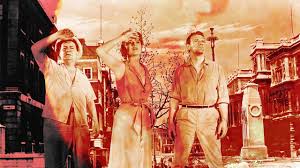
One gets a sense that there existed at least a portion of Western society that was of hardier intellectual stock in the late 1950’s and early 1960’s than today by the caliber of Arts and Entertainment they enjoyed. Ok, so maybe the gourmet food they were partaking in was hit and miss, as well as the fashion, but I would point to a certain type of film that became slightly trendy to produce during this time period; the Science-based Doomsday picture. Movies where an occurrence based on possible or even probable scientific activity could lead to the doom of mankind, the Planet Earth, or both. Most of these films I am referring to not only had strong casts, they were steeped in pragmatic analysis and possessed thoroughly written scripts.
Films such as “On the Beach”, with an all-star cast concerning the last days of mankind as it saw the Human race wiped out by fallout from Nuclear War. “Fail Safe”, “Doctor Strangelove” and “The Bedford Incident” all contemplated a full-out Nuclear War between the Soviet Union and the United States, “Fail Safe” perhaps by default being the most hopeful of the Three. “Panic in the Year Zero” and “The Last Man on Planet Earth” are films with titles that are somewhat self-evident. Doomsday pictures covered dread-filled scenarios, how the characters processed and dealt with impending catastrophic situations were where the crux of the cinematic efforts lay.
I was restless on a Family vacation on Cape Cod over forty years ago in 1984, when the late show of a Boston-based TV channel I was watching announced the upcoming Saturday Night film; “The Day the Earth Caught Fire” was the offering on this particular Summer night. Certainly a title that left little to the imagination, I figured I was getting ready to view a cheesy 60’s Science-Fiction Horror movie, maybe it was going to star John Agar and John Saxon, I thought. What I ended up viewing was far more thought out than I was anticipating, this movie was almost over my head. A blend of warnings about not only the use by the superpowers of Atomic bombs and energy, this film seemed to be an early warning about climate change as well.
A surprisingly high-brow and haunting experience, I recently revisited “The Day the Earth Caught Fire” when I was thinking about hot temperatures during a recent East Coast heat wave in the present day. Viewing this movie brought back those surprising feelings of melancholy, isolation and anxiety from that night on the Cape all those years ago but it also dawned on me that “The Day the Earth Caught Fire” was a remarkable effort for it’s time and seems like a movie of almost Nostradamus-like properties when viewing it now. Some digging into details about this film brought out even more fascinating anecdotes that I had missed the first time I saw this on that sweltering August night in 1984.
An English film from 1961, “The Day the Earth Caught Fire” was a pet project of a Film Director who was typically making Horror films for England’s famed Hammer Studio, Val Guest. Apparently, he had wanted to make a Doomsday flick for years that no studio was interested in funding, due in part to it’s somber subject. The film takes place for the most part in London, during an unusually hot Summer. The film’s plot centers around a journalist, Peter, played by English actor Edmund Judd, Judd looks and sounds a lot like modern actor Thomas Jane. The role was supposedly initially written for Richard Burton, but Burton was too expensive by this point. This film was made on a modest budget of 190,000 British pounds, which is extraordinary considering the effects they are able to pull off as well as how well this movie is put together.
Peter works in his Newspaper Office with Leo McKearn, a crusty life-weary Newsman named Bill. Peter is a single Father with a Seven-year old Son he sees as part of a custody agreement. Peter is also an admitted alcoholic, prone to emotional outbursts. Peter has a chance encounter with Jeanine, a beautiful phone receptionist, played by Janet Munro. If the latter name sounds familiar, Munro plays the object of Sean Connery’s affections in the Disney Classic film, “Darby O’Gill and the Little People”, Munro plays Katie in that movie. Here, she’s a gorgeous and skeptical Phone Operator who at first is repulsed by Peter.
While these and other characters are living out another mundane Summer in London, the weather appears to be warmer than ever, which is doubly odd since in the film, the United States and USSR have been conducting simultaneous Nuclear Bomb tests. As the weather becomes more unpredictable, including Cyclones, Heat Mists and other odd meteorological occurrences, the group of characters that the film is following who are predominately working in a London tabloid newsroom, discover that the Nuclear tests and the rogue weather are indeed linked; the Nuclear Bomb tests have knocked the rotation of the Earth off it’s previous axis and in addition may be sending the Earth in a new direction: A direction towards the Sun.
While this potential cataclysmic activity is occurring, Peter and Jeanine are having a courtship under climate changing duress. The movie is multi-faceted in that while the literally Earth-shattering events are taking place, the romance between Peter and Jeanine is as important to we the viewers as the potential end of Mankind. Peter goes through his motions as a news reporter attempting to discover as much as he can about the potential climate change apocalypse while existing within the framework of an anxiety-riddled workplace, attempting to see his son and keep his son oblivious and calm about the impending doom that awaits them all and still have time for dating, might as well while there is still time.
The banter in the newspaper office, especially with sidekick Bill, is straight out of old-school crackerjack scripts such as Howard Hawks’ “His Girl Friday”. I can’t tell whether the Newspaper Office scenes show off how bright these Newsmen are about climate Science or that they simply sound smart because they speak so fast. Filmmaker Guest apparently put some real Newsroom people in speaking roles which adds to the authenticity of the Office scenes. The workplace environment is somewhere between Billy Wilder and Elia Kazan; it may contain a volley of dry British comic barbs and then turn stark and cynically serious. Guest films the newsroom scenes like they are a stage play, the newsroom is like a podium for this film that sets the tone, makes important announcements and gives off the impression that there once was a perception that news rooms were full of smart and independent thinking people who constituted possibly one of the most important think-tanks in 20th-Century Western society.

“The Day the Earth Caught Fire” is not just a climate change disaster movie, it’s an anti-Nuclear Arms and War movie. The film contains multiple scenes of characters discussing the global need for Nuclear weapons and/or the Nuclear tests the super powers were conducting in the 1950’s and 1960’s. This picture contains a newsreel-looking, Anti-nuke rally in London, complete with counter-protesters. The pro-Nuke supporters of course eventually snap out and start confronting the anti-Nuke protesters, as much as things change, some things will remain the same. Nuclear weapons are decidedly not seen as as a good thing in this film by any means.
This is a remarkable looking film, considering it’s meager budget. Director Guest and his special effects team manufactures a night time Cyclone in London, a daytime Solar Eclipse, a day and nighttime Heat Mist that envelopes London, Monsoons and of course, super hot days that look realistic. There are no villains here, except for third-hand characters’ complaints about Superpowers whom we never see. Peter has to fight some doomsday beatniks later in the film, but they are not villains so much as they are nihilistic youth who are acting up due to the potential of mankind’s ending and all that. There is no music in this movie, which is a haunting touch, the aforementioned beatnik scene involves street musicians, who are playing music created by Monty Norman. Norman is associated with being the creator of the original James Bond theme in later years. “The Day the Earth Caught Fire” also includes a cameo by a young unknown actor who plays a Police Officer, the actor’s name is Michael Caine.
Unlike “On the Beach”, this particular movie still gives the audience hope that the Earth could be saved, but the collective melancholy of the film’s characters is coupled with a very English form of camradarie. It’s like all the Londoners are in Battle of Britain mode with no Nazis to focus their collective energy against, only Mother Nature and fate. There are some scenes of populist unrest but not as much energy is spent on that as there is on the love story, the brightest spot and endeavor of the film.
Being that this film was only made Fifteen years after the end of the Second World War, the screenplay (written by Director Val Guest, along with Wolf Mankowitz) brings us a tight-knit London, a city that appears steeped in it’s unity when the chips are down, there is a sense of community and civic pride that exists in this fictitious portrayal of the city’s denizens, they are all looking out for one another, this is not a representation of the city as a Rat race. This is a society that has seen it all and in place of anxiety we get compassion and frugality among it’s partisans. As cynical as this movie is, it is not cynical about the Human spirit and more specifically, the inhabitants of London.
Aside from it’s clairvoyance concerning ecological blight caused by Man, it’s sharp commentary on the destructive power of Nuclear proliferation, It’s displaying the edgy pathos of an ambitious modern business environment, “The Day the Earth Caught Fire” gives us a love story we can be invested in, involving Two lonely souls brought together by crisis. They see in each other a postulate not only for rekindling their fervor for their own lives, but the energy and hope to save the world. Though the focus of the film seems aimed primarily at the Male lead, the Female lead is somewhat fleshed out as well. Actress Janet Munro wanted more to do on screen than her past Disney fluff, she wanted a role with some depth. She is given a scene or two where she is practically nude getting in and out of her bathtub and for this the film received a Mature Audiences Only Rating by the British Ratings Board at the time.
Munro’s performance is understated and traditional, but she’s no pushover. She’s a working girl who is skeptical of Peter, yet taken by his charming and eloquent persistence coupled with the sudden anxiety of the moment which brings them together. In one sequence, due to a Heat Mist that envelopes London, Jeanine allows Peter to stay in her flat until the mist subsides. While a guest, Peter becomes increasingly forward with Jeanine to the point that she feels the need to momentarily rebuke him, reminding him that he is too easy, too obvious and telegraphing his motives. Peter returns to her a few minutes later and in so many words tells her that he doesn’t want to kiss her or hold her or make love to her as they sit sweating on her bed due to the heatwave. The look in Jeanine’s eyes says it all, it’s a fantastic scene filled with romantic tension that has to be broken, not even the threat of Ecological Armageddon can quell this.
As for the character of Peter, the film is essentially as much about his character arc as it is the fate of the World. We can tell he’s an egotist, that he’s good at his job as a reporter, that he’s torn in regards about what to do with his son. The scenes between Peter and his Seven-year old son are bittersweet, we truly don’t know if these are the last moments for the Two of them together and Peter has to continue to put on a happy face for his normal and emotional child; he’s not ready to break the boy’s spirit and confide in him that the World may be coming to an end. Peter would rather give his son the facade of a boyhood, complete with laughter, Ice Cream and Amusement Park rides. I truly felt the ironic influence of the sci-fi writers of the time of this film such as Ray Bradbury and Isaac Asimov. Guest created a film that is both a personal confession and a global statement, this is such an undervalued and thought-provoking film.
It speaks to the sophistication of Boston Television in the 1980’s that a film such as this only qualified for the kind of late night time slots normally reserved for retro trash like “The Giant Gila Monster” or “Silent Night, Deadly Night” in most cities. The Cinematography was done by Harry Waxman, who was also the Cinematographer for the groundbreaking Horror film, “The Wicker Man” with Christopher Lee. The movie has the tight Black and White look of A-pictures in it’s day. Guest’s use of lighting and shadows in night time scenes brings about an unspoken tension. The presence of the incessant heat heightens the atmosphere of the sexual tension between Peter and Jeanine, it’s just too darn hot not to want to be in love at a time like this.
I think it’s pertinent to ask if you end up watching this criminally underrated movie, ‘what is this’? Is it a climate change and anti-nuke movie? Is it a soliloquy on human behavior in the face of extinction or is it a love story with the anhilation of Mankind as a backdrop. The focus of the movie seems to shift as each previously mentioned concept steps in front of the other in almost a cycle. The film never tires of keeping our attention, there are definitely zero lags here.

Director Guest, coming from what might be considered an exploitative filmmaking background for his time, made a heartfelt gem of a film that is at once heartbreaking, inspiring and deeply romantic. There is a sense of yearning from his characters, a collective desire to turn back the clock from the Nuclear age and return to a headspace where they can sunbathe on their lunch break, take their children to the amusement park, argue about Right-wing versus Left-Wing politics, sing and drink at their favorite bar until they are tipsy and aroused enough to go home and make love.
Yet, in a brief period of time, all of that is taken away from them, an ecological cancer has appeared overnight and it may be too far gone for even an Earth-wide biopsy. In a savage moment late in the film, the workers at the Newspaper are shown down in the printing press room awaiting the outcome of news from the World’s higher-ups who are attempting drastic measures to save the planet from imminent catastrophe. As the presses are on the precipice of printing the next day’s headline, one carbon ready to print exclaims ” World Saved” and a second one reads “World Doomed”. Roll credits, they don’t make these truth-telling kind of films anymore, today’s audiences can’t handle the truth.


Leave a Reply