When a film gets released at the wrong time for all the right reasons, I suppose that it’s only natural that it would be dismissed and forgotten. Add on that the movie is made by arguably one of the best American Filmmakers and Screenwriters of their generation and that the main star is a Hollywood icon, known as much for his ability as his pragmatism and integrity, and now the film is suddenly by word-of-mouth, considered a disappointment. I came across just such a film years ago in the middle of a blah weekday afternoon and then rediscovered it this week and was veritably stunned at how hip, electric, relevant and well-executed it was. I was referring to a Political Comedy from 1961, Directed by Billy Wilder, with a script written by I.A.L. Diamond and starring James Cagney with a totally forgettable title, “One, Two, Three.”
From what I gather, this Cold War satire/farce was released at Christmas time of 1961, in the midst of the actual Cold War, so the masses didn’t think the timing was right nor found the idea particularly funny. This flick is a howl, a rapid-fire joke fest that is hard to keep up with, I feel like I need to watch it again, just to pick off more of it’s best lines. Apparently, it was actually filmed in part on location in Berlin, (Filming was actually interrupted in August of 1961 while the Berlin Wall was being built) which seems incredulous to me; I know it’s not the same as “Open City” or “The Bicycle Thief” being filmed in post-War Europe in real time in a smoldering zone, but still this is high-voltage political satire being allowed to be filmed in an extremely tense and divisive area at the time.
My Father informed me that when he was a lad of 16, his parents (my Grandparents), took him to see this when it opened in theaters. He must have had a hipper childhood than I realized, this flick is fraught with Capitalist vs Communist ball-busting, lampooning of European lost-fascist cultures and Sexual double entendres. Aforementioned script-writer Diamond’s work here is razor sharp and dogged, on par with his previous work like “Some Like it Hot”. I had forgotten that not only was “Some Like it Hot” a recent triumph of both Wilder and Diamond, but “The Apartment” had just been released a year prior to “One, Two, Three” and had been a smash success with audiences, critics and the MPA. Wilder and Diamond swung for the fences again with “One, Two, Three” and early 1960’s audiences’ reactions aside, I thought they crushed it. Diamond’s wordplay is in Preston Sturges’ territory here, it’s that sophisticated.
Filmed in Black-and-White by Cinematographer Joseph Lashelle, “One, Two, Three” is supposedly based on a Hungarian stage play from the 1920’s, but it is also allegedly based on “Ninotchka” (A film Billy Wilder co-wrote the screenplay for) from 1939 starring Greta Garbo. This movie, “One, Two, Three”, as another online critic noted, is chock full of product placement, something that was relatively new to cinema in 1961, especially industry jargon about soft drinks, namely Coca-Cola. Cagney’s character, thrifty and sanguine Businessman C.R. MacNamara is a ruthlessly ambitious Coca-Cola executive stationed in Berlin with his family in tow. MacNamara’s newest hot idea is attempt to sell Coca-Cola to the Russians, even as Berlin has now been divided (As had Germany been at the time) into East and West.
The set-up at MacNamara’s office is a hoot from the start, if you’re not easily offended. Diamond’s script gives us a West Berlin branch of Coca-Cola that runs with all the efficiency of a Swiss watch. Since all of the employees are German, they are still traumatized and conditioned from the Third Reich days, they crave discipline and an authoritarian boss as if this was a skit written by Don Rickles. The more MacNamara shouts at them and pushes them around, the better they respond and harder they work, although MacNamara only pushes buttons by way of his manic capitalist instincts, not because he initially means to be inside their collective Teutonic heads. Every morning he arrives at the office, they all stand at attention at their desks as if they are wardens of “Stalag 17” (another Wilder film from years earlier). While MacNamara appreciates their effectiveness, he has reservations about being the catalyst to the workers’ innate Fascist conditioning.
MacNamara’s assistant, Schlemmer (played by Hans Lothar) is so far gone in his personal submissiveness that he clicks his heels in deference to MacNamara every time he reports to his American boss or is given a command. Somehow, this running gag never gets old, it’s like a reliable jab from a boxer that is comedically relentless and effective. Speaking of “Stalag 17”, two of the Russian business envoys that come to McNamara’s office to discuss a possible business deal to sell Coca-Cola are actors (Johan Banner and Werner Klemperer) who end up cast on the TV show “Hogan’s Heroes” later in the decade, this TV show was intentionally and obviously based on “Stalag 17”. MacNamara has a wise-cracking stay-at-home wife, played by TV and Movie actress Arlene Francis and a Secretary/Mistress played by Liselotte Pulver, who is sort of a Euro version of Marilyn Monroe. Whereas I found her just as visually appealing as Monroe, she is a superior Actress and Comedienne to boot.
So, MacNamara lives on this hustle energy, he’s got plenty of Women to juggle and he’s hoping to eventually get moved by the company to perform essentially the same gig. Then the plot abruptly thickens. MacNamara’s boss calls from Atlanta, Ga (Where Coca-Cola’s headquarters is)and informs MacNamara that he needs to house, watch over and chaperone the boss’s precocious Seventeen-year old daughter for a few days until the Boss can get to Berlin and take her home back to Dixie. The daughter is travelling across Europe and is a pistol and a trouble maker, especially when it comes to attracting strange Men. For instance, when MacNamara goes to pick up Scarlet Hazeltine at the airport, the daughter (played by young and upcoming actress Pamela Tiffin) is trying to decide which one of the handsome Male Airline Pilots on her flight she wants to date first. When MacNamara puts his foot down and tells the pilots to all get lost, the pilot the daughter had chosen, named Pierre, turns to Mrs. MacNamara for a hoped for second opinion. Protesting that Daddy MacNamara’s actions aren’t fair, Pierre says to Mrs. MacNamara, “This is unfair, as a Woman, I appeal to you”. Without skipping a beat, Mrs. MacNamara looks Pierre up and down and declares, “Yes, you certainly do.”

When the Coca-Cola boss Hazeltine (played by Howard St John) informs MacNamara that he is coming to Berlin to pick up his daughter, the riotous fireworks begin. We discover that the daughter has been secretly visiting East Berlin at night to hook up with a handsome Communist played by Horst Buckholz. I hadn’t realized that the young actor had just starred as the young gun in the original “Magnificent Seven”. The daughter is a daffy rich debutante amid this fertile comic ground. When describing to MacNamara how she came to meet and fall in love with a young Communist radical, the daughter remarks, “He called me a bourgeois parasite when I first met him…..so naturally I fell in love with him.” The banter between Scarlet and MacNamara’s wife is equally zany. “Have you ever made love with a revolutionary?” The daughter inquires. MacNamara’s wife responds, “I once made out with a Stevenson Democrat, does that count?”
“One, Two, Three” is over 100 minutes of zingers like this, watching this I felt like I had seen a junior version of this type of humor before and then it struck me that the I.A.L. Diamond style of joke writing was one of the Godfathers of the modern sitcom. Yet here, among all of the fast-flying jokes. the energy of Cagney is truly amazing, he is the tireless Bell Cow. While certainly there are jokes that misfire and at times the dizzying pace of the humor wears the viewer out, one scene in particular encapsulates Wilder and Diamond’s messaging here and it is in my mind, one of the funniest scenes in American screen history, on par with his best bits from “Some Like it Hot”.
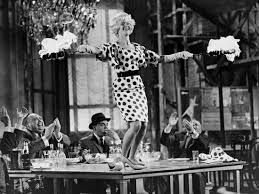
Without going into too much background detail, MacNamara finds himself in a pickle at one point and needs to dangle the one thing his Russian business counterparts covet most of all in order to get them to influence the East German Police to release the young Communist on trumped-up charges that were originally orchestrated by MacNamara. The Russian business envoys are gaga over MacNamara’s secretary, they want her for themselves, thinking that they can arrange the same sort of shady and potentially sordid arrangement with her that MacNamara has, but they are not as suave or as slick as him. A negotiation breaks out at an after-hours joint in East Berlin where the only way the Russians can have access to the secretary is if they promise to influence the East German police to let the young Communist go. MacNamara tantalizes the Russians by having the secretary dance on top of tables in a polka-dotted dress that MacNamara has purchased for her as part of his promise to her of “fringe benefits”. The scene gets compounded by the waitstaff bringing out flaming shish-kabob lances for her to twirl while she dances and begins to strip. While MacNamara and the Russians drink, the secretary’s dancing drives the Russians crazy, one Russian even takes off his shoe and begins banging it off the table, a la Premier Khrushchev’s action during an infamous real-life heated Cold War moment. Diamond’s script doesn’t miss a moment of toying with the audience’s prior Cold War knowledge. Add the pounding rhythms of Khachaturian’s “Sabre Dance” as background music and the scene is too uproarious to be believed.
Whether it’s “Sabre Dance” or MacNamara’s German-style cuckoo clock belting out an accelerated version of “Yankee Doodle” every Five minutes it seems, the music in this movie by Andre Previn only adds energetic fuel to the raging comic fire here. There are no moments of grief in this picture, hence no moments of tension-filled music. The characters’ collective outlook never gives the music a moment to be glum, and that’s part of the joke here, that Capitalism and Communism are relentless and undoubtable. Every curveball that the film’s outlandish scenarios hurl at MacNamara, he is immediately attempting to scheme his way out of them, like a dutiful Capitalist businessman. Erstwhile, the same goes for the Russian Communists and the Germans raised on Third Reich Fascism, all these ideologies are portrayed as tireless. No defeat, no retreat, no surrender. The more hopeless MacNamara’s situations appear, the more coked-up optimism he seems to embody, except it’s literally the Brown-bubbly kind of Coke.
Wilder and Diamond’s creation seems to imply that successful people are innately corrupt, both in business and their private lives. When Mrs. MacNamara calls out McNamara for his incessant philandering, it’s almost like she’s caught him cheating at Golf or Gin Rummy, he assumes she really doesn’t give a shit, it’s just a leverage game she’s playing. While the Soviets certainly take philosophical shots at MacNamara and Western Capitalism, they seem to simultaneously want in, or perhaps that’s just Diamond’s script projecting. The film also teeters on the absurd at times, examples include a trio of Military Police who show up at MacNamara’s office, including one played by Red Buttons, who’ve been informed by the Russians that there’s a Woman in a polka-dotted dress in MacNamara’s office with “Yankees Go Home” scribbled on her chest. Then there’s a “torture” sequence where East German police attempt to coerce a confession out of the young Communist by playing the novelty Rock-n-Roll song “Itsy Bitsy Teeny Weeny Yellow Polka Dot Bikini” endlessly to get him to talk and confess. I believe Woody Allen stole this bit for his film “Bananas” ten years later.
With such momentous historical events as The Bay of Pigs and the Cuban Missile Crisis taking place not far chronologically from the release of this picture, I suppose people in the moment had issues finding this material funny, but Sixty-Five years later it seems like timeless hilarity. The Seventeen-year old debutante tells MacNamara that she and her Communist Boyfriend have so much in common because when she was helping him blow up balloons for a Communist parade that read “Yankees go Home”, she realized her Southern Heritage and that she was from the Deep South, where all of her friends and family didn’t like Yankees, either.
As mentioned earlier, this movie feels like it was based on a play, which apparently it was. Most of the scenes take place indoors with long takes and drawn-out fast-talking exchanges. A car chase occurs that involves a run-down Russian vehicle that constantly backfires and falls apart as it drives (an obvious dig at the oft-lampooned Russian auto industry). Maybe audiences and critics were worn out from Wilder and Diamond’s winning by this point, because this film sticks out as being extremely energetic, edgy and sarcastic. It’s difficult for me to imagine smart people from any era watching this and not being at least slightly bemused. There’s no scenes of melancholy or preachiness like we so often get in modern comedies, this film is a machine-gun of torrential comic bits with no relent until the final credits, apparently modern German audiences loved it when it was rediscovered in the 1980’s.

The real mystery to me while watching “One, Two, Three” is Cagney; he is so good in this, just a ball of non-stop energy, I was concerned he might stroke out while delivering one of his blistering rants. For the rest of his life, and he was 62 when he made this film, Cagney only appeared in two more films, passing away in 1986 at the age of 87. His next film after this was twenty years later as the crusty, cynical and racist Police Chief in Milos Forman’s brilliant and widely ignored “Ragtime” from 1981. Twenty years! Cagney’s last performance was in a TV movie titled “Terrible Joe Moran” from 1984. Legend has it that Francis Ford Coppola offered Cagney a role in “The Godfather’ and Cagney turned it down. Could you imagine if Cagney had been in “The Godfather?”
Cagney is simply brilliant in “One, Two, Three”, so brilliant he wore me out. You can’t help but giggle in response to any one of his retorts every time he snaps at a co-star. During one scene while he’s attempting to dress up the young Communist as a fake Capitalist so MacNamara’s boss doesn’t freak out on MacNamara and fire him (due in part to the Young Communist has bedded the daughter of the Coca-Cola boss) Buckholz as Otto, the young angry Communist idealist vehemently denounces Capitalism while standing in his undershorts to which Cagney as McNamara replies “Ah, put on your pants, Spartacus!” Cagney is nothing short of a comedic volcanic cyclone in this flick, he might have experienced some sort of philosophical crisis with acting and Hollywood, I can’t imagine that he wasn’t getting script offers after this masterful comic tour-de-force that is available to watch on celluloid. While his legendary work in movies such as “Public Enemy”, “Angels With Dirty Faces”. “Footlight Parade”, “White Heat”, “The Roaring Twenties”, “Yankee Doodle Dandy”, “Mister Roberts” and countless others are well-known, I am willing to go out on a limb and proclaim that Cagney’s work in Billy Wilder’s “One, Two, Three” might have been his best work, certainly his best comedic work ever.
Leave a Reply