Let me take you back to November 7, 1976. I was Eight, my parents were in their early 30’s and immersed in their fledgling business, running a repertory movie theater that took hardly any days off. November 7th was a Sunday and it was an NFL Football Sunday. My two favorite NFL teams when I was in the Third Grade were the Washington Redskins (since we lived in Virginia) and the New England Patriots (and we had relatives who lived an hour from Boston, plus I think I just liked their helmets and uniforms). My parents were of the mind-set that too much TV was bad for kids, so I was in principle only allowed to view two hours of TV a day (that they knew of). On this day, the Patriots would play at 1 PM against Buffalo, the Redskins were on at 4 Pm against San Francisco. I had to make a deal with my parents to only watch an hour of each game, although by 3 PM both of my parents would be in and out of the house until almost Midnight, attending to the needs of the theater. My side plot was to watch “The Six Million Dollar Man” at 7 Pm as well, figuring both parents would be dealing with a Seven O’clock show by then of some forgotten Swedish masterpiece.
A dying Bee had crawled into the house on it’s last stinger and of course stung me so I was able to feign incapacitation while Mom and Dad shuttled back and forth from the family business, located ten minutes away downtown. All went according to plan. At Seven O’clock, Mom was at the theater selling concessions, Dad was selling tickets, I was watching Lee Majors as Colonel Steve Austin running in slow motion. Near the end of the show, a promo came on for a movie that was going to play that night on the ABC network after “The Six Million Dollar Man”. The promo concerned a new made-for-TV movie about the Olympic games, the ones that had taken place in 1972. I had just been exposed to the Olympic Games Three months prior when they had taken place in Montreal, Canada, and I had loved watching them as a kid. Sugar Ray Leonard, Nadia Comaneci, Caitlyn, Er, Bruce Jenner, the USA Basketball team, the 1976 Olympics had been an unbelievable spectacle to behold. During the broadcast of those Montreal Olympics, I vaguely recall TV host Jim McKay discussing a terrible tragedy, where Olympians got killed at the games by terrorists at the previous games of 1972, but I didn’t really understand what he was talking about.
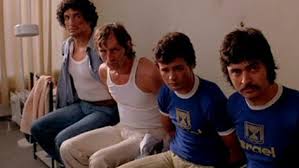
The trailer for the movie that was about to come on ABC that night in November started with Olympic athletes lighting the Olympic torch and the Olympic theme came on, I thought maybe this was some kind of sports movie. Next thing I know, the trailer for the movie showed dudes in masks firing machine guns and German police surrounding dorms with sniper rifles and my Eight-year old creative mind was sent buzzing. Oh my God, what is this shit? This movie looked incredibly exciting, especially to me at that age. Mom must have been busy doing stuff upstairs, Dad was at the theater. I thought to myself “Shit, I’m watching as much of this as I can!” The title of the movie turned out to be “21 Hours at Munich”, a TV movie based on fact about the hostage situation and subsequent tragedy that occurred at the 1972 Olympic Games in Munich, where a team of Palestinian terrorists, part of a terrorist splinter group called Black September (which had ties to the PLO, the Palestinian Liberation Organization) took a group of Israeli Olympic athletes hostage.
Flash forward to decades later as I am an adult (somewhat), having dinner with my children and my Mother and Step-Father. A conversation breaks out as it typically does at the family dinner table and a discussion of film is again front and center. This evening it seems like the particular topic being bandied about was the greatest film(s) of Director Steven Spielberg. My Mother and Step-Father immediately piped up with the film title “Munich” as being Spielberg’s penultimate work. Considering the body of work that is entailed with such a proclamation, i found this to be quite a provocative statement. I mean, we’re talking a colossal collection of hailed cinema, superlative titles that include “Jaws”, “Close Encounters”, “Empire of the Sun”, “Amistad”, “Schindler’s List”, “Saving Private Ryan” and “A.I.”, just off the top of my head.
No, they meant it, they doubled down on “Munich” being Spielberg’s greatest cinematic achievement of all time. So, I finally caught up with the Historical thriller/drama and was honestly underwhelmed. I definitely didn’t think it was better than any of those Spielberg films I just listed prior, and to be honest, when I saw it all I wanted to do was reaffirm my belief from Eight years old that I had already seen the best movie made about the Munich hostage situation (dramatization, that is, there are some really good documentaries out there about it) and subsequent tragedy. I am not saying that “Munich” is a bad film, but Spielberg creates fictitious events to juice up the aftermath tale, “21 Hours at Munich” is just dramatic meat and potatoes, plus it gives more humanistic background on the terrorists, we feel their plight at least somewhat as opposed to heavier sympathies given to the hostages and the negotiators.

The background, as you might be well aware, was that Germany in 1972 was hosting it’s first Olympic Games since it’s infamous turn at hosting the games in 1936 in Berlin and also a spate of violent events that occurred between the 1930’s and 1945 that you may have heard of called World War II. The 1972 Olympic Games were to be held in Munich, Germany in the late Summer, this was to be a new Germany that the world would be privy to. Of course, by this point, there would be two separate Germanys, East and West. Munich was located in West Germany. At the same time, the relatively newer sovereign state of Israel was seemingly in the 1960’s and 1970’s consistently at odds militarily with neighboring countries such as Egypt and was in the midst of a long-running blood feud with the people of Palestine, the latter conflict continues on today and has of late shocked the world more now than ever.
Watching supplemental material to the film “21 Hours at Munich”, I learned that terrorism experts had been brought in prior to these Munich games and declared that there were numerous holes in the security situation concerning and surrounding the athletes of the 1972 Olympics. One terrorism expert had actually written about dozens of potential scenarios that German police and security would need to be wary of, one of those scenarios involved Arab terrorists accessing the Olympic village, where the athletes for the games were housed. Security measures in retrospect were shockingly lax for the 1972 Olympics, all the subsequent Arab terrorists had to do was to get to Munich undetected and then scale a twelve foot fence to get into the Olympic Village where the athletes were being housed. If I have any qualms with this movie, the only two instances where the movies’ events seemed odd were these (although maybe this is what really happened): 1. After the terrorists enter the Olympic Village wearing Olympic-looking track suits, which seemed like a plausible disguise, they immediately changed into street clothes that made them appear to be a combination of either obvious well-dressed criminals or dudes frequenting a Middle East discotheque. 2. The terrorists were opening fire with sub-machine guns on the grounds of the Olympic Village at 4 or 5 in the morning and seemingly nobody wakes up in a cramped dorm campus of hundreds of Olympic athletes; it seemed implausible, but it’s my only gripe with the movie.
The Arab terrorists are portrayed as methodical and ruthless, yet while they are not shown as sympathetic per se, they are not portrayed as cartoon bad guys, either. Led by Franco Nero as the lead terrorist in command named Lutif, we get some hazy background on why they are doing this and what their goals are. Nero is quite compelling as the terrorist squad leader, his intense stare and international-sounding accent which is difficult to pinpoint is quite effective here. He and the other terrorists’ movement and actions look decidedly realistic, the action in this movie almost has a docudrama feel to it, similar to the look and flow of the 1975 TV film directed by Jeffrey Jameson titled “The Deadly Tower”, a thriller based on true events starring a young Kurt Russell that depicted the 1966 Austin, Tx sniper killings from the infamous Bell Tower by deranged shooter Charles Whitman.
“21 Hours at Munich” was directed by William A. Graham, the movie has a slick, theatrical look to it and besides being nominated that year for Emmys awards, it was actually released in some Foreign countries in movie theaters, the film is that proficient and technical looking. The action scenes are on par with anything Hollywood put out at this time, there are flowing night-time shots of Helicopter flights that are first-rate, you forget while watching this that it was originally a TV movie. Laurence Rosenthal’s musical score is exciting and keeps the viewer’s adrenaline pumping. This was made at a time when Network TV had churned out a spate of well-made movies concerning then recent historical events. In addition to this, just off the top of my head there was the fantastic “Helter Skelter” (previously reviewed on this Blog), about the Manson Family murders, there were two movies made about the Israeli raid on Entebbe Airport in Uganda, there was also an excellent movie about Patty Hearst and the SLA. A lot of crazy shit happened in the 1970s and Network TV executives were all over it.
As an American child growing up in the 1970s, there were also quite a few movies that dealt with Israel and it’s dealings with Foreign aggression and terrorism. My young mind at the time was definitely swayed by the messaging, witness how many well-made action films were released in a 25-year window on or related to the subject. There’s Otto Preminger’s “Exodus” from 1961, concerning the birth of the modern nation-state of Israel. “Cast a Giant Shadow” from 1966 had an all-star cast and was centered on the struggles of the Israeli military in it’s early years. Preminger revisited the Middle East for his 1975 film “Rosebud” with Peter O’Toole. There was, as mentioned earlier, two American Television Network films about the Israeli special forces’ spectacular and miraculous hostage rescue mission at Entebbe Airport in Uganda, 1976’s “Victory at Entebbe” with an all-star cast that included Kirk Douglas, Burt Lancaster and Helen Hayes which appeared on ABC and then NBC’s “Raid at Entebbe”, which was directed by Irvin Kershner and also contained an all-star cast which include excellent performances by Peter Finch as the Israeli Prime Minister Yitzhak Rabin and Yaphet Kotto as Idi Amin. 1977 also saw the release of Director John Frankenheimer’s intense “Black Sunday”, based on a book where there is a fictitious plot involving Black September attempting to kill thousands of Americans at the Super Bowl and years later Director George Roy Hill made perhaps the best of all of these films, “The Little Drummer Girl”, which was based on a novel by author John LeCarre and starred Klaus Kinski and Diane Keaton. My childhood was littered with films and books concerning the savagery of the PLO and the purported heroism of the Israeli Military and it’s intelligence branch used in defending it’s turf. It seems like another era now that we as a world public are being subjected to the brutality and tragedy of the current humanitarian crisis occurring in the Gaza Strip.
“21 Hours at Munich” tells it’s story mostly from the perspective of the West German Police and officials attempting to negotiate the release of the hostages, but as the story and hours unfold, they realize that they are working against two sides that won’t budge and that the Israeli Olympic Athletes will be nothing more than sacrificial lambs. The West Germans, of course, are played in this film by American and English actors, some with German accents, some just speaking straight English. William Holden has top billing in this movie as the head of the West German police and while there is nothing in his performance that appears that he is German at all, he is still solid in this and you know it’s a bankable William Holden effort. The mannerisms and perfunctory delivery are there, his voice is unmistakable. In this humble writer’s opinion, Holden still had the presence of an A-list movie star in the late 1970’s and I would die on that hill. Holden still had several excellent performances left in his career at this point; Sidney Lumet’s Oscar-winning “Network” also from 1976, Billy Wilder’s enigmatic “Fedora” from 1978, Blake Edwards’ forgotten and blisteringly funny “S.O.B” from 1981 and the criminally underrated “Damien: Omen II”(A Horror film about the ruling class from a Mike Hodges’ screenplay) from 1978.
Other notable names from the West German side in this movie include Richard Basehart as a German higher-up( he does take a believable swing at a German accent here), Anthony Quayle as an Israeli Intelligence expert and Shirley Knight as Annaliese Graes as she makes an impactful turn as a West German Olympic envoy who is sent in to negotiate with the terrorists. The thinking by the West Germans is that a Female negotiator will dial down the animosity of the Palestinian terrorists and according to the film’s script (written by Edward Hume, Howard Fast and Serge Groussard, the movie being based on a book by the latter, titled “The Blood of Israel”)the move had some effect as Knight and Nero as the terrorist leader have respectable and less antagonistic dialogue then Nero seems to have with the Male West Germans. Knight is striking here, although she looks like a Lufthansa Airline Stewardess in her Olympic get-up. She is not only easy on the eyes, her acting work here has merit and substance, she’s not an object, she’s convincing as a Woman who buys the authorities more time with her reassuring manner. Her character and Nero’s share a pack of cigarettes between 7 AM and 9 PM in the movie’s chronology, something that my son noticed while we were viewing this film together. I reminded him that in the 1970’s, smoking was more prevalent then, people hadn’t figured out the direct link to lung Cancer as succinctly back in them days.

Just as Spielberg had made “Lincoln” back in 2014 to be more of an advertisement for the righteousness of the modern Obama modern presidency and legacy, I felt his “Munich” had pronounced the same moral spin for the Mossad and Israeli Military and Government of the 21st Century. Though the current climate in Gaza I believe is exponentially more savagely violent and pernicious on the part of the Israeli Government and Military now, I found “21 Hours at Munich” to be a more even-handed telling of the Munich tragedy. There is a sequence where the West German officials contact Israeli Prime Minister at the time, Golda Maier (played by Elsa Quecke) and Maier flatly declines the Palestinian offer of freeing the Israeli Olympic hostages in return for the Israeli Government releasing 236 Palestinian terrorists from Israeli prisons. No dice, says Maier in the movie and subsequently in real life. While bound together in their dorm room, one Israeli Olympic athlete remarks, “We know we are dead men.”
To give a final glimpse as to why I prefer this film to the better known Spielberg cinematic effort from 2005, is the attention that “21 Hours at Munich” attends solely to the details from that unforgettably grim day in September of 1972. The scenes that depict the killing of Israeli Wrestling Coach Moshe Weinberg (played by Martin Gilat) is done in such detailed and dramatic fashion, it sucked me into this film as an Eight-year old and was still just as effective when I re-watched this movie almost 50 years later. You see, Weinberg had been out drinking while the initial hostage-taking had occurred, so he showed up at almost 5 in the morning on foot, drunk off his ass and singing Israeli songs, dancing by himself as he made his way to the dorms. He was such a bad-ass, according to the depiction of events in the screenplay, that he had to be gunned down twice in hails of automatic weapon fire before succumbing to his wounds and he was able to stab a terrorist as well. There is no music used in these scenes and the violence is jarring. “21 Hours at Munich” is a tremendously harrowing cinematic account of a high-voltage, yet dark event in recent modern world history that makes the viewer feel like they are truly getting in touch with the most accurate retelling of what happened on the day of September 5th and early hours of the 6th, 1972. A sorrowful day where people on both sides played a deadly and stubborn game of poker with human lives and the end result was everybody lost.
Leave a Reply