Sam Peckinpah films weren’t/aren’t for everyone, but those that fall under his spell as viewers share a camaraderie even if they don’t see the same messages from his films. As amazing as “The Wild Bunch” is, it’s still fairly coherent and congruent storytelling with spectacular imaging, a more mature and probing presentation of themes Peckinpah had breached in previous Westerns like “Ride the High Country” and “Major Dundee”. Peckinpah’s attention to detail and technical work on “The Wild Bunch” make it a fantastic blood-soaked nihilistic Male Ballet, a cinematic doctorate thesis on Man’s pursuit of his most glorious death. There could never be a “Wild Bunch 2”, everything was said. Although, it could be said that the Phillip Kauffman directed 1973 film “The Great Northfield, Minnesota Raid” and Walter Hill’s 1979 epic “The Long Riders” come pretty darn close.
Yet Peckinpah was nowhere near done and even though I have fondness for the quiet and reflective “Junior Bonner” (1972), the gritty and spooky “Cross of Iron”(1977), and hell, I even enjoyed the messy “Osterman Weekend” (1983), four movies from the 1970’s under Peckinpah’s direction really stand out as potential equals to the almost unsurmountable “Wild Bunch”. “The Getaway”, “Pat Garrett and Billy the Kid”, “Straw Dogs” and “Bring Me the Head of Alfredo Garcia”, the latter probably being his most personal film of the four. “Alfredo Garcia” has been mentioned by Director Quentin Tarrantino as almost like a metaphor on making films in Hollywood, that Peckinpah’s messaging is more important than the surface story he is telling, the characters and their respective fates are incidental to the profundity that the master Director is attempting to impart on us. I can see how this movie was considered to be too much for critics and audiences upon it’s release; that it took itself too seriously, that the violence is so chaotic and omnipresent it borders on embarrassing. In my estimation, the years have been kind to this film, it is a very, very serious movie that has alot to say about what people want out of their lives and how they might go about getting it. Certainly it is a statement as well as a confession by the Director on how he wants to create his art and what he thinks about those who attempt to stand in his way of making it.
While it is debatable whether any Peckinpah film is specifically just about action, “Alfredo Garcia” is not just a neo-noir Western, it’s a romance, it’s a character study, it’s a revenge flick, it’s a diatribe on bucking the system and possibly destroying or upheaving it. Sometimes, I think “Alfredo Garcia” might be Peckinpah’s best film, though I do marvel at both “Straw Dogs” and “The Wild Bunch”. If the film has a weak link, it’s that for this particular film, with the exception of the character played by the enigmatic Isela Vega, the film has mostly demure or ancillary Female characters, but I feel like the reason for this was that Peckinpah was putting the suits, especially Hollywood suits, on blast for their formulaic arrogance, that he had less of an axe to grind with this particular cinematic message with Women in the filmmaking Industry as he did Men. I believe Peckinpah wanted Men who were in his Industry and who weren’t serious about the wisdom and deep meaning that film can evoke to be the embodiment of his intended celluloid targets.
There isn’t a wasted scene here, it’s all relevant, Peckinpah’s driving narrative about the pursuit across Mexico by desperate Men searching for the cabeza of a Mexican playboy/gigolo is one of obsession, to these characters, failure and death are conjoined. The film begins in Mexico, almost akin to a Mexican-ized version of “The Godfather”. A giant estate, a ranchero of a wealthy Mexican family is on display. Children playing, people in festive outfits everywhere, a winsome and thoughtful young Woman daydreams by a large body of water. But what is this, it looks like the young Woman is pregnant. Another Woman, flanked by some hired hands, appears to fetch the younger pregnant Woman and take her before an authoritarian Male figure. Suddenly, we are alerted to an expansive infrastructure of family members, hired guns, Women in traditional attire and ancillary figures inside the estate as the patriarch of the family, played by Peckinpah regular, Emilio Fernandez, (The sadistic General from “The Wild Bunch”) asks the young Woman, who happens to be his daughter, “Quien su Padre?” (“Who is the Father?”)The scene goes from potentially hopeful and innocent to savage and cruel.
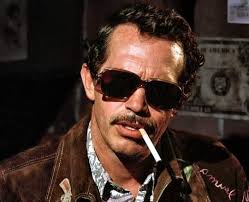
When it is disclosed that the Father of the unplanned pregnancy is a known rogue named Alfredo Garcia, the Patriarch demands not only accountability, he wants the young lothario’s head….literally. A veritable army of bad asses, weaponry in tow, immediately vacate the ranchero in cars, motorcycles and horses to span out throughout Mexico to find and bring back the head of Alfredo Garcia. This is just like the first five to ten minutes of the movie, Western in tone but Modern Crime Action pic in look and demeanor. As intense as the beginning is, Peckinpah only ramps up the violence, madness and grandeur as the picture accelerates, you know bad shit is about to go down in glorious and grandiose style as only Sam Peckinpah can deliver. While the premise may sound like a B-movie action yarn, Peckinpah’s use of slow-tracking shots and moments that linger let the viewer know that this is indeed moving art as well. The movie hones in on a Mexican town where two pristine, yet shady looking White hitmen (played by Robert Webber and Gig Young) saunter into a local Mexican bar. An American nobody (played by the magnificent Warren Oates) is playing piano for tourists, locals and hookers. He humors everyone with a pedestrian version of “Guantanamera”, doing his best low-budget Hoagie Carmichael impersonation without the piano-playing chops but with Dollar Tree shades on and shiny White dress shoes. The steely-eyed hitmen pull up to his Piano, smoking heaters, punching Mexican whores who try to rub their crotches and tossing American dinero in Oates’ tip glass. These guys are so macho, they could be gay.
When Oates, who plays piano and does everything else with shades on, even at night, learns of the nationwide manhunt for Garcia’s dome, he’s interested in joining the fray, especially when the Gringo hitmen say they will pay him Ten Grand for info leading to the stud’s skull. Oates as Bennie, seems like he is the embodiment of Peckinpah’s persona. He is Peckinpah in Hollywood, a gritty everyman searching to establish his vision in a world full of savage and cold-blooded suits. Bennie’s first visit is to his on-again/off-again girlfriend, played with a heart-felt intensity by the dynamic Isela Vega, her character’s name in this is Elita.
When Elita informs Bennie that she spent three days with the mythical Garcia, Bennie realizes he must realign himself with her in order to locate the Holy Grail of Mexican craniums. In a complicated 1970s way, the couple sets off on a treacherous adventure to find Garcia, dead or alive. While road tripping together, they rediscover their symbiotic need for each other, including fantasy-driven ideas about marrying each other. Peckinpah blends cheerful Mariachi singing, humorous naked bedroom hijinks, somber and probing personal introspection and of course, gut-wrenching cathartic violence along the dusty rural highways of rural Mexico as Bennie and Elita search for Garcia’s head as well as search for themselves, each other and their respected purposes in life. Needless to say, many characters and random bystanders get toe-tagged before this epic existential voyage of a film completes. A viewer who needs clarity may find themselves frustrated by this film, that it’s too abstract. I think it’s brilliant in it’s weaving of narrative and symbolism, maybe a perfect film.

Peckinpah creates something of a dream here, that it’s partly image-driven, partly nihilistic. We don’t need specifics on why Bennie needs the head so badly, it’s worth more to him than Ten grand. Procuring the head symbolizes a feeling of accomplishment, that his life struggles would have had innate meaning, the culmination of his travails will have served a worthy purpose. The Mexican landscape provides a perfect backdrop for this tale of honor and depravity; the land seems to provide an atmosphere of utter lawlessness, we never see any police, shoot-outs seem to occur every few minutes, yet we never see first responders, just dead bodies and the peaceful innocent who bury them and carry on with their lives. Peckinpah’s bystanders here don’t scream in terror or show signs of being helpless victims, they carry a quiet resolve and a knowledge that the impatient, the greedy and the haughtily ambitious will extinguish themselves in their tumultuous and rash need for instant gratification and fortune. While we do root for Bennie to survive, his motivations are murky, at best. He loves a singer/prostitute, he’s searching for a random guy so he can decapitate him and receive compensation for it, not exactly the textbook resume of a classic hero.
Yet Bennie searches and kills for the right to claim the prized head like Peckinpah creates a story about it; with ruthless focus and purpose. Music Composer Jerry Fielding delivers a transcendental score here; it’s jarring and remorseful at all the perfect times. There’s actually quite a bit of ancillary music here as Bennie plays the piano, Elita sings and plays the guitar with verve, the characters sing at odd times, even Kris Kristofferson makes a sinister cameo in a scene that involves random singing. Music is an essential aspect of “Alfredo Garcia”, it is the lifeblood of the poor and struggling, it also details the angst-ridden dilemmas that are going on inside the minds of it’s main characters. When Bennie and Elita discuss potentially getting married in a cheap hotel room before a crucial scene involving Bennie’s pursuit of Garcia, Fielding’s music explodes in a moment of classical fury and regret, this is at times, an angry and resolute film.
The look of this movie is hypnotizing, whether it’s the splendor of the ranchero, the open spaces of Mexican desert, outdoor shots that look like they are shot against the moonlight or scenes that play out in cramped and decaying Mexican hotels or sterile offices housing corporate-sanctioned bad guys. Peckinpah’s Mexico is truly a final lost frontier. The Cinematography by Alex Phillips, Jr is memorable, it couples perfectly with Fielding’s score and the editing work by a team consisting of Dennis E. Dolan, Sergio Ortega and Robbe Roberts . Close-ups here mean something, Peckinpah’s slow-motion violence is a make-or-break moment of committal for the viewer, the slow motion draws you further in. These moments, if executed correctly, linger in your recollections of the images that Peckinpah has chosen for you. Slow-motion can be a clumsy device in the wrong hands, but not with Peckinpah. It’s as if he has taken a musical phrase and augmented it, stretching it’s meaning in a moment of four dimensional entertainment. The film is not meant to be funny, but it does carry irony and an unrepentant adrenaline that makes the movie uncompromising. The violence isn’t unnecessary either, it’s as tactical as it is random. “Bring Me the Head of Alfredo Garcia” includes a litany of characters who express themselves through violence, words they say are just the sounds of an animal before it is engaged in the provocation of or defense from an attack.
The script by Sam Peckinpah and Gordon T Dawson is wise, haggard and cynical. The professional killers condescend to Bennie, they look down on him as if he is not worthy of their fraternity, to them he’s an amateur. This may circle back to the film as a metaphor theme, Oates as Bennie is simply greedy and willing to take risks, but the M.O. for him becomes kill anyone who gets in his way and/or disrespects or underestimates him. Give them what they deserve. There are instances in this picture where the violence may appear to be nonsensical, but I believe that is only if you are not totally invested in Bennie by this point in the film. He has to kill, in part because even those that simply want to humiliate him do so at too big a cost to go unanswered. As the film progresses, Oates has an inner dialogue that he speaks out loud to himself, he’s starting to crack up or is it an attempt to self-regulate and self-focus? It feels like through Oates, Peckinpah is staking us on his journey. For an action movie, at times this movie broods, it boils on low heat. It feels like a noir, especially in the dialogue. When Kristofferson and his pal attempt to rob and rape Bennie and Elita respectively at gunpoint, Bennie remarks, ” I think you guys are really on my shit list.”
The chemistry between Oates and Vega is the kind of real on-screen intimacy that is very difficult to emit from actors and get that kind of sincerity. Vega is naked in this continuously in several scenes. One unnerving sequence involves her and Kristofferson. Vega shows quite a bit of range in this film. She’s an entertainer of the wealthy, she’s a hippie, she’s a hooker, she’s vulnerable, she’s cagey, she’s an artist, Vega has quite a bit to do in the amount of screen time she has. Vega has an earthy look here, it carries both the look of a Woman who could sell jewelry at an outdoor jam band festival or maybe go in the other direction and doll herself up and strut down a runway, she’s that striking. It’s interesting and topical that a movie romantic relationship looks so unorthodox and yet the end result in terms of it’s appearance and effect results for me in some of the most real and authentic looking physical and emotional bonds between a Man and a Woman in a Hollywood movie.
My last two aspects of praise for this film start with Warren Oates. There is no question of his brilliance in countless films from the 1960s, 70s and 80s, but his work here borders on dominance amongst a strong cast and even stronger directorial vision. Oates’ work here is like that of a noir protagonist, yet we suffer with him. Oates projects sleaziness and desperation, but he’s hard. While his character is a two-bit opportunist, he’s also a philosopher and has the spirit of a prospector who’s not sure what he should be prospecting for. When Elita remarks to him that the two of them should just flee so that they can be alone and start a life together, Bennie replies (and I may be paraphrasing) “That’s all well and good, but we need money, bread…..pan.” Her innocent romanticism is lost on him in that moment, he feels he has not earned the right to enjoy success, that securing Garcia’s head provides him with tangible accomplishment, he can’t rest until he has finalized the possession of such a valuable asset. Oates conveys all of this conflicting emotion with aggression and eloquence. He looks like he is either a used car salesman or a gambler, someone living outside the walls of normalcy. Oates portrays a character who is uniquely American. He taps into the grit and self-loathing of a man who has let too much of his life slip by without accreditation, all the drinking, smoking ands whoring has left him with a desperate and beyond dangerous predicament to stay afloat symbolically.
The final laurels of this celluloid master work go back to Director Peckinpah and his vision. Having visited Mexico in 1974 as a six-year old, I remember Mexico as a beautiful, yet wild and more dangerous landscape than America. Here, Peckinpah delivers an untamed land that still carries components of modern First world civilization with a Mariachi soundtrack. So many scenes stand out for their concise attention to detail. This was an influential film for other future filmmakers, Tony Scott’s “Revenge” with Kevin Costner leaps to mind. It’s interesting that there are quite a few similarities between this film and Antonioni’s “The Passenger” with Jack Nicholson made the same year, 1974, with the exception that Antonioni’s film takes place in Africa in spots.

It’s obvious that Peckinpah had quite a bit of fondness and reverence for Mexican culture. Several scenes stand out in my mind’s eye while writing this; the depiction of the ranchero, the seedy bar where we are first introduced to Bennie, the upscale restaurant where Oates confronts Vega about her sleeping with Garcia, the depiction of rural Mexico and it’s subculture, the nighttime exhumation of Garcia’s grave, Oates’s conversation with himself in a sweltering Mexican hotel room and the staggering and insightful portrayal of the corporate organized crime suits (doubling as metaphors for Hollywood Industry types) who are holed up in a sterile corporate hotel, complete with passive muzak and dentist office decor. Even with the existence of Peckinpah’s other great films, “Bring Me the Head of Alfredo Garcia” is like the finest of wines, a movie that only gets better with age, a searing and profound example of Peckinpah’s endearing genius and legacy.
Leave a Reply