I couldn’t imagine how offensive a person who would consider themselves “middle of the road” would find a film such as Carl Reiner’s “Where’s Poppa?” back when it came out in 1970. When you watch TV talk shows from the early 1970’s, there seems like there was much more decorum back then, but the tone of quite a bit of early 70’s entertainment appears exceedingly loose as well. I recall getting dropped off at the babysitter in like 1972 or with my Country Club chic Grandmother back then and they were watching shit like “Family Affair” and “Love American Style”, TV shows that still portrayed a buttoned-down, G-rated tongued America. “Where’s Poppa?”, a bawdy comedy from the mind of satirist Carl Reiner, a contemporary and colleague of Mel Brooks, gives off the impression like it was attempting to blow the roof off in 1970, that Reiner did not give a last call fuck if he was offending people, that he was actually trying to get under people’s skin, in a forceful manner.
My first encounter with this film was through a trailer, in the mid-1970’s I viewed the trailer for “Where’s Poppa?” and the trailer was honing in on it’s own ability to titillate and shock the viewer by triumphing a scene where Ruth Gordon pulls down George Segal’s pants and bites him on the ass cheeks. Yes, you read that correctly. The trailer made such a big deal out of the scene, you would think the other Eighty-One minutes of the film were superfluous, just a dramatic ascent and descent from a moment of such polarization. When I finally saw this movie, my anticipation of it’s grandeur was centered around this cathartic celluloid moment of posterior hijinks. I wonder if both Gordon and Seagal paused when they saw this moment in the script when they read it. I wonder if any other actors or actresses turned this movie down when they saw this potential moment in the script they were reading. Nudity is one thing (more on that in a minute), ass play with a senior citizen is entirely another issue.
I mean, in 1970, America’s entertainment society is not far at all from “wholesome” family fare like “Yours, Mine and Ours”, “With Six you Get Eggroll” and Disney family comedies. The humor of comedic films from artists like Brooks, the now pariah Woody Allen, and British comedy troupes such as Monty Python and Beyond the Fringe aimed to blow this family friendly mentality out of the water. Films such as Brooks’ “The Producers”, Milos Forman’s “Taking Off” and the new works from Allen were anything but full of “family values”. “Where’s Poppa?” is a Fifty-Five year old movie now that looks like it was not intending to shock people with just it’s vulgarity, it’s goal was to offend, to create word-of-mouth through staged perversion. Whatever social taboo bluff others were willing to cite, Carl Reiner was calling them out and pushing twice that amount of his metaphorical morality chips to the center of table. The movie wasn’t just intending to be edgy, it was pushing way past that.
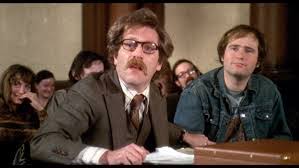
I don’t think it’s wrong to say that Reiner was winking and nodding at fellow Jewish people with this cinematic effort, there appears to be a Jewish Vaudeville Comedy tinge to the exploits portrayed in this movie. Not that the “Goyim” couldn’t enjoy it as well, but that the situations and the dynamic discussed here by Reiner’s film were meant inceptionally for other Jewish people not concerned with old school propriety. Reiner’s movie has a swagger with it best exemplified by a cameo in the movie by future TV star and filmmaker Rob Reiner, in which Reiner the junior plays a court defendant who engages in an X-rated verbal exchange in court with a Military Man who is played hilariously by old school comedic Hollywood actor Barnard Hughes. I can only imagine what virginal early Seventies movie-going ears first thought when a film that to this point had been only slightly risque, suddenly plunged over the line of moral decency as Reiner and Hughes exchange such phrases as “cocksucker”, “asshole”, “fucking fascists” and “goddamned gooks”. The blistering exchange mentioned prior is actually really funny, but “Where’s Poppa?” is just getting started.
Only Eighty-Two minutes in length or so, “Where’s Poppa” is a very claustrophobic film, most likely this is on purpose. The movie begins in what looks like a tidy New York City Apartment. It looks extremely similar to the apartment in the film adaptation of Neil Simon’s “The Last of the Red Hot Lovers” from 1972, almost looks like the exact same layout. An opening scene from the films of the 70’s and early 80’s, the protagonist waking to the sounds of an AM radio station as an alarm clock I have mentioned before from my previous post about Adrian Lynne’s 1980 film “Foxes”. The scene trope has been used from multiple films from this era, Ted Kotcheff’s “North Dallas Forty” leaps to mind. The protagonist, in this instance, is played by George Segal, who has facial hair that makes him either look like a guy with a trendy 70’s moustache or a member of a Barber Shop Quartet from the 1890s.
Segal plays Gordon, a Jewish Attorney who wakes up in the morning, does some chores and then for no apparent reason, dons a full Gorilla costume. He then marches to a room that he has locked with a block of wood that he hammers and pulls out nails from like he is unsealing Dracula’s tomb, opens the door wearing the full Gorilla costume. He then attempts to terrorize an old Woman, who is sleeping in her bed, she is played by Ruth Gordon who was coming off of playing a sweet Old Satanic Grandma in Roman Polanski’s “Rosemary’s Baby” a year earlier. Here, she appears to be in her 60s or 70s. When Gordon wakes her up, she promptly punches the Gorilla in the Bananas and goes back to sleep. When I saw this film as a kid, I found the humor to be totally abstract, you know, “Gosh, those Seventies adults were weird.” My slow thinking ass took years to comprehend that Gordon was wearing the costume in hopes of giving his Mother a heart attack. This is the level of depravity this film seeks. The movie puts a breezy spin on a yarn about a Man hoping to kill his dementia-riddled Mother with natural causes. He’s too much of a good guy to strangle her and he had to take an oath with his neurotic Brother (Played with manic energy by Ron Leibman), years ago while their dying Jewish Father lay before them that they would never put Mama in a nursing home. The problem is, Gordon’s Mother is now a senile lunatic, an incessant troublemaker and jealous overseer. Gordon can’t get a Nurse to watch her and he subsequently can’t get laid. He’s his Mother’s emotional hostage.
When Gordon is at work, he is actively recruiting for a Nurse to hire to watch his Mother, and take some of the stress and responsibility off his hands, problem is most of the Nurses in town know his Mother or are aware how impossible she is. Gordon can’t give his Mom away. When he meets a gorgeous, virginal sweetheart of a Nurse, played by Trish Van Devere, Gordon takes up the look of a desperate Man, he is hoping he has just discovered a miraculous two-for-one, an understanding and saintly Woman that will both watch his cantankerous Mom and also potentially date him. That’s the jist, the rest of the film is a series of ascendingly offensive skits based loosely based around these philosophical battle lines drawn by Mother and Son. The son wants to free himself from the obligation of being his Mother’s caretaker and she’s so far gone, she keeps inquiring when is her dead husband going to return, hence the title of the film, “Where’s Poppa?”

Taking shots at senility, or more succinctly, making fun of people with senility is a potentially tacky endeavor, certainly if one has had traumatic experiences with close family members who have suffered from the condition, but if that doesn’t effect one, then the absent minded jokes here have a certain obvious effect and charm. Gordon and Segal have effortless chemistry between them. The film’s sexual boundaries are not as visceral (aside from the infamous ass-biting scene) as they are implied, mentions are made in the dialogue of acts such as defecating in bed after sex or a Man raping another Man in drag and then receiving flowers for it. To some, what is being implied here could make for a good Friday night film at the Frat house kinda movie, for others this could be deemed as just plain raunchy. “Where’s Poppa?” seems to revel in it’s ability to shock delivered in sheep’s clothing, this is like an X-rated episode of “The Mary Tyler Moore Show” directed by Norman Lear and Gore Vidol.
The script (by Robert Klane) by modern standards on the surface appears quite racist. On further inspection, some of the jokes that involve Black characters in New York City in 1970 don’t seem that much different from similar humor involving Black characters from films created by African-Americans in 1970 such as “Cotton Comes to Harlem” (Directed by Ossie Davis) or “Watermelon Man” (Directed by Melvin Van Peebles). In one scene, Segal as Gordon is interviewing a prospective nurse to watch his mother, the nursing prospect happens to be Black. “Is she dead yet?”, the African-American prospect inquires before turning down the job offer, having prior knowledge of the cantankerous old Woman. In another scene, an African-American Woman is attempting to hail down a taxi cab at night and the cab driver would rather pick up Ron Leibman as a Jew in an anonymous Gorilla costume, the inference being that even lowly cab drivers would rather have the business of a lunatic in a Gorilla suit than a Black Woman. In true modern vaudeville subtext, the African-American Woman brushes off the slight and forges on with the fortitude of an extra in a Marx Brothers comedy.
Then there are the late night menacing Central Park hecklers, all of whom are Black who terrorize and humiliate Ron Leibman as Sidney every time he has to travel through Central Park at night to get to his Mother and Brother’s apartment. Since Gordon keeps threatening to kill their Mother every time her senile act infringes upon his sanity, Sidney rushes over to keep the peace. The group of Black Men and Sidney are familiar with each other from prior run-ins, in one sequence they re-create the scenario as a joke from the Cornell Wilde-starring wildly racist action adventure film which takes place in Africa from 1965, “The Naked Prey”, in which a White Man is chased in a game of life-and-death by African Warriors. Here, the Urban Park dwellers chase Leibman through Central Park, led by a character named MothaFucka, stripping him of his clothes every time they catch him until he is butt-ass naked once he reaches Gordon’s apartment complex. This was 1970, so no CGI or special camera tricks here, unless Leibman wore a sock over his pocket monster, people on set get to see all of him, because except for his front, we do. Though the Black hecklers are certainly stereotyped and pigeon-holed as depraved in this movie, they aren’t subservient, nor are they stupid, if it were a White gang, I don’t think anyone would have had reason to feel offended, outside of the depraved activities the group is pursuing.
In this regard, it is arguable that “Where’s Poppa?” is somewhat enlightened, that it’s shock value entertainment with a wry smile on it’s face. Everything here can be attributed to being of it’s era, although the dubious morality of that particular outlook is in play. I felt in ways that the sex, race, drug and propriety humor here was the American equivalent of the swinging London vibe of the same time, that Reiner and company are upping the ante on prior offensive comedies of recent years to that point, such as 1965’s “The Loved One” or Beyond the Fringe’s wildly cynical “Bedazzled” from 1967. In retrospect, quite a few reputable performers must have seen value in this screenplay, because the cast is fairly impressive.
Besides the recognizable names at the time of Segal, Gordon, Leibman and Van Devere, the film also stars well-known comedic actor Barnard Hughes, future TV star and film director Rob Reiner, future Saturday Night Live comedian and contributor Garrett Morris, Paul Sorvino makes a brief appearance here as does Penny Marshall, Tom Atkins, Vincent Gardenia, Helen Martin and John McCurry. This cast ended up being in a considerable amount of Movie Theater and TV movies and shows throughout the 1970s, 80s and 1990s if you are familiar with their resumes. Most of the work this collective did in their careers was in Comedy.
Segal gets a considerable amount of screen time and his work is consistent and affable. He gives as good as he gets and though his character suffers multiple humiliations, he has the chance to get karmic payback and blow steam off to the audience’s satisfaction. His delivery of the F-word so many times may have been jarring to film going audiences in 1970, but his comic timing is admirable, we feel his frustration and inevitable acts of retribution. This is not a heroic role by any means, which makes the appearance of the indefatigable and innocent Van Devere that much more hilarious. No shmuck like Gordon deserves a woman this good, that’s part of what makes the severity of the scenarios portrayed so funny, that they’re not realistic. When Sidney is wiling to risk life and limb to play peacemaker, it’s part in due to the fact that he enlisted to raise a drab Nuclear family with battle-axe wife Gladys (played by Theresa Abruzzo). Gordon has to take care of Mom because Sidney had children with Gladys. Both Jewish Men here are prisoners of the sort of Women that psychologically torture them, or so the narrative portrays it as such. While this is all played for laughs, there are a myriad of angles that one could find offense with if one wished. A wellspring of jokes stem from angelic nurse Louise desire to placate and seek peace with Mom, while the Mom has no desire to be anything other than a senile and petulant drama queen, any attempt by Gordon to break the vice-grip that his Mother has over him is met with childish and obscene antics.
The film’s look is quite droll, either outdoor shots that take place during what looks like Winter in New York City or late Fall, indoor shots that look like a stage play. The film’s soundtrack deserves notice due to the fact that there is no film score per se, but there is music and it appears quite original. The soundtrack comes across as homemade in that the songs have the look of a mixture of old-time songs you would hear perhaps on a player piano and modern (for the time) R and B Gospel. If I were to compare the music to a more modern equivalent, the title song and some of the other music sounds akin to the music that was featured on the HBO show “Curb Your Enthusiasm” and other music sounds like it could back a Gospel Choir or be featured on TV learning shows for children such as “Sesame Street”. Written by Jack Elliot and Norman Gimbel, if you listen closely to the lyrics, they were specifically written for this particular movie. For example, the opening song during the title credits has lyrics that could only be described as rambling and scatter-brained like a senile person was talking. Music where Sidney is running to attempt to keep from being humiliated by random African-Americans in Central Park has lyrics with swear words with swear words in this about you got to move it or you’re going to get your ass kicked.

While we know from Reiner’s direction, the tone and wording of the screenplay and the rhythm and speaking flow of actors such as Segal and Leibman that this film has a dynamic from 1970’s Jewish New York City culture about it, that the part of the film’s humor depends on the audience’s pre-disposed knowledge of White Ethnic family values, standards and outlooks, for myself I didn’t feel that the characters here weren’t that different from the look and sound of my own New England Italian relatives. “Where’s Poppa?” for all it’s taboo-shattering humor isn’t so self-indulgent that it forgets to be funny, the humor here does have an organic feel to it and there are some genuine laughs throughout the movie’s relatively brief running time. While the film carries an ironic hue that at times has the effect of placing something sour in your mouth, the movie feels like it could have been made by Mel Brooks or Woody Allen if one doesn’t look beyond the surface. It has the veneer of a film written by R-rated sitcom writers, Carl Reiner with his cinematic statement was trying to offend and bust the viewer’s balls for not being thick-skinned enough to handle it.
Leave a Reply