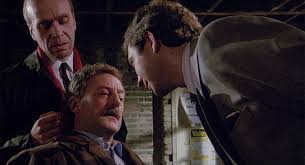
Not all robbery movies are inherently equal. There is definitely a separation between heist flicks that feel like pure fantasy and posturing about robbing institutions as if it were the afternoon musings of pre-pubescents engaged in cosplay and robbery flicks that share and engage in the criminal and procedural minutiae of larger scale klepto schematics. I would place the French diamond heist classic “Rififi” from the 1950’s in the latter category. Someone associated with that movie either knew a capricious amount of detail about diamond heists or had engaged in a productive conversation with someone else who had. Films from the past such as “Thief” with James Chan from 1980 that dealt with detailed scenes of thievery retail craftsmanship liking to the audience recieveing a trade school cliff’s notes on the fine art of high value retail theft.
For a myriad of reasons, most robbery films are just surface-detail oriented, enough info for the audience, but at a remedial level. Who’s guarding the door, how much time do we have, the basics. The rare heist flicks that portray intimate details make us feel like we’re part of the operation, there is a subtle validation of the accomplished criminal, it definitely seems like difficult, tedious and highly-skilled work. In 1987, a British Film Company mostly associated with more independent British Film Artists like members of Monty Python’s Flying Circus, the Company being named Handmade Films, released an extremely detailed heist/robbery thriller that was in addition a tense character study and gritty crime thriller, the film I am referring to was directed by Richard Loncraine, titled “Bellman and True”. The origin of the film’s title is in a Children’s song , an Old English Folk Ballad concerning two brave hunting hounds, “d’ye Ken John Peel”. The film’s subject matter also concerns the soft extortion-related abduction of a young boy.
The story in the film begins with a down-on-his-luck computer programmer named Hiller, played with brooding and aloof intensity by English actor Bernard Hill, in what must have been considered one of the crowning performances of his career. He has a stepson from a failed marriage in the film, he hasn’t told the lad (played by a young Kieran O’Brien) that he really isn’t his Father. He cherishes being a Father to the boy, who appears to be a tween. The Father doesn’t want to upset the lad by telling him that his wayward Mother has abandoned him and is probably never coming back. This provides the movie with an alternate emotional core that continues to circle back as the heist plot unfolds, intensifies and boils over.
Apparently, Hiller has attempted to pull a fast one on some unsavory casual associates who have connections to the London mob, the computer programmer ghosted them for a thousand pounds and after he has spent the money, the peripheral mob types find him and his son, taking the son as a soft captive while informing Hiller in no uncertain terms that if he doesn’t assist them in the technological aspects they require for a major bank heist, they will kill him and his son without a second thought. Of course, without some kind of insurance/assurance, Hiller is now thinking the thugs are just going to kill them anyway. The initial shady characters, led by Ken Bones and Richard Hope as Salt and Gort, need Hiller’s expertise in circumventing the Bank they intend to rob’s alarm and security system so their crew can enter the Bank at Christmastime and loot it for over 12 million pounds. Hiller now has to do the bidding of the criminals while keeping his erstwhile fantasy-land thinking son grounded and not aware that he has been kidnapped for the holidays.
Once the metaphorical Maginot lines of this movie have been drawn, the movie becomes a taut bank heist picture, with tantalizing side story themes that intercut; there’s the daily detailed inner-workings of a complicated bank caper preparation, there is Hiller’s ongoing relationship with his son that is accompanied by parable-filled stories that the Father and son tell each other throughout the movie, some of the stories we gather are related to the absence of the boy’s Mother, there is the main character’s attempts to stall the gangsters and be coy with them while he desperately attempts to plan on outwitting them and then there is the main character’s inner struggles with his own abilities, his feelings of self-worth and his loyalty to the boy. This movie percolates under the surface with emotion that manipulated me into giving a damn about these characters, a plight I could identify without quarry.
The screenplay here is phenomenal, written by Director Loncraine, along with screenwriters Desmond Bowden and Michael Wearing. A couple of months back, I reviewed an early 1970’s British crime thriller titled “Sitting Target”. I praised that film for it’s authentic looking and sounding gangster portrayals, that the movie didn’t feel contrived at all in it’s underworld scenes and the same goes here for “Bellman and True”, the mobsters Are clever in a sinister manner but occasionally lack an eye for detail. The scenes where the gangsters make plans and subsequently carry them out feel like somebody with experiences with underworld types wrote this. There are few cliches, this film carries with it a sense of underworld authenticity.
Since we are to believe it is late December as the backdrop for the story, London and the surrounding countryside (and beaches) are overcast and dank-looking. The manner in which the film was shot by cinematographer Ken Westbury gives it simultaneously a big-screen appearance as well as the smokey haze of a 1980’s British Television series. There is a period in the movie where Father and son are being kept in a large, chilly old manor as dust and cold breath spray into the air. This is not a glamorous-looking movie and in part that’s what makes it so effective; it’s ability to look mundane and presumably normal, meanwhile this film seethes under the surface while never going over the top, yet we as the audience can feel the veracity of what is coming, the power of the messaging here is in the movie’s ability to make it’s criminal characters look nondescript and like humdrum everyday working folks who are anything but.
Scenes involving the discussing of robbery protocol details are not done in the manner of surface crime-movie cliches, we learn to understand why the criminals have chosen Hiller to do their needed tech work, he speaks the language of computers, a necessary tool in today’s job world and one far beyond the grasp of most London street thugs in the mid-1980’s. In one scene, where discussing breaking code in regards to potentially jamming the bank’s security system, Hiller speaks of the use of patterns and algorithms by the bank’s computers, certainly we all know about such things in our dual cyber lives forty years later.

While “Bellman and True” does a solid job incorporating it’s personal stories of loyalty and redemption, they add a layer of raw human emotion to the caper plot line, the aspect where the film truly shines is in it’s ability to portray the build up to and execution of it’s central occurrence; the bank robbery. This film actually contains a couple of scenes of raw and shocking violence, which adds to its elements of surprise, since for a crime film, this movie is more cerebral than most of its genre. The movie portrays the police as somewhat disinterested company employees who seem unaware and mentally unprepared for the ruthlessness and depravity of the desperate men they are up against. Where I have seen some online observers relate that they felt this movie had moments of Black comedy, I would contend that the film may contain moments of comic relief that break the extreme tension that the film’s atmosphere creates.
These particular gangland characters may have a buttoned-down retail appearance, one of the higher-ups in the gang even has a day job as a meat plant foreman, yet they are at their core a surly lot and whilst they are not carelessly and savagely murdering off peripheral characters like in other crime films of this era, most notably American crime films, there is an unpleasant and pernicious air about this crew. In one scene, an argument is settled by an angry gangster placing and cocking a double-barreled shotgun against an antagonists’ taint, that’s gotta hurt. The violence in this film simmers beneath its visuals, when it explodes, it’s as effective as any crime film that comes to mind. Maybe comparing the violence in this to the superb British crime film “The Long Good Friday” is an apt comparison.
The film contains an accurately tense film score, composed by Colin Townes. The editing by Paul Green is crisp and evolves from somber and reflective in the early stages of the movie to taut white knuckler as the film progresses. A good classic robbery picture, such as the aforementioned “Rafifi” or “Bob Le Flambeur” or “Straight Time” draws in the viewer with the ability to be quiet, the seconds of critically important meticulous detail feels like minutes are going by. We find ourselves rooting for everything to go according to plan, that we identify with the criminals. “Bellman and True” is an oddity in some respects, for while it can be viewed as an action movie for the cerebral crowd, due to it’s harrowing explosions and car chases, it could also be considered to be a smart movie for the action crowd, once the adrenaline of the robbery preparation begins, it really never shuts off.
An angle of this movie that gives it a boost as well is the protagonist’s knowledge of science and technology where his criminal adversaries are self-detrimentally ignorant. We as the audience are not sure whether operations by the protagonist are being done to strictly appease the gangsters or for future necessities of facilitating an escape for himself and his son. This is not your typical robbery movie, the human side stories make this all the more compelling. The film is also unique in its working-class depiction of the underworld figures here, this world is far from glamorous, thievery is like a side-hustle for these chaps. A certain amount of Cockney grit is on display. Mostly living boring mundane lives, the lure of free tax money and the tendency to want a life of adrenaline-filled danger feel like plausible reasons as to why these proletariats would take up a life of crime. The bad guys here have the appearance and mannerisms of blokes you would see at the local pub for happy hour, they speak with the informal rhythm and quirks of the street. The Father is seduced by one of the Female members of the gang, in part, to keep him distracted and attempt to get a read on him. It’s an act in part, because the Female character we know is a Lesbian.
The son is played by Kieran O’Brien , and it’s a haunting portrayal, the kid has a horrible situation to navigate mentally and emotionally, the film feels accurate in it’s representation of how a disaffected tween would mentally cope with a menacing and dysfunctional situation. The dynamic reminded me of the young character Christian Bale plays in the disregarded and forgotten film by Steven Spielberg, “Empire of the Sun”, the child retreats mentally to his personal land of make-believe when Adult life is too much to process. We can see the stress on the Father as the criminals intimate to him that any false move on his part would lead to the abrupt ending of the son’s life, the potential unaliving of the son leads to the most gripping leverage on the viewer here.
The criminals are akin to an ensemble, the stand out actors portraying them include Derek Newark as the head of the gang, who is imposing, he carries with him a volatile temper that you know is going to erupt every time things go even a wee bit sideways. A beefy man with a receding hairline, he looks and sounds like a Union Steward, like he could be a British Teamster. Frances Tomelty as Anna, the Female member of the gang is another well-drawn character; she’s deceptive, she’s jaded, she feigns sincerity while attempting to illicit information, she strikes the viewer as someone who could be working a side-hustle at a Hippie Witch shop.
The performance by the lead character as played by Bernard Hill is endearing and memorable, we begin to identify with him and his plight, his withdrawn and trite manner we hope is his inner mind attempting to work out a way to escape though as the film goes on, it’s difficult to determine whether his character is giving in to the prospect that the heist will work and he will get a cut of the money (albeit a small cut) or whether he is plotting counter moves against the gang. Hill sells the character’s inner conflict and his loyalty to his son is as much loyalty to his own self sense of integrity. We get a feeling that without the kid, the Father would have nothing to live for, that his own sense of self-preservation is secondary to that of his attempts to shine a light of hope for his estranged son.
What made this arty British thriller click for me were elements that reminded me of a movie I reviewed in this blog a couple of years ago, an introspective Canadian thriller titled “Kings and Desperate Men” from 1977 in which the plots coincided; a violent thriller plot mixed character studies about people attempting to guide themselves through harrowing and potentially life-threatening predicaments while attempting their best to teach, inspire and protect their children through those same crises. Whereas “Kings and Desperate Men” is a much more political and meditative film about the chasm between Right and Left wing ideologies on how society should be run, both films center on the ideas of crime and violence emanating from Working class frustration. Oh, and both movies take place at Christmas time, just like another movie that came out one year later after “Bellman and True”, a little American picture called “Die Hard”. What is exceptional about “Bellman and True” is the film’s ability to shift gears from introspective PBS-style human character study to White-knuckle thriller and back again without any turbulence. This film is never confused or incongruent in it’s story-telling.

When this film needs to appear relatable and accessible in terms of it’s scenes of mundane dialogue between characters, it is totally believable, these are people from our daily lives we all know in some capacity; their hopes, their fears, their flaws. When these same characters are suddenly thrust into a tense bank robbery situation, we the audience are not only learning nuanced information about bank heist etiquette and minutiae, we’re getting a top-notch action picture at times as well, complete with shoot-outs, explosions, car chases, tension-filled countdowns and other shocking violent surprises, “Bellman and True” is an unusual and exceptional crime film in that it gives multiple niche audiences what they want; the art film crowd gets an authentic and thought-provoking drama about introverts pushed to the edge and we are immersed in their complex dilemmas.
While for action and thriller fans, this is a slow burn and engaging ride, that once the film shifts to its second half, is as harrowing as any crime picture of the last fifty years. As worn down as I was from the bleakness of the potential plight of the protagonists, I was just as invigorated and inspired by the lead character’s mental savvy. Unlike modern action flicks where the hero nowadays always seem to reveal themselves as some kind of sleeper passive/aggressive super hero that can wipe out a room full of bad guys due to the protag’s latent ass-kicking abilities from their past, “Bellman and True” gives us a real person with believable dilemmas who we can cheer for due to his perseverance and resilience reminds us of our hoped for selves, we have no special ops abilities, we just want to use our knowledge and skills to be able to inspire our children, take them on vacation and help them smile about life.
Leave a Reply