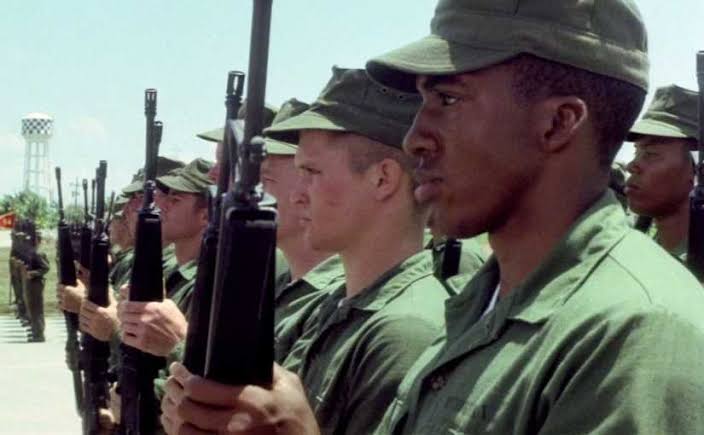
As far as war movies go, I had always found Director Stanley Kubrick’s “Full Metal Jacket” to be one of the most informative and coherent films regarding the procedures of Twentieth Century ground wars in the century’s latter half. The viewer feels as if they experienced boot camp, the minutiae of maneuvers in a live fire situation and the pursuing and subsequent cornering of enemy snipers in hostile territory. In this manner, “Full Metal Jacket” feels like a first person experience, like we are in the platoon. We receive detailed directions, methods and techniques on succeeding in combat situations, “Full Metal Jacket” espouses the core pursuits and goals on the ground of the United States Marine Corps in the theater of urban combat as it pertained to the armed conflicts in Southeast Asia of the 1960’s. Until recently, I had never known that there already existed a Hollywood film very similar to this (The CBS-produced film ” A Rumor of War” from the early 1980’s is another excellent Vietnam War-centered film of this sort.), made ten years earlier and mostly ignored.
I realize “Full Metal Jacket” was based on a book, however there exists a Hollywood film from 1978 that is not only acutely similar in structure and tone to the Kubrick effort, this earlier film even stars one of the very same actors who’s performance in the very same role in the Kubrick film enhanced it’s legendary status. “The Boys in Company C”, from 1978, is a decidedly off-beat, but still discussion-worthy piece of filmmaking. Directed by English film director Sidney J. Furie (Director of a film reviewed previously in this blog, a surreal political thriller from 1966 starring Frank Sinatra titled “The Naked Runner”.), “The Boys in Company C” is somewhere between Robert Altman’s “M*A*S*H”, the Civil War epic “The Red Badge of Courage” and Kubrick’s previously mentioned “Full Metal Jacket”.
Though this particular cinematic effort was made ten years prior to the Kubrick film, there are decided similarities between the two movies; both films start in US Marine boot camp in Camp Pendleton near San Diego, Ca, introducing the viewer to a diverse group of recruits and their stereo typed backgrounds, the dialogue ranges between serious and laugh out loud comedy, the drill Sergeant in both movies is played by R. Lee Ermey. (you read that right, same guy, both movies, same role, ten years apart.) The second half of the movie shows our young ambitious Marines in battle and strolling the surprisingly commercialized streets of Vietnamese cities, haggling with local hookers and playing soccer for the entertainment of the South Vietnamese Military. Characters in both films get killed that you don’t expect, jaded wisdom and bitter irony are rampant throughout the dialogue and the ending(s) leave more questions than answers.
Although there are some awkward lumps in the film’s “M*A*S*H”-like climax, “The Boys in Company C” is a surprisingly engaging and well-written war movie that does make specific statements about the Vietnam war, but is a better film about military bureaucracy and portraying the lives of 1960’s-era young American working-class teenagers and twenty-somethings trying to understand what the fuck they are supposed to be doing and how do they stay alive. The movie’s ability to show military service as a trial-by-fire experience for young men rather than a gung-ho historical war picture is one of its key strengths. The Viet Cong here are just a nameless, faceless enemy defending their land, like Indians in a Cowboy movie. The American protagonists might as well be serving here as part of a Summer internship, where incidentally they can very easily get paralyzed or killed.
From a frenetic script and story written by Director Furie and Rick Natkin, the latter of whom had originally written the story while attending Yale University in 1972, “The Boys in Company C” begins in some respects like the Bill Murray comedy of the subsequent year, “Stripes”, from 1979, the latter being a breezy and hysterical trust-fund comedy from Director Ivan Reitman and various late night TV skit comedy personnel. “The Boys in Company C” starts with our introduction to the young troops as they arrive fresh off the recruiting bus. While the early rigors the “Boys” are put through in their initial indoctrination to the corps are somewhat predictable and cliche, such as hippies getting crewcuts, etc, the exposition of these procedures are rife with quips and the young marines sound like young guys attending a summer football practice, rather than preparing for war.
One of the first soldiers we meet is Tyrone Washington, played by Stan Shaw, he’s the character that gets the most screen time, an African-American character from Los Angeles who aspires to making fast money moving drugs while soldiering. Toughened up by a perilous upbringing on the streets of L.A., he is the most seasoned of all the young soldiers here. Andrew Stevens plays a Country boy with a pill addiction for anxiety and a predilection for hot-headed confrontation. Craig Wesson is the contentious hippie, who plays the guitar and sings folk songs to curious Vietnamese refugees. Michael Lembeck is Vinnie, the Italian with a loud mouth and insidious libido. James Canning is the writer, documenting all of this chaos for a book he is penning on being a soldier in Vietnam.

With the possible exception of an action sequence near the end of the picture that borders on the sublime, the film is able to create an unusual atmosphere for a war film, where the action sequences are laced with tension yet they never lose a sense of irony nor levity. In one sequence, which to me was akin to the rowdy on-screen chaos prevalent in Director Mike Nichols’ 1971 adaptation of “Catch-22” as well as the previously mentioned 1970 film by director Robert Altman, “M*A*S*H”, the platoon of protagonists is being hounded by their superiors back at base over their inability to deliver a body count of how many of the enemy they have killed today. The commanding officer, played stoutly by James Whitmore Jr., he’s had enough of the chain of command’s harassment. When the platoon finds an abandoned village, the officer calls in an air strike, pretending that the village is full of hostile enemy combatants. When the air strikes arrive, the soldiers all celebrate on the ground, totally butt naked. It’s a win-win and endemic of the tone of the analogies and metaphors in this film on the American military and the Vietnam war.
This satirical viewpoint makes the “Boys in Company C” an unusual war film, and somewhat of a breath of fresh air. Battles, strategies, politics, history all seem superfluous here, this movie is much more honed in on the characters’ reactions to their new-found temporary lifestyle; the macho informality of military life, the idea that this is the next phase in their life development, that of participating in a for-profit war, where there is no moral or righteous high ground, only following procedure to stay alive and complete your tour. While the film gives us the premise of standard scenes from war films that we’re accustomed to, the content of these scenes is unorthodox in that the focus is not on the war or America or patriotism but about the immediacy of the young soldiers’ own lives. There is a fantastic early scene exchange between Shaw and Army in which a sort of colorblind understanding of a masculine caste system amongst the troops is intimated. Shaw as an African-American soldier is physically imposing and wants to know from his superior that if he decides to snap out and beat up some racist fellow soldiers who are harassing him and are physically inferior to him, will his superiors look the other way and/or punish him based on unspoken racial dynamics within the military, equating the military to the law enforcement he knows of from living in Los Angeles. Ermey lets Shaw know in uncertain terms that he personally has a set of unspoken rules based on merit and not skin color. It’s an amazing scene, devoid of sentimentality but also rife with self-awareness.
The portrayal of the Vietnamese, both North and South, is nothing new here but it is refreshing to get a Vietnam War movie where the civilians aren’t portrayed consistently as over-dramatic , shifty-eyed front lobe types in big straw hats. The Vietnamese for the most part are characterized as being as disinterested in the war as the Americans are. A later scene involving a competitive soccer game, cheerleaders and marching bands with cheering crowds speaks more to a populace wanting to live their lives and experience the 60’s rather than spend their lives intertwined in violent struggle.
Shot on location in the Philippines, “The Boys in Company C” has a stellar look. The scenes are wide in scope, the settings believable, although one sequence looks like it could have been filmed in rural California, Director Furie’s staging of what an armed excursion involving US forces would have looked like in the late 1960’s is palpable, in these scenes the movie looks a lot like the aforementioned Kubrick Vietnam war film. For all it’s contrarian manners, the movie’s fire fight realism is noticeable, Furie displays an ability to balance the existential confusion of twenty-year-olds immersed in conversation during downtimes with sudden bursts of realistic looking late 20th century war action quite deftly. There are no Women here, besides Vietnamese extras playing fleeing refugees, city dwellers or Saigon hookers. Oh, and teenage cheerleaders and marching band participants.
The issues on the battlefield couldn’t be further from being the most important thing on the soldiers’ minds, yet the film’s dialogue constantly gives us military updates, like the weather. One soldier is either always discussing issues like how much do hookers cost and where to get treatment for STD’s he got from said hookers. The writer-soldier is always either writing or talking about his book. The Country boy always needs his meds or an equivalent. The hippie questions everything, placing his pacifist beliefs in folk songs he writes about the war. The African-American is the most grounded of the young soldiers, the most focused on the moment and specifically, surviving. Some young impressionable soldiers acquire a sense of fatalism, the stress of combat merging with the sight of so many dead and wounded Vietnamese civilians causing some young Men to do rash acts of what they deem to be attempted heroism.
To be clear, “The Boys in Company C” is not so much an anti-war movie as much as it is an anti-establishment statement, clearly lamenting the loss of young life so needlessly. The “Boys” do want action and danger and recklessness but not as part of a defeatist conglomerate. The movie puts forth the notion that the Vietnamese war was less a righteous pursuit and more a mobile overseas business venture with casualties thrown in. What movies can I compare this to, you ask? The obvious parallels to “Full Metal Jacket” are unavoidable, the final quarter of the film it seems, centers on a symbolic soccer game straight out of Altman’s previously mentioned “M*A*S*H”. The tone of the film at times reminded me of Tony Richardson’s scathing historical anti-war film, “The Charge of the Light Brigade” from 1968, as well as Peter Weir’s 1981 film, “Gallipoli” (if it was self-deprecating and had jokes in it.)

Craig Watson is interesting here in that he did two Vietnam War movies the same year. In the much more serious “Go Tell the Spartans”, (previously reviewed in this blog) Watson plays an idealistic draftee who bonds with the Vietnamese he comes across and fights to save them. In “Boys in Company C”, Watson plays an idealistic hippy solider who bonds with the Vietnamese he comes across and wishes to perform maudlin folk songs for them on his out-of-tune acoustic guitar. James Whitmore Jr. as the Sergeant looks and sounds like one of the specific characters from “Go Tell the Spartans”, he brings a presence to the film that is it’s most foundational, he guides the “Boys” through combat situations with a sturdy conviction in what he’s doing, the character understands the mentality of the younger soldiers and leads with wisdom and understanding.
A visually pleasing film, Director Furie brings a counterintuitive laid-back rhythm to a war film that isn’t necessarily satire, it’s commentary. We accept the ludicrous and sublime here at times because the statements of certain scenes are metaphorical. The film is devoid for the most part of tired trench drama. I am gathering that since this was filled with young actors and no big stars and not overwhelmingly graphically violent that it was a difficult task to market and categorize this picture. The movie however, in recent years has churned up a critical groundswell on the internet, due in part to it’s similarities to “Full Metal Jacket”, viewers quite keenly notice the obvious similarities between the films. Not as accomplished or proficient as the big name Vietnam flicks out of Hollywood in the late 1970’s, particularly, “The Deer Hunter”, “Apocalypse Now”, “Who’ll Stop the Rain?” or the aforementioned “Go Tell the Spartans”, “The Boys in Company C” still looks spry in the rearview mirror, an overlooked and fascinating take on the war in 1960’s Vietnam.
Leave a Reply