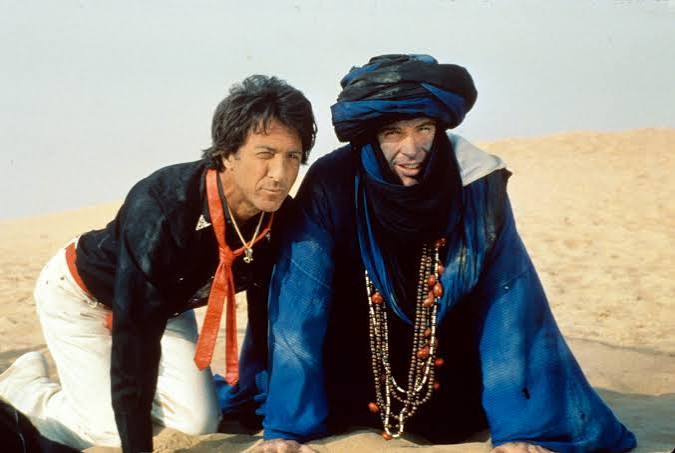
When you sit around a room long enough with a bunch of musicians, conversations involving movies can erupt and you’ll see musicians can be prone to watching and advocating for strange shit to watch. Or cats can be found championing the most contrarian flicks that you would never get from say, a corporate retail manger. A Pittsburgh Blues Singer turned me on to the final segment of “If These Walls Could Talk 2” and I ain’t mad that she did. Rappers I hung out with in the 1990’s pointed me in the direction of compelling martial arts flicks by Sir Run Run Shaw. Then there was the time I was hanging out with Jazz and experimental Rock cats when a creative force on the music scene in Pittsburgh, Pa, Bassist, Educator, Recording Artist and Online Content Creator Paul Thompson, interrupted a meandering flow of room conversation to proclaim, “Hey, any of you cats hip to ‘Ishtar’ with Dustin Hoffman and Warren Beatty?”
The room grew quiet, cats did not know how to respond. Those in the room privy to, as a Saxophone-playing former roommate of mine once remarked, “bourgeoisie knowledge”, knew the movie that PT was referring to but this movie had a cinematic pariah-like reputation of sorts. “Ishtar?”, someone in the room abruptly blurted out, “Isn’t that movie supposed to be really bad?” “Nah, Man”, was PT’s response, “You gotta watch it again, it’s brilliant.” I myself had to admit, I remember when it came out, I recall everyone in 1987, critics and audience members, taking a hot sweaty dump on this movie as if it was so bad that there was no point in even watching it. Years later, I attempted to watch moments of it during some inanimate time of day and I indeed found it forgettable and disjointed, but I wasn’t hep to what was going on, I came in too late to cop the comedic premise(s).
Upon a recent viewing on a sketchy internet platform, I too, would agree that “Ishtar” deserves a rewatch under the modern chasm of comedy, especially today’s cinematic pacing. I am thinking of popular TV shows such as “The Office” where comedy is insidious and infectious at times versus obvious slapstick and word play. Though I did not join hard-working Americans in coughing up $3.50 back in 1987 (or whatever movie tickets cost in them days), I would put up a verbal tussle to defend the film now. It has occurred to me that two things could be true as well; that many films hold up better in the rear view mirror if the production values are bearable AND this could be an indictment on how bad modern film comedies are when “Ishtar” suddenly starts appearing to be a lost comedy classic.
Unless you were born under a rock or lived in a cave (Like ones in the Middle East) or just happen to be under the age of 35, any cinephile will have prior knowledge of this movie; that it starred Dustin Hoffman and Warren Beatty, that it was written and directed by Elaine May, that it cost 55 million dollars to make in the 1980’s, that it was a complete financial and critical Hindenburg. A copycat film of this with Chevy Chase and Dan Akroyd called “Spies Like Us” was released around the same time, the two films are almost synchronous, very similar in plot. The Chase/Akroyd film has some comic moments but is mostly woefully predictable. The Elaine May film is much more nuanced and sly.
“Ishtar” was lampooned, vilified and mocked for its budgetary excesses in the press, there was a sense of incredulousness on the part of journalists and critics alike in relation to this film. Nobody could apparently understand how such big name movie stars and production talent could attach themselves to such an overblown misfire of a picture. The reviews were almost to the point of daring the reader to possess the temerity to like this movie or find it funny. I am hard pressed to think of what people thought was funny in 1987, I suppose Eddie Murphy’s concert film and John Hughes’ fluffy teen comedies were in vogue then.
A movie like Robert Townsend’s “Hollywood Shuffle” was high-brow humor in 1987, and that was a tiny-budget underdog movie compared to “Ishtar”. Mainstream Hollywood humor in the late 1980’s was full of obvious punch lines, too much music, choppy editing to emit a manic tone, late 1980’s comedy seemed like it was less interested in making the audience laugh and more interested in subduing them with a series of lights, sounds, visuals and gimmicks. Word play appeared to be exclusive to Indie flicks and films from the British Isles. Comedy was escape, very few comedic films of this era were filled with sharp-tongued witticisms, it was almost all banana peel falls and bad overt pick-up lines. Which for me, going back and seeing “Ishtar” now after forty years, this movie felt fresh in a retro manner, if there is such a thing, This movie is more Woody Allen than Mel Brooks.

Going over the “plot” as it were seems like an incongruous waste of time, this movie seems like an idea wealthy, successful Hollywood types came up with one night at a party while they were drinking, carousing and one-upping each other in a way that only the brilliantly and successfully talented can. I love Director Robert Altman’s vision of Hollywood in “The Player” where everyone is shouting screenplay ideas at each other, “Ishtar” feels like just such a movie bore of idle time of the idle rich (and creative). I am sure there are people with deeper and more profound internet sleuth skills that could explain the movie “Backrooms” to me (even though I loved it anyway, I enjoy being perplexed and confused sometimes) just as they can explain the true meaning and messages of “Ishtar”, yet here’s what I thought it was; a reimagining of the old Bing Crosby/ Bob Hope road pictures from the 1940s, except now the contemporary politics are more detailed, relevant and snarky instead of dim-bulbed carricatures, and the Hope/Crosby duo is replaced by failed musical dorks from New York’s artisan class.
In essence, the Twentieth century Jewish-influenced Vaudeville style is coupled with current Middle East politics and is overseen by one of the 70’s most celebrated comic directors in “Ishtar”. From the moment they hit the screen, Hoffman and Beatty feel like they are playing with house money to me, they had me giggling from the moment you can hear their voices over the logo at the start of the picture. The humor is decidedly deadpan, it’s protagonist middle-aged true fund babies Rogers and Clarke, are a musical singing and songwriting act who’s act nowadays would probably play to cruise ships or drag show sing-a-longs. Though they are in their forties, the two leads carry an enthusiasm with them as if they are fresh out of Julliard, looking for their big break. They perform oldies such as “Lil’ Darlin” for hardened New York City club-goers while they attempt to play instruments and dance around on stage. If the visual of esteemed and prodigious actors such as Hoffman and Beatty floundering around on stage like Ninth graders at a 4-H talent show doesn’t get you giggling, maybe this movie is not for you. I couldn’t stop laughing at this premise, it never got old, it was like a top-notch SCTV skit.
The musical duo of Rogers and Clarke have an agent, hilariously played by the consistently great Jack Weston. Weston plays the agent like a jaded and litigious show-biz New Yorker, complete with hat and cigar. He, like we, know the musical act sucks and yet they pester him all the time for work, so he attempts to placate them to his benefit any way he can. The musical duo’s self-indulgence always feels light-hearted since we know that his is Hoffman and Beatty hamming it up as hapless losers. The agent lands them a gig in Morocco, in part so he doesn’t have to see them for awhile.
Meanwhile, a silly side-plot involving important ancient Islamic artifacts, CIA meddling in puppet-government operations, populist insurgencies and Abbott and Costello-type spy routine antics with the musical duo’s foreign gigging unfolds. As stated before, this does have an acute feel to 1940’s Hope and Crosby road pictures as a construct, except they are devoid of Western mockery of international cultures and the musical numbers are really, laughably and intentionally bad. When Hoffman and Beatty are brainstorming and songwriting, they play like beginners, they sing like amateurs at a company karaoke night and the lyrics they create are simultaneously hysterical and mind-numbingly pedestrian. Somewhere between Neil Sedaka and Captain Kangaroo. They sound like they are writing jingles for a local auto dealership, yet they are somehow strangely enthused by their work, as if they have created something brilliant. This to me speaks to the side culture of failed music school wash-outs going full clown to keep the dream alive. Reminded me of seeing a singing duo near Port Jervis, NY singing to retirees in the early 2000s using toilet lids on stage as the bodies of their air guitars while they sang to tracks.
In one scene involving Rogers and Clarke, the duo is playing in a Moroccan resort restaurant for Western tourists and they sound embarrassingly like shit. But Hoffman keeps incessantly cheerleading like a drunk extrovert at a Holiday office party, continuing to act like he is bringing the house down. Hoffman is Jerry Lewis here, he is Bud Abbott, he is Gilligan, and he immerses himself, an incredibly and underrated and misunderstood comic transformation by Hoffman. I could see critics of the time of this film’s release tearing him down for being self-indulgent, tacky and tone deaf, but to me that’s what makes it so infectiously amusing. By this particular gig’s end, Hoffman and Beatty are now leading sloshed American tourists in sing-a-longs of show tunes such as “There’s no Business Like Show Business”, the kind of scene you could see going down at a pretentious drunken Hollywood party, Elaine May is pulling the audience’s leg and I am here for it. It’s self-deprecation in satiric song form and Hoffman simply dominates.
Serious and winsome French Actress Isabel Adjani is in this as the Dorothy Labour prototype and while critics may have found her out of place in this particular flick, I found the combination of her aristocratic looks in peasant’s clothing combined with her emotionless stoicism and occasional daffy comic timing to be an understated cohesive fit with the manic throwback shtick of Hoffman and Beatty. When she meets Hoffman’s character at the airport in Morocco, he doesn’t believe she’s a Woman, since she’s in disguise as an Arab youth and he is a dolt. When nobody within eyesight is looking, Adjani briefly pulls out one of her tits to prove her gender to Hoffman, who’s facial reaction is R-rated sight gag comic gold, straight out of Burns and Allen.

The one performance that did receive adulation upon “Ishtar”‘s release way back in the 1980’s was that of the venerable comic veteran Charles Grodin as a real estate agent type characterization of a CIA operative. Gordon brings his low-key, droll style to this as a seemingly calm operative who is constantly giving Hoffman intelligence assignments while trying his best to get his subordinates to kill the musical duo. Grodin and May had worked together before on the well-received “Heartbreak Kid” from years earlier, so there appears to be a comedic approach symmetry between them. Grodin is not only a comforting presence when he’s on screen, the movie advances most of it’s satiric political commentary through his character and Grodin’s smarmy, duplicitous and off-putting repartee is scene stealing. The CIA is portrayed as Ivy League bullshit artists, not menacing so much as they are corporate stooges. Interplay between Grodin as the annoyed and sarcastic CIA rep and Watson as the crusty Broadway talent agent are chock full of guffaws as well. Beatty, as well, is in on the inside joke here, much as he is years later in the tragically ignored social political comedy “Bullworth”, a film he also wrote and directed. Beatty understands the assignment here and he is the less is more of the comic duo. Rather than being a clever hustler who’s ahead of the game as he is in his other films, Beatty plays it way, way behind here and it’s a shtick that blends with the hijinks. A chaotic market scene in this movie seems lifted straight out of Woody Allen’s 1971 hit “Bananas”.
Albeit there are a couple of awkward and tired sequences near the movie’s climax, “Ishtar” is not going to be on any top ten lists, it did something for me as a viewer that I find very few modern comedies (with notable exceptions) are able to do and that is; make me laugh and keep me laughing. While nobody would mistake any of this as the best work of Beatty, Hoffman, May, Gordon, Weston or Adjani by any means, the kitschy idea of updating the “Road” pictures of the 1940’s to a sort of neurotic modern vaudeville premise mixed with political commentary makes this film for me a humorous curiosity. Shot by cinematographer Vittorio Storaro , the movie is an attractive watch and its plot never gets maudlin. The screwball inanity of “Ishtar”‘s plot is relentless, so we are never far removed from another laugh, like an oasis in the desert. Laughs that is, if you as the viewer are in with the spirit of “Ishtar”‘s snarky and tongue-in-cheek style. Throughout the film, I kept waiting for the film to lose its comedic moxie, yet for me it never did. If you’re not laughing in the first half hour, you can shut it off because it’s not going to change.
Leave a Reply