Conversations about “pre-code” Hollywood get a little hazy for me. The historical precedent that Hollywood imposed on itself (with external coercion, no doubt) in which certain rules were enacted to curtail what many in society had deemed Hollywood films of the early 1930’s going too far with the insidious and potentially graphic nature of their onscreen content. For example, in 1933’s epic “King Kong”, there is a deleted scene in which Kong is disrobing Faye Wray. I saw a brief clip of this on a TV special once. In 1931’s “Frankenstein”, Boris Karloff as the monster tosses a little girl into a pond to see if she’ll float, this disturbing visual was cut from the original as well. Other stand-out legendary films that pushed boundaries of censorship included 1932’s “The Sign of the Cross”, in which actress Claudette Colbert takes a racy milk bath (Directed by Cecil B. DeMille, by the way), 1934’s “Tarzan and his Mate”, where Maureen O’Sullivan as Jane goes for a dip in an African water body supposedly in the buff and the notorious 1932 film “Freaks” in which director Tod Browning assembled a cast of actually physically deformed people.
By 1934, Hollywood censored its own innuendo with more vigilance for the ensuing two or three decades. I recently came across one of these controversial pre-code movies by accident while scouring my Facebook page searching for trash diversion. A film from 1933 that starred Barbara Stanwyck and a young and unknown at the time John Wayne. I was introduced to the movie through a film clip in which a young Stanwyck and an African-American Female character (played by Theresa Harris) are attempting to stow away on a train. They are caught by a railroad worker and what ensues is a couple of minutes of dialogue and suggestion that looks like a family movie and sounds like the beginning of a scene from an adult movie, leaving very little to the imagination.
Directed by Alfred E. Green, “Baby Face” is mentioned by film historians as being one of the bell-cow catalysts of film that ushered in the establishment of the Hollywood codes. A movie with a gritty veneer, this picture has to have been considered a drama, while there could be considered moments in this film that border on comedic irony, for the most part what is going on is far from funny. From a script written by Gene Markey and Katheryn Scola, this Black-and-White yarn has the polished look of the best of the A-list pictures of its day. The movie’s events begin in a small Northeast mill town, I thought I had heard Erie mentioned, which I would first assume must be the Erie in Pennsylvania. The town is given a smokey, hazy appearance as we are first introduced to Stanwyck’s character in the film, Lili.
The movie opens in what looks like a working-class speakeasy, run by young Lili’s shady Father Nick Powers, played by Robert Barra. While Lili is the bar-maid, the previously mentioned African-American character Chico, is the kitchen help. When the Father gets verbally abusive with Chico and tells her she’s fired, Lili threatens to quit if Dad doesn’t get off Chico’s back and keep her employed. So, there’s this whole slutty bar-maid angle that Lili appears to embody at first glance in front of the working stiffs who frequent the speakeasy, a visual that is as cringy as it is provocative. This is getting close to being a one hundred year old movie, mind you. Lili is the sexual object on display in front of the local mill workers who appear at the joint after work. outside is dark and misty amidst the faraway sounds of prevalent industry. The Men who enter the speakeasy appear to be raucous and raunchy, a couple of guys are even bare-chested and sweaty, and Lili meets this energy with elusive and misguided sexuality, there for the visual arousal but she is not a fan of being pawed upon by these boorish worker bees. She rebukes and redirects the various forward gestures and insinuations of the men. Some of the men exude a sort of expectation mixed with desperation, there are hints we’re being given about her past. At one point early on, a local big shot wants alone time with her and uses his suggestion of his local influence with the father to make that happen.
We found out quickly that Liii has had enough of this shit, she snaps out on Daddy and meanwhile is receiving advice from a local Professor in regards to using her Feminine gifts of persuasion as a weapon in the business world. When Daddy’s illegal booze still explodes and kills him, Lili is on her own, with only a beautiful face and figure. a keen sense of style, her knowledge of Nietzsche from the Professor and her experience of skills learned as an involuntary child prostitute to guide her. It’s remarkable to think this film is like a combination of Ayn Rand and Louis Malle’s “Pretty Baby”. She hops a rail to New York City.

Lili decides not long after arriving in New York City that she wants to work in finance, most pointedly a large bank in what looks like to be mid-town Manhattan. Stanwyck as Lili knows. how to entice and encourage the right supervisors at her job, she isn’t so obvious that she appears desperate, but she turns heads wherever she goes, whether it’s at work or not. Lili’s look and efficiency make her an enormous target for her Male co-workers who are incrementally anxious and impatient in attempting to get her attention. Lili moves through her liaisons like a social hit-and-run vampire, she lets the HR guy hit it so she can get an interview. Co-workers are sending her flowers and following her into the can, her Male employees obsess over her with their eyes but nobody brings it up with each other because everyone thinks she’s their private fuck.
As well-done and mature as the film’s narrative style is, it still carries a morality-derived core for its time and accompanying cautionary tale. Lili is rewarded for her gamesmanship in the short run, but the script does give Lili’s character a soul to a degree, although we must groan through a number of ethically questionable maneuvers on her part through most of the film, she moves with a focused pathology, like a predator. She possesses almost a Gangster-type ruthlessness to her strategies, which almost makes this movie feel symbiotic to rise-to-power gangster movies of it’s time, such as “Public Enemy” and “Little Caesar”, where crime does pay in the short run, but always with an irreparable cost.
This is old-fashioned melodrama with a salacious core subject, though it’s arguable that “Baby Face” is just a tale of an ambitious person who happens to be Female and happens to make a personal decision to fully use tools of seduction and allure to have the access she desires to have to material needs and status. She’s not intentionally damaging people’s lives, (though jealous lovers do confront, assail and attack others in pursuit of her), but there is quite a mess in her romantic wake. “Baby Face” is still a film where characters are shot to death, blown up in Whiskey Still fires and other tumultuous occurrences. This movie is as much about a “trouble making Female”in the broadest sense. as it is a chronicle of the chaos that surrounds such a Female character, perhaps a character that is more of a Male fantasy due to her cold detached use of intimacy. The congruence here with gangster crime films is the need for the character to have a meteoric rise based on something far short of virtuous, a lifestyle and way of doing things that lacks loyalty, morality and integrity.
Stanwyck as Lili seems to benefit in part because her Nietzsche-influenced thinking has no need or use for guilt or self-examination; she is using the world’s energy against itself for purposes that will improve her personal situation, what’s so objectionable about that? How has that made her a sinner except to those weighed down by the superstitious beliefs of organized religion? Though the film does provide a vague preamble as to why Lili behaves in the cold-blooded manner that she does, she exhibits a kind of calculation-based behavior that is recognizant of an up-and-coming business tycoon. Lili is not unethical in a business sense, she is a competent performer in the death grind of the banking industry. She possesses the look, the tempo, she speaks formally and defers to power publicly, she is an ideal worker in the male-dominated construct. In addition, her lovers are far from upstanding. They are attentive to her intimacy like drug fiends, nobody pushes back on her, they’re all dupes. In her business world job, she’s not screwing anybody out of money, she’s screwing dudes to get them to pay for her everyday needs and beyond.
The film bases it’s ideas of shock based on the notion that the ticket buyers for this movie already had it in their heads that proper Feminine behavior has parameters based on ideas emanating and encouraged from an unspoken presumed patriarchy.That is, Lili’s behavior makes her an oddity and scandalous figure based on her inability to conform to what was believed to be a Woman’s place in 1930’s American society. For her character to not heed these preconceived notions about normal Feminine behavior makes her a radical to be gasped at and scrutinized. The idea that a Woman would use her guile and sexual prowess to obtain her desired lifestyle at the expense of Male control and virility must have piqued interest among some viewers of the time and aroused moral revulsion amongst others. Certainly there would be those who would be less contentious about her end results and more argumentative about the propriety in the messaging of showing how she got them.
There are quite a few familiar faces in this, starting with Stanwyck and a young and briefly seen and heard John Wayne as an early office liaison. I recognized at least a couple of actors from other films, including Douglas Dumbrille (From the Marx Brothers film”a Day at the Races”) and Nat Pendleton (He was a detective in “The Thin Man”). The script is somewhat predictable in that once the behavioral patterns are set by the players, you can almost see the results coming, though the razor sharp dialogue and jaded subject matter does make this feel different. Watching A Woman use her carnal powers to succeed in business without really trying seems like it would have been unusual scattalogical territory for audiences in the 1930’s, certainly American ones.
The melodramatic material and salacious fringes wouldn’t work here without a charismatic performance form Stanwyck and this movie gets one in volume. Always a classy looking dame, Stanwyck is not only a serial ice queen here, she simmers under the surface and when she erupts, it is dazzling emotional handiwork. There are air least three separate scenes here I can think of where her character is asked to go into heated emotional territory and she does so with nuclear force; screaming, crying, shouting with shrill intensity like a well-oiled battlefield machine gun. “Baby Face” as a film premise already carries with it a sense of anticipation, in part due to it’s tawdry under the surface veneer, but there is a sense that Lili is from a tainted past, that her values are skewered. When she rages out, it’s like moments of clarity for her soul, we the audience are given a momentary sense of relief, that we aren’t losing our bearings, she does possess a super ego deep down underneath her seductive exterior.

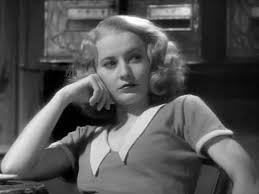
As a young Woman in 1933, Stanwyck is dazzling to look at, she grabs the viewer’s attention the moment she steps on screen here with her ruthless upwardly mobile energy, she carries with her a bewitching blend of appearing sure and unsure. That she can manufacture the aura of high class ice queen and bemused commoner speaks to her depth. “Baby Face” feels like it was a coming out party of sorts for Stanwyck as an actress considering how early the film is from. In the film, the character of Lili has no Female friends aside from Chico, who she confides whatever is on her mind to whenever it serves her whims.
The look of “Baby Face” is quite professional, despite the film’s age, it is quite coherent, first rate tech credits, etc., the direction by Director Green is engaging, the sensationalist material sells itself. Most of the scenes are shot indoors, like a play. The movie’s big scenes play out in boardrooms and bedrooms. The two selling points for me here were the film’s taboo-infused tone which seemed revolutionary and potentially scandalous for it’s time and the unbridled volatility of Stanwyck’s performance; aside form her youthful beauty and vibrant look that makes watching her every moment here vibrate, her scenes where she flies off the handle are so alive with focused pure emotional energy that those particular scenes stayed in my head long after the movie was over.
Leave a Reply